
I used to think the biggest problem in AI would be capability. Faster models. Smarter outputs. More advanced reasoning. That was the narrative everywhere. Every new release was measured by performance benchmarks, speed improvements, and parameter size.
But over time, something started bothering me.
The smarter AI became, the harder it became to understand where its intelligence was actually coming from.
At first, that did not seem important. Most people only cared about results. If the answer looked good, nobody questioned the system underneath. But the more AI entered real decision making environments, the more dangerous that mindset started to feel.
Because eventually, intelligence without transparency becomes a trust problem.
And I think we are now entering the stage where the industry is beginning to realize that black box AI may not be sustainable long term.
The invisible problem hiding inside modern AI
Most AI systems today operate like sealed machines.
You provide an input. The model produces an output. Somewhere inside billions of parameters, statistical relationships generate responses that appear intelligent. But the pathway between input and output is largely hidden.
For casual use, this may seem acceptable. But once AI starts influencing finance, healthcare, governance, media, and autonomous systems, opacity becomes risky.
The issue is not simply that we do not know how models think.
The bigger issue is that we cannot fully trace:
Where the training data came from
Who contributed to the intelligence
How outputs are economically derived
Whether information was used ethically
Who should receive value attribution
That creates a structural trust gap.
And I think this gap is becoming one of the most important challenges in AI today.
Why black box systems create long term instability
The more I thought about it, the more I realized that black box AI centralizes not only intelligence, but also power.
When a company controls the model, the training pipeline, the data sources, and the deployment infrastructure, the public only sees the surface layer. Everything underneath remains invisible.
This creates several problems at once.
First, contributors disappear.
Millions of pieces of data shape model behavior, yet almost nobody involved in that process receives recognition or compensation. The intelligence becomes detached from its origins.
Second, accountability weakens.
If harmful outputs appear, tracing responsibility becomes difficult. The system becomes too complex and too closed to audit effectively.
Third, trust erodes slowly over time.
People may use systems they do not understand temporarily, but once those systems begin affecting livelihoods, financial outcomes, and information ecosystems, transparency becomes essential.
I think this is the point many people are starting to miss. The future AI race may not only be about who builds the smartest model.
It may become about who builds the most trusted model.
Why attribution changes everything
This is where the idea of Proof of Attribution becomes incredibly important to me.
When I first explored the concept, it felt simple on the surface. But the deeper implications are massive.
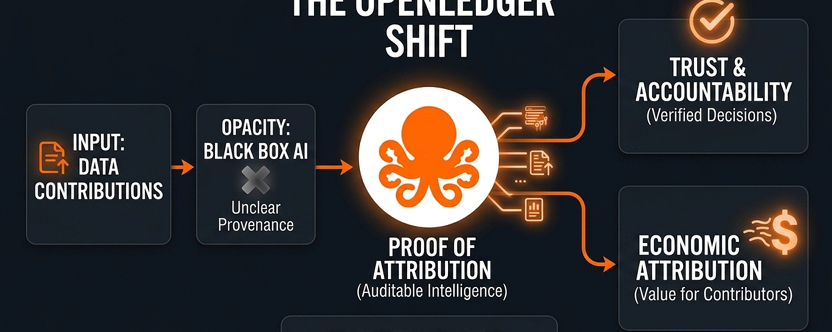
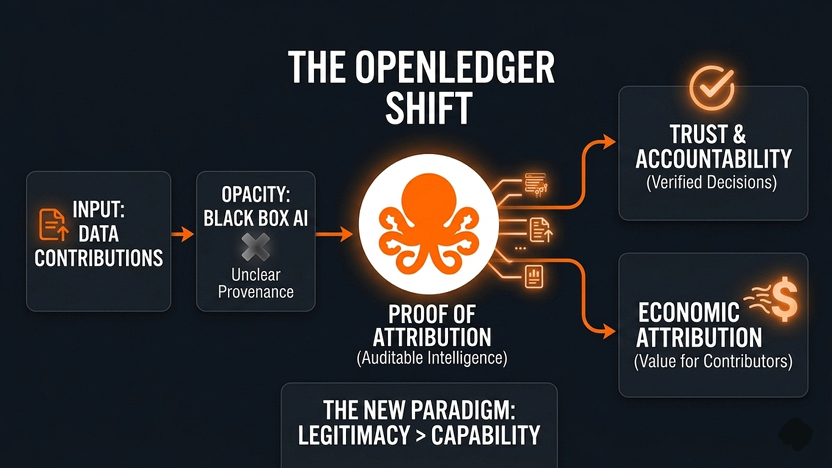
Proof of Attribution is not just about tracking data usage. It is about creating an auditable intelligence economy where contributions remain visible throughout the AI lifecycle.
Instead of intelligence appearing from nowhere, every layer can maintain provenance.
Datasets can carry contribution history.
Models can preserve lineage.
Outputs can maintain traceable origins.
Agents can distribute value transparently.
That changes AI from a black box into something far more accountable.
And I think accountability is going to become one of the defining infrastructure layers of the next AI era.
OpenLedger and the shift toward transparent intelligence
What makes OpenLedger interesting to me is that it approaches AI infrastructure differently from traditional systems.
Most AI platforms focus on model performance first and transparency later. OpenLedger seems to reverse that logic by treating attribution as a foundational layer instead of an optional feature.
That distinction matters.
Because once attribution becomes native to the architecture, transparency is no longer dependent on corporate promises. It becomes embedded into the system itself.
From my perspective, this could fundamentally reshape how AI ecosystems operate.
Instead of centralized entities extracting value from invisible contributors, intelligence becomes economically traceable.
That creates:
More accountability
Better incentive alignment
Clearer ownership structures
Transparent contribution mapping
Auditable AI workflows
And honestly, I think this is where blockchain technology finally starts making practical sense in AI.
Not as a marketing layer.
Not as speculative hype.
But as infrastructure for trust.
The future problem most people still underestimate
Right now, many users still accept black box systems because AI outputs feel impressive. But I do not think that phase lasts forever.
As AI becomes more autonomous, people will eventually ask harder questions.
Who trained this model?
What data shaped this decision?
Who profits from this intelligence?
Can outputs be verified?
Can manipulation be detected?
Without transparent systems, those questions become impossible to answer confidently.
And once trust breaks at scale, rebuilding it becomes extremely difficult.
I think this is why attribution may become more valuable than raw intelligence itself.
Because intelligence alone does not create stable systems.
Trust does.
AI agents make the problem even bigger
The rise of AI agents makes this issue even more urgent.
Agents are beginning to interact autonomously with wallets, applications, smart contracts, marketplaces, and other agents. Some may eventually manage assets, negotiate services, or execute financial decisions.
Now imagine millions of autonomous systems operating globally without transparent attribution layers.
That creates enormous risks:
Invisible manipulation
Synthetic misinformation
Unauthorized data usage
Revenue extraction without accountability
Opaque automated coordination
Without auditable infrastructure, the ecosystem becomes difficult to govern fairly.
This is another reason why I think AI specific blockchains are becoming increasingly necessary. They provide a framework where attribution, ownership, and economic activity can remain visible even as intelligence becomes decentralized.
What I think the next AI era will prioritize
For years, the industry optimized AI around capability.
Bigger models. Faster inference. More scale.
But I think the next phase will optimize around legitimacy.
The systems that survive long term may not simply be the most intelligent. They may be the most verifiable.
Because societies can adapt to powerful technology.
What they struggle to adapt to is invisible power operating without accountability.
That is the danger of black box AI.
And that is why Proof of Attribution feels bigger than just a technical feature to me. It feels like the beginning of a philosophical shift in how intelligence itself is treated.
Not as mysterious magic hidden inside private infrastructure.
But as an auditable system where contributors, decisions, and value flows remain transparent.
Final thoughts
The strange thing is that black box AI once felt futuristic.
Now it increasingly feels outdated.
Not because the models are weak, but because opacity becomes fragile as systems scale.
The more AI influences the world, the less acceptable invisible intelligence becomes.
And maybe that is the real turning point happening beneath the surface right now.
We are slowly moving from an era obsessed with artificial intelligence toward an era obsessed with trustworthy intelligence.
That shift may end up changing everything.
