
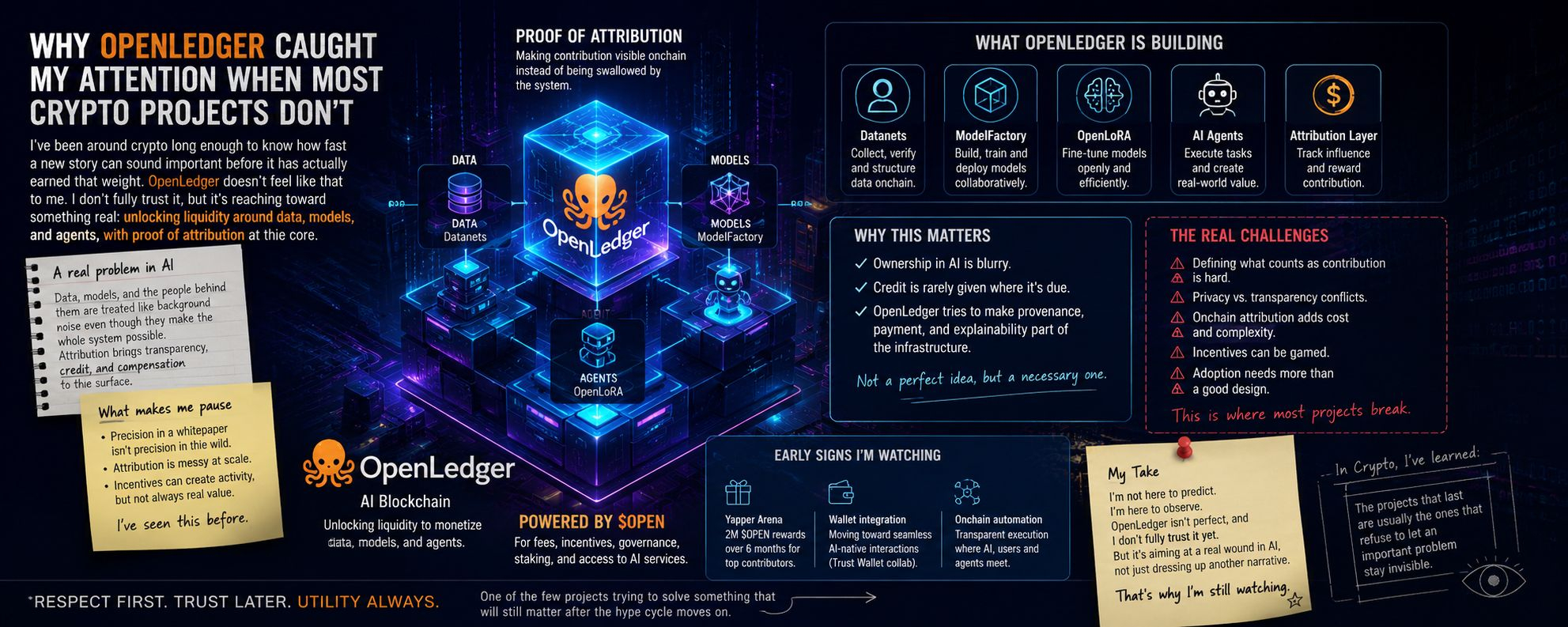

I’ve been around crypto long enough to know how fast a new story can sound important before it has actually earned that weight. Most of the time, it is all surface. A little AI language, a little decentralization, a little talk about ownership, and suddenly people act like the old problems have been solved just because the words have been arranged in a fresher order.
OpenLedger does not feel like that to me, at least not entirely. I am not saying I trust it. I do not. But I do think it is reaching toward something real, which is rare enough that I notice when it happens. The project keeps talking about unlocking liquidity around data, models, and agents, and its own framing is built around proof of attribution, the idea that contribution in AI should be visible and rewarded instead of getting swallowed by the system and forgotten. That is a serious problem, even if the crypto packaging around it still feels familiar.
What I keep thinking about is how often people in this market confuse a decent idea with a finished one. They are not the same. In fact, they are barely related once the real work begins. OpenLedger’s paper is trying to solve the old problem of invisible contribution in AI, where data, models, and the people behind them are treated like background noise even though they are what make the whole thing possible. That part resonates with me, because I have seen this complaint come up again and again, only usually with less discipline and more hype.
Binance Academy describes OpenLedger as an AI blockchain with pieces like Datanets, ModelFactory, and OpenLoRA, and says OPEN is used for fees, incentives, governance, staking, and access to AI services. That kind of structure makes me cautious, but not because I think it is nonsense. It makes me cautious because once a token is expected to do that many jobs, the project has a lot of ways to confuse activity with value. I have seen too many systems where the token economy becomes the main event and the actual product quietly gets reduced to a reason for the token to keep circulating.
Still, I do not want to dismiss the effort just because the category is crowded with noise. The studio page says verified contribution earns $OPEN onchain, which is the sort of line that can sound empty if you have seen enough crypto, but it also points to a real design choice. The project is trying to tie value to participation in a way that is visible and legible, not just promised in vague future tense. I respect that more than I trust it.
That is probably the right mood for something like this: respect first, trust later, maybe, and only if the thing holds together under pressure. Because pressure is where these projects usually break. Attribution sounds clean until you ask who decides what counts as contribution. Liquidity sounds great until you ask who gets exposed, who gets paid, and who gets left out. AI sounds efficient until you realize how much of it depends on hidden labor, hidden training data, hidden compromises, and hidden assumptions. I have seen enough cycles to know that the interesting part is almost never the launch. It is the mess that starts after the launch, when the easy language has to survive contact with actual usage.
That is why I keep circling back to OpenLedger instead of brushing it off. Not because it has convinced me, but because it is trying to answer a question that has not gone away. Who owns value in AI? Who gets credited? Who gets paid? Who gets ignored? These are not new questions. They are just being asked in a louder room now. And most projects I’ve watched over the years either avoid the question or answer it in a way that sounds good until you look at the incentives.
The more I sit with OpenLedger, the more it feels like a project built around a real frustration rather than a fantasy. That does not make it good. It does not make it durable. It does not mean the market will care for the right reasons. But it does mean the idea is not completely decorative. I think that matters. In crypto, I have learned to be suspicious of anything that arrives too polished. The projects that end up mattering usually have some roughness left in them, some sign that they are grappling with a problem instead of staging one.
I am still skeptical of the token side of things. I am skeptical of how easily communities can become performance machines. I am skeptical of the gap between reward and actual usefulness. I am skeptical because I have watched too many networks become very good at producing participation that never quite turns into real dependence. That part never gets old, even though the marketing around it does. People love to say a system is alive when it is mostly just busy.
But something about OpenLedger feels a little less like that. Not safe. Not proven. Just less fake than the average pitch. It feels like it is aiming at a problem that will still be there after the narrative cycle moves on, which is more than I can say for a lot of what passes through this market. I do not fully trust it, and I do not need to. I only need to notice when a project is pointing at something that is genuinely awkward, genuinely unresolved, and genuinely worth thinking about. OpenLedger feels like one of those. And in crypto, that already puts it in a smaller group than people usually admit.
