

OpenLedger is one of those projects I didn't pay much attention to at first.
That wasn't because there was anything obviously wrong with it. If anything, it was because I've spent enough time around crypto to become cautious whenever a project combines several popular narratives into one story. AI, blockchain, data ownership, monetization—these are all themes that attract attention quickly. The problem is that attention and substance are not always the same thing.
So instead of looking at what OpenLedger was saying, I found myself thinking about why it exists in the first place.
The more AI becomes part of everyday life, the more one question keeps appearing in the background. Where does all this intelligence actually come from? Every model is trained on data. Every useful output is built on countless inputs contributed by people, communities, businesses, and systems over time. Yet the connection between contribution and reward often feels surprisingly weak.
That gap seems to be what OpenLedger is trying to address.
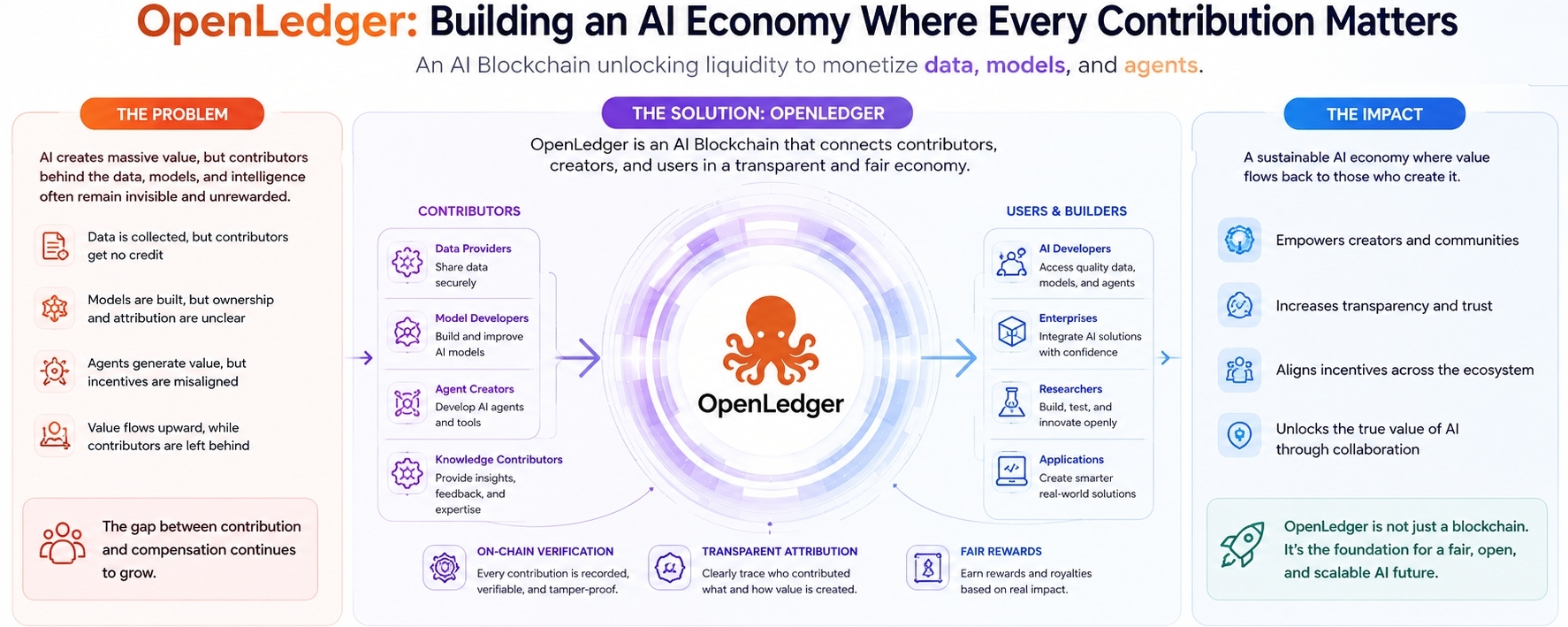
Rather than treating data as something that simply gets collected and consumed, the project appears to view it as an asset that should have a clearer path to value creation. The same applies to AI models and autonomous agents. The idea is not just to build another blockchain network, but to create an environment where the resources powering AI can be recognized, tracked, and monetized in a more transparent way.
What I find interesting is that OpenLedger seems focused on a layer of the AI economy that most people rarely discuss. Conversations usually revolve around model performance, new features, or which company is leading the race. Much less attention is given to the infrastructure behind those outcomes. The data providers. The contributors. The mechanisms that determine how value moves through the system.
Those details are easy to ignore when everything is working. They become much harder to ignore when questions of ownership, attribution, and incentives start to emerge.
That is where OpenLedger caught my attention.
Not because it promises a breakthrough, but because it appears to be looking at a problem that is likely to grow as AI becomes more valuable. If intelligence is becoming a digital asset, then the resources used to create that intelligence will inevitably become more important as well. The challenge is creating a framework where those resources can be accounted for in a way that is transparent and verifiable.
Of course, identifying a problem is very different from solving one.
The history of crypto is full of projects that pointed toward real issues but struggled when theory met reality. Incentive systems often look elegant until actual users interact with them. Markets can behave differently than expected. Attribution can become complicated. Value can be difficult to measure fairly, especially when many participants contribute to a single outcome.
Those are the kinds of challenges that any project operating in this space will eventually face.
Still, OpenLedger feels like it is asking a worthwhile question. As AI continues to expand, should the benefits flow only to the platforms building the models, or should there be a more direct relationship between contributors and the value they help create?
The project seems to be built around exploring that idea.
Whether it ultimately succeeds is something only time can answer. What stands out today is not a bold claim or a flashy narrative. It is the attempt to create a system where data, models, and AI agents are not treated as isolated components, but as parts of an economy that can be connected more openly.
That may or may not become an important piece of the future AI landscape. For now, it is simply a project trying to tackle a problem that many people acknowledge exists, but far fewer are actively working to solve. And in a space often driven by short-term excitement, that alone makes it worth paying attention to.