
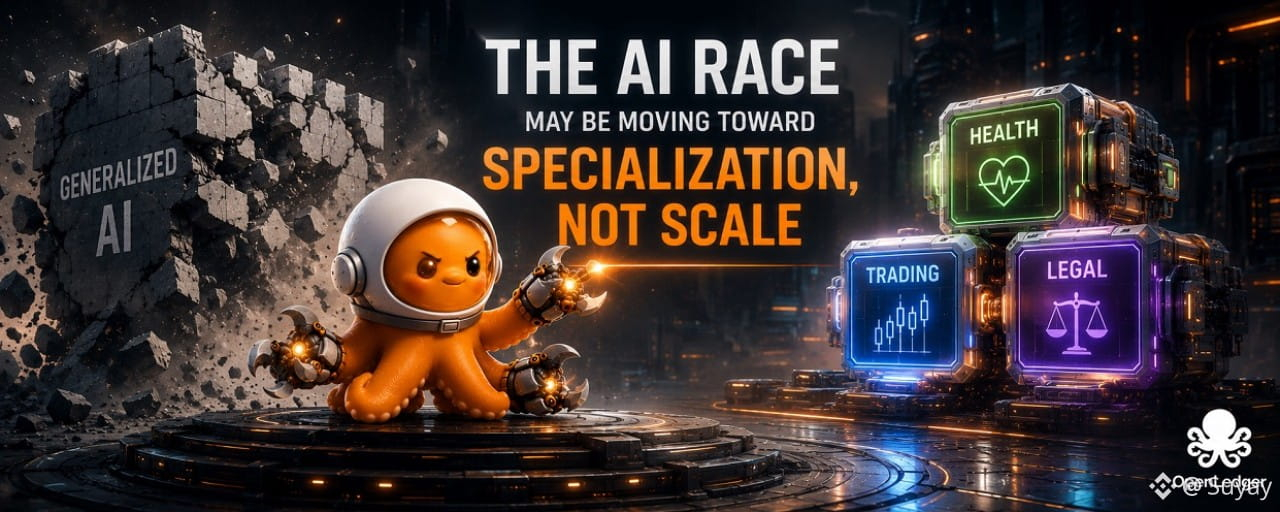

The more I study the AI market, the more I think most people are still looking at the wrong metric.
Everyone is focused on building the biggest model.
Bigger context windows.
Bigger parameter counts.
Bigger benchmark scores.
But I’m starting to think the future AI economy may not belong to the largest intelligence systems.
It may belong to the most specialized ones.
Because once general intelligence becomes widely accessible, scale stops being rare.
Specialization becomes rare.
And that changes the entire economic structure of AI.
Right now, the market still behaves as if intelligence itself is the scarce asset.
But that probably won’t remain true forever.
General-purpose models are already becoming increasingly commoditized.
Every few months, another powerful model appears.
Performance gaps shrink.
Capabilities spread rapidly across the ecosystem.
At some point, raw intelligence alone stops being enough to create durable advantages.
What starts mattering instead is context.
Who has the best domain-specific knowledge?
Who owns the highest quality niche datasets?
Who can coordinate specialized contributors?
Which systems can adapt intelligence to real environments instead of generic prompts?
That is a very different competition.
And honestly, this is why I’ve been paying attention to what @OpenLedger and $OPEN are building around specialized AI infrastructure.
Because the project seems directionally aligned with a future where intelligence becomes modular, attributable, and economically coordinated instead of centralized into a single monolithic system.
That distinction matters more than most people realize.
The internet already taught us something important: general information scales fast, but specialized knowledge remains incredibly valuable.
AI may follow the same pattern.
A massive universal model can answer millions of questions.
But specialized intelligence trained around specific environments, industries, behaviors, workflows, or financial systems may ultimately generate more economic value.
Why?
Because real-world execution depends on context.
A generic model can explain trading strategies.
A specialized system trained on financial behavior, execution logic, risk management, and live market interaction can potentially operate inside trading environments themselves.

That gap is enormous.
And I think the market is still underestimating how important these specialized intelligence layers may become.
This is where concepts like Datanets and attribution infrastructure start becoming much more interesting.
Because specialized intelligence doesn’t emerge from scale alone.
It emerges from contributors, environments, and highly contextual knowledge.
That creates a coordination problem.
How do you incentivize contribution?
How do you measure influence?
How do you reward specialized data creation?
How do you prevent the people generating value from disappearing behind the model itself?
Most AI systems today still operate through extraction.
People contribute information.
Platforms absorb it.
Models improve from it.
The economic upside concentrates elsewhere.
But OpenLedger appears to be exploring infrastructure where specialized contribution itself becomes part of the economic architecture.
And honestly, I think that may become one of the defining themes of the next AI cycle.
Because the future AI economy may not simply reward whoever owns the largest computational systems.
It may reward ecosystems capable of coordinating specialized intelligence at scale.
That includes: domain experts, contributors, agents, contextual datasets, execution systems, attribution layers, and interoperable AI infrastructure.
The more AI integrates into real industries, the more specialization becomes necessary.
Healthcare requires different intelligence than trading.
Trading requires different intelligence than gaming.
Gaming requires different intelligence than legal systems.
Legal systems require different intelligence than autonomous coordination networks.
One giant universal model may not dominate all of those environments equally well.
Instead, we may see networks of highly specialized intelligence systems operating together.
That possibility changes how we should think about AI entirely.
Maybe the future of AI isn’t one superintelligence controlling everything.
Maybe it’s millions of specialized intelligence systems coordinating across open infrastructure.
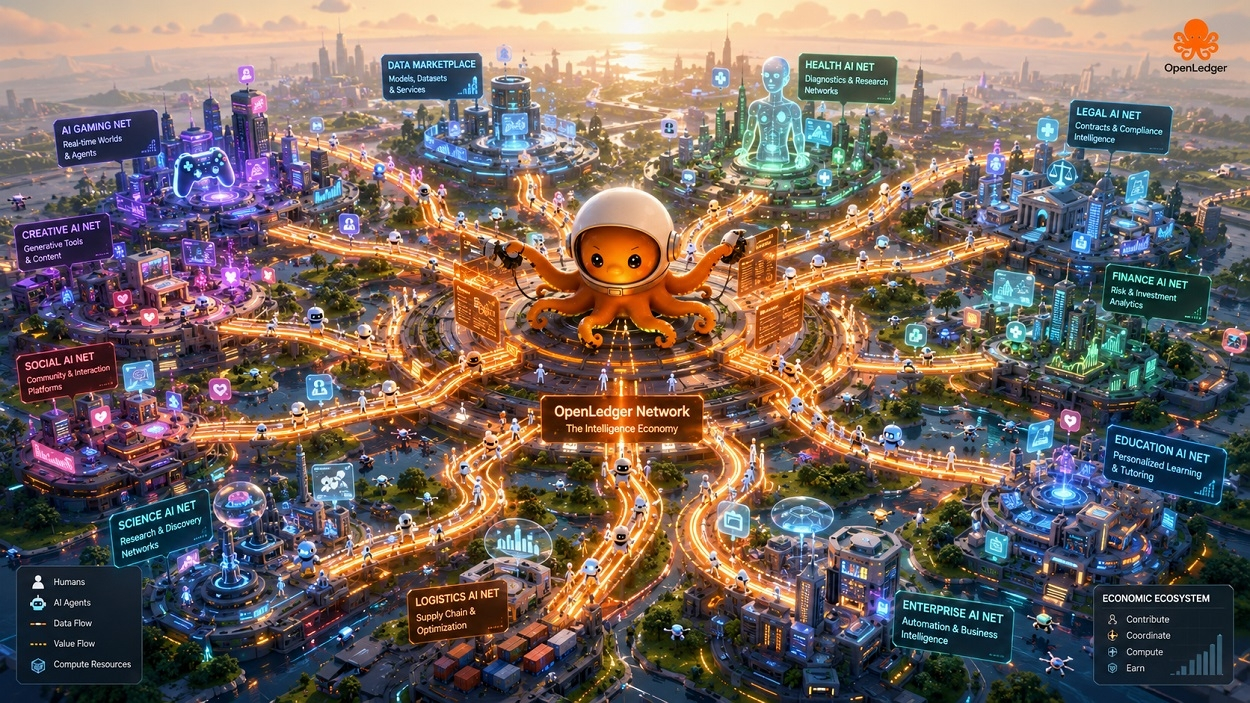
That future feels much closer to economic ecosystems than traditional software.
And that’s why projects focused on attribution, modularity, specialization, and execution infrastructure may become increasingly important over time.
The AI race may not ultimately be won by the smartest model.
It may be won by the ecosystems capable of organizing intelligence most effectively.
And those are not necessarily the same thing.