
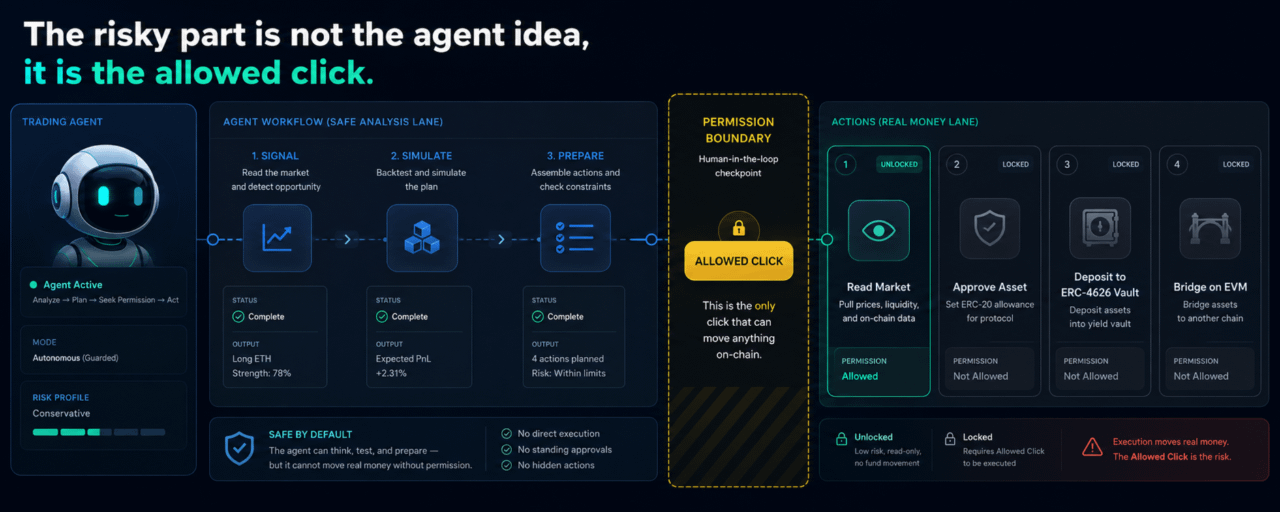

The sim passes. The agent finds the spread. The route looks sane enough on the dashboard, and nobody wants to make the demo pause on every signer boundary, so trade becomes the drawer where everything after the signal gets thrown.
The first swap is boring. Tight slippage, bridge asset acquired, output close enough. Then the pool moves before inclusion, so the agent replaces the transaction with a higher gas price because the route decays if it misses another block. Still within the strategy. Still easy to justify.
The bridge call needs approval.
Now the token starts acting like the real chain instead of the local fork. approve() does not behave consistently through the wrapper. One path returns no boolean. Another returns false without a clean revert. The spender already has residue from the failed attempt, and the token wants the allowance reset to zero before any new approval. The router helper tries to jump to max because exact spend was not forced in policy. The worker is watching for an event the token barely emits, or emits through a proxy shape the indexer treats like background noise.
The route has not failed yet. That is the annoying part. It is half-alive.
Destination L2 state is stale by roughly the time it takes a relayer to ruin your morning. The agent sees a balance that may be there, may be pending, may be indexed before it is usable. Native gas is low. The route can still be rescued if it sells a tiny slice after arrival, but arrival is not final enough, the gas sale depends on the clipped amount, and the clipped amount came from the fee-on-transfer hop the route engine treated like a normal transfer.
The permission still says trade.
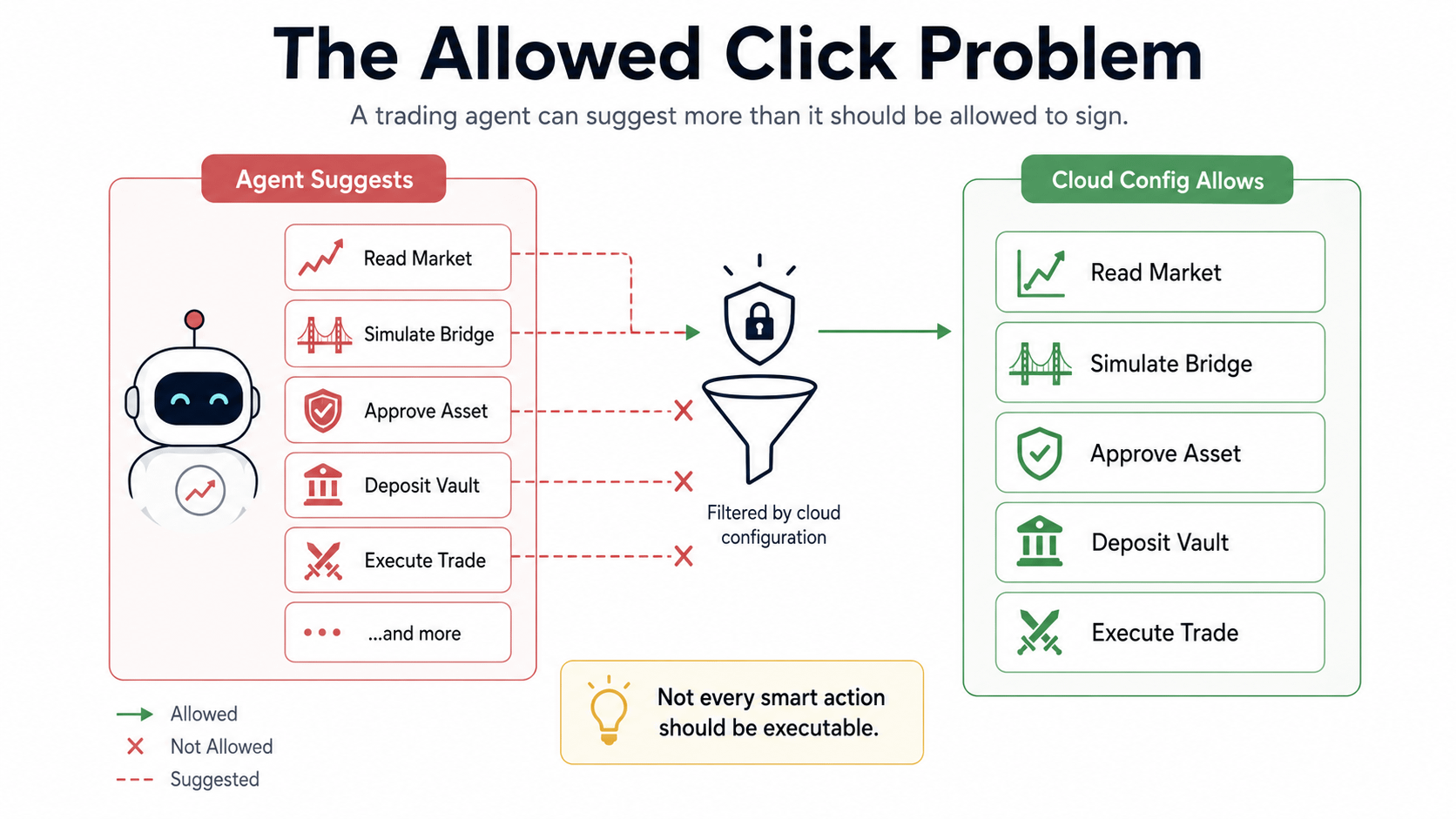
Token A into bridge asset, bridge to cheaper liquidity, swap into the vault underlying, deposit. Nothing crazy in the abstract. It is the kind of route an agent should be able to discover.
Signing it is where the shape changes.
The first approval leaves a spender relationship sitting there after the quote has expired, after the bridge has lagged, after the replacement transaction changed gas assumptions, after the agent has started treating the rest of the path as cleanup. If the same permission allows pool reads, calldata construction, spender approval, bridge execution, slippage widening, and retry logic, then the signer is not enforcing an agent strategy. It is just letting the agent keep touching whatever broken piece still has a next action.
The bad path degrades in small legal moves.
The bridge lands light because the earlier fee-on-transfer token shaved the amount. The second swap still clears, but the L2 wallet is short on native gas, so the agent sells some output to fund itself. That sale pushes the remaining amount under the vault route minimum. By the time the deposit is attempted, the vault cap has moved, totalAssets is no longer the value used for the preview, and the share math is rounding against a smaller input size than the original sim accepted.
One branch says retry with more gas.
Another branch says widen slippage within tolerance, except the tolerance was attached to the old quote before the fee-on-transfer haircut.
Another branch says reroute around the vault, but now the approval to the vault spender already exists and the agent is holding a half-mutated position on the wrong chain with not enough native gas to cleanly unwind.
The balance bleeds without any single line in the trace looking like an obvious exploit.
previewDeposit is useful until someone mistakes it for authority. Reading totalAssets is cheap. Preparing vault calldata is also cheap. The expensive mistake is letting the same agent approve the underlying and submit the deposit after the route has already crossed chains, lost size to transfer fees, repriced gas, and drifted past the state window the preview was built against.
Redemption is worse because the exit path is not the entry path backwards. Shares can burn before the next quote is usable. Liquidity can sit behind a queue. The agent may have to wait, fund gas, route around, or mark the position as stuck, and a broad trade permission makes those choices look like ordinary continuation instead of new custody decisions.
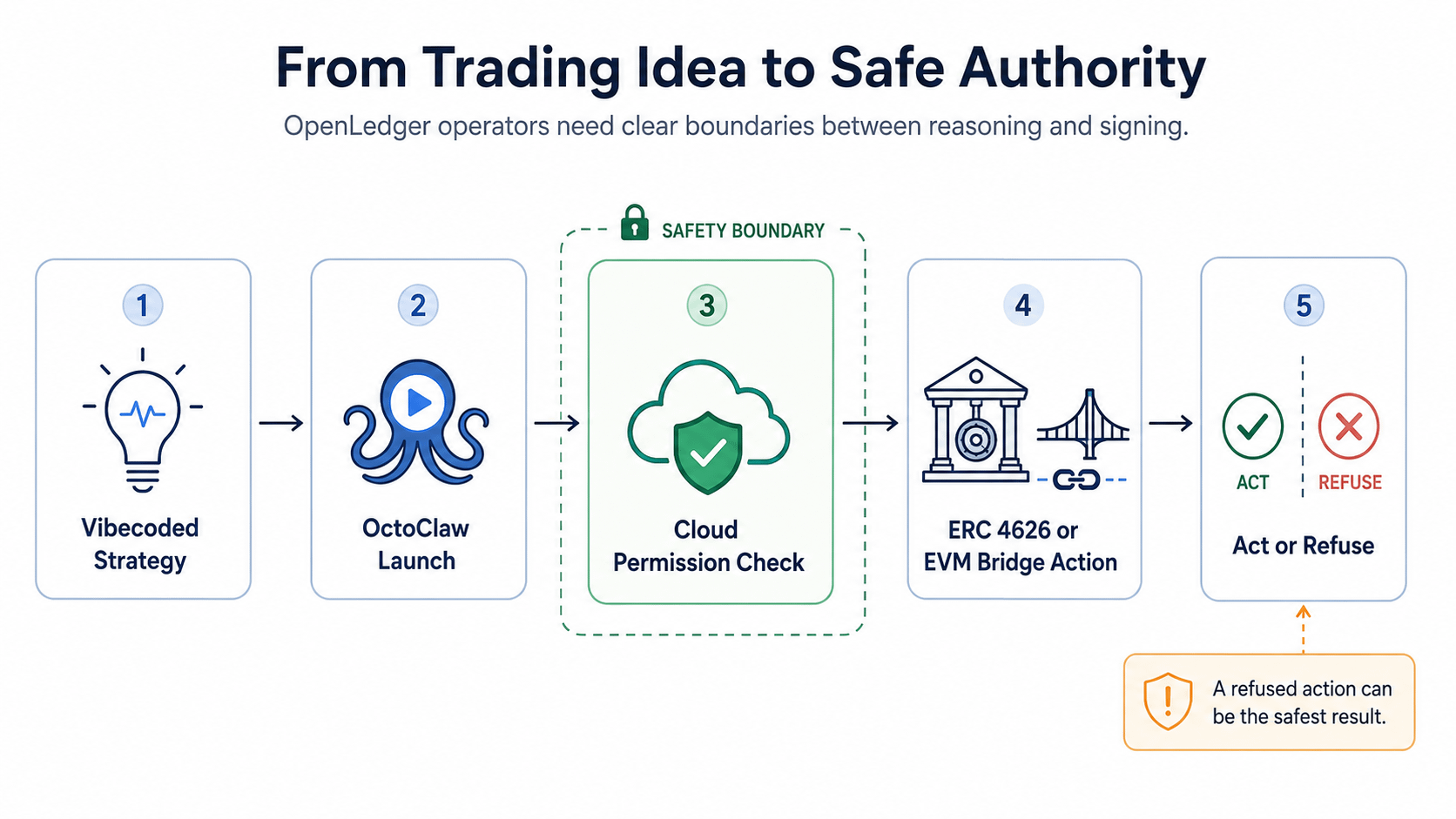
OctoClaw can make launch smooth. Fine. Smooth launch does not make the signer safe.
The config has to bind authority to the transaction being signed, not to the strategy label the user clicked. Selector and spender cannot be hidden in a friendly permission bucket. Chain and amount cannot be inferred from the route after the agent has already branched. State freshness has to be enforced before submission, not logged after the worker notices the bridge read was stale.
The agent needs to fail in ugly, developer-readable ways.
Not a cute product error. A real refusal that says the spender was outside policy, or the L2 gas floor was not met, or the vault preview was older than the allowed block window, or the replacement transaction changed the slippage envelope enough that the old permission no longer applies. If that makes the demo look stalled, good. The demo was trying to hide the signer.
The unsafe version completes the route and looks smarter.
The safe version stops at the one transaction that would have made the clip work.
OPEN only belongs in this system if staking follows the same brutal boundary. A quote-only agent cannot be weighted like an agent that can call 0x095ea7b3, approve a live spender, bridge assets, and enter a vault after cross-chain state has already drifted. Gas attribution cannot be agent active. Slashing cannot be route failed. Those labels are useless once the trace crosses a bridge and half the meaningful context lives in a worker, an indexer, or a dashboard database.
If a builder stakes OPEN behind approval authority, the slashable object has to be the permission that authorized that exact call. Spender. Chain. Allowance ceiling. Policy hash. Agent id. Route step. State window. The protocol needs those tied to the signature path before the transaction lands, because after the loss everyone can manufacture a clean story from logs.
And logs are not state.
An indexer missing the approval event during the relayer delay is not a rare edge case. It is exactly the kind of gap an automated agent will fall into because it needs a next action before the infrastructure has a final answer.
So the real OPEN staking question is ugly at byte level.
When the bad approval is already mined and the route has branched through a bridge retry, does the slash contract have the permission proof in state, or does it have a tx hash pointing at an off-chain trace that may never reconstruct the policy path.
#OpenLedger $OPEN @OpenLedger