
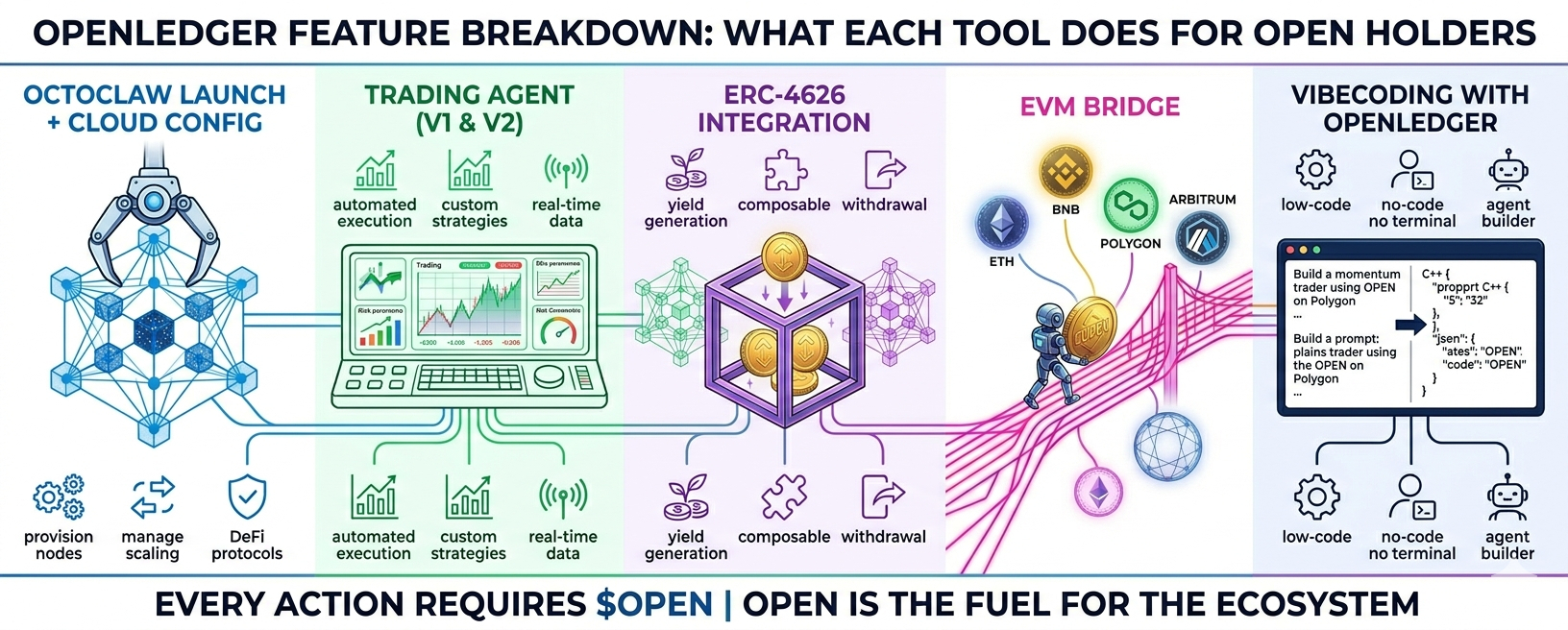
No fluff. Just a clear breakdown of what OpenLedger's five major features actually do — and why each one matters for OPEN.
Let's get straight into it.
🐙 1. Octoclaw Launch + Cloud Config
What it is: Decentralized node orchestration layer.
What it does: Spins up, manages, and scales nodes without a terminal.
Who it's for: DeFi protocols, dApp builders, trading bot operators.
$OPEN utility: Nodes are provisioned and maintained using OPEN.
Why it matters: Removes technical barriers to running reliable DeFi infra.
One-liner: AWS for DeFi — but decentralized.
🤖 2. Trading Agent (Two-Part Rollout)
What it is: Modular on-chain trading automation framework.
What it does: Executes strategies, manages risk, integrates real-time market data.
Two releases: Release 1 brought basic automated execution. Release 2 added custom strategies plus risk parameters.
OPEN utility: Agent deployment and transaction fees paid in OPEN.
Why it matters: Turns complex trading into plug-and-play modules.
One-liner: Not a sniper bot — a trading operating system.
🏦 3. ERC-4626 Integration
What it is: Standardized yield vault token standard.
What it does: Allows OPEN to be deposited into composable, transparent yield vaults.
Key benefits: Composable with any DeFi protocol, transparent APY and fees, withdrawable without custom code.
OPEN utility: Deposit OPEN → Earn yield → Withdraw anytime.
Why it matters: Your OPEN can now earn passive income across the entire Ethereum ecosystem.
One-liner: Standardized yield for standardized tokens.
🌉 4. EVM Bridge
What it is: Cross-chain bridge for EVM-compatible networks.
Supported chains: Ethereum, BNB Chain, Polygon, Arbitrum, and more.
What it does: Moves OPEN and trading agent strategies across chains.
$OPEN utility: Bridge fees paid in OPEN.
Why it matters: No more fragmented liquidity or multiple wallets.
One-liner: One OPEN bag. Many chains.
🎨 5. Vibecoding with OpenLedger
What it is: AI-powered low-code/no-code agent builder.
What it does: Converts plain English prompts into deployable DeFi agents.
Example prompt: "Build a momentum trader that uses OPEN on Polygon"
Open utility: Gas and deployment fees paid in OPEN.
Why it matters: Non-coders can now build and deploy DeFi strategies.
One-liner: Write English. Get code. Deploy with OPEN.
🔗 The Big Picture: All Features Compared
OpenLedger's five tools cover five different categories:
· Octoclaw handles infrastructure. OPEN pays for node provisioning.
· Trading Agent handles automation. OPEN pays for deployment and fees.
· ERC-4626 handles yield. OPEN goes into vaults and earns returns.
· EVM Bridge handles connectivity. OPEN pays bridge fees.
· Vibecoding handles development. OPEN pays gas and deployment.
Skill levels vary from beginner to advanced, but every single action requires OPEN.
📊 OPEN Utility Summary
Every major action in the OpenLedger ecosystem requires OPEN:
· Deploy a node via Octoclaw → Yes
· Run a Trading Agent → Yes
· Deposit into ERC-4626 vaults → Yes
· Bridge across chains → Yes
· Use Vibecoding to generate agents → Yes
· Pay gas for execution → Yes
Bottom line: OPEN isn't just a governance token. It's the fuel for every action in the OpenLedger ecosystem.
🧠 Final Thought
Campaigns end. Infrastructure stays.
OpenLedger is building five interlocking tools — and OPEN sits at the center of all of them.
Watch the @OpenLedger ecosystem closely. Octoclaw, trading agents, ERC-4626, EVM bridge, and vibecoding aren't random updates. They're layers of the same thesis: make decentralized finance accessible, automatable, and cross-chain by default.
And yes — I'm holding OPEN while I watch it happen.
