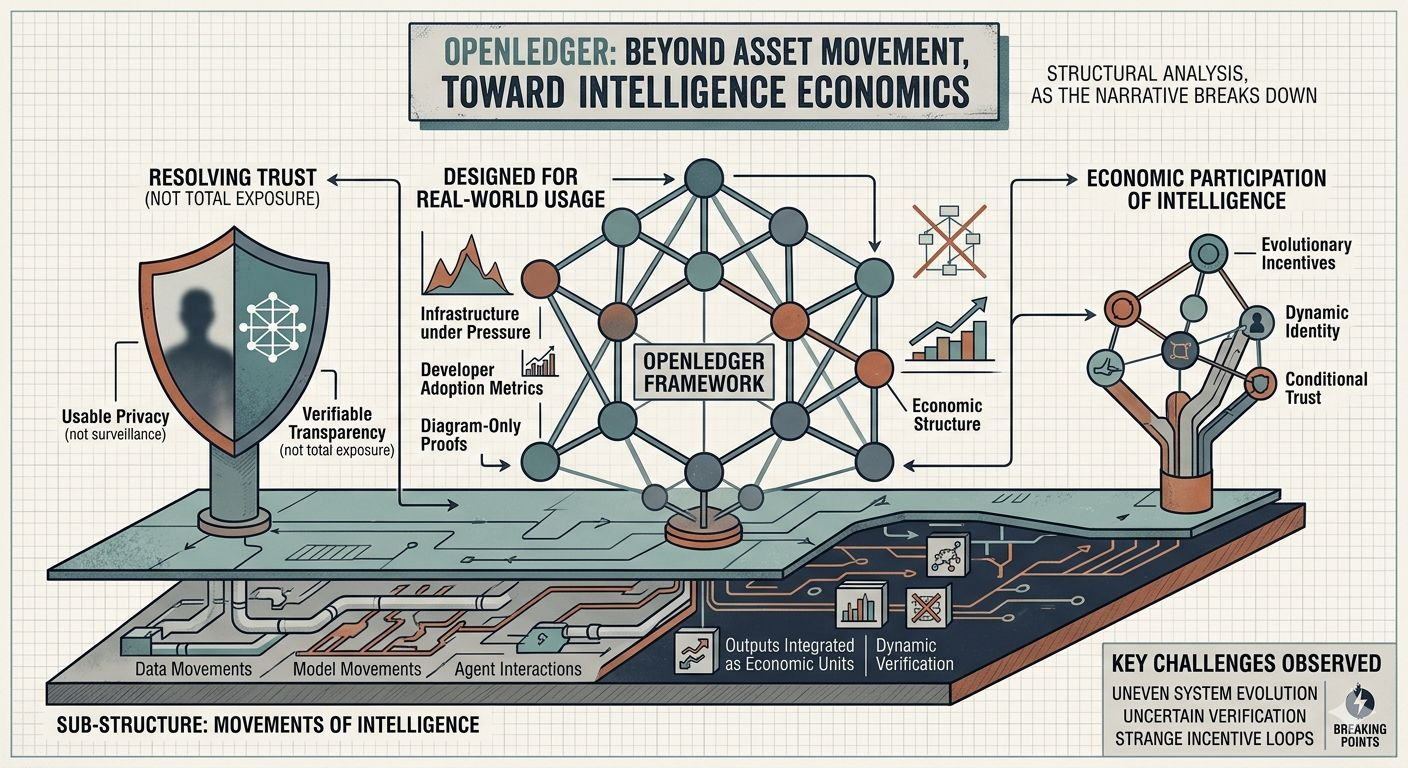
I’ve spent enough time watching this industry repeat itself that I can usually tell where a narrative is heading before it even fully forms. Every cycle introduces a new language for the same promises. Decentralization becomes scalability. Scalability becomes interoperability. Then AI enters the conversation and suddenly every project starts sounding like it’s rebuilding the future from scratch. That’s partly why OpenLedger caught my attention differently. Not because I immediately believed in it, but because it didn’t fully fit into the usual pattern I’ve become used to distrusting.
The strange thing about OpenLedger is that the more I looked at it, the harder it became to categorize. Most systems I come across still feel centered around movement of assets, movement of ownership, movement of speculation. OpenLedger feels like it’s trying to sit somewhere underneath all of that, closer to the movement of intelligence itself. I don’t mean that in some grand futuristic way. I mean it more practically. Data moves. Models move. Agents interact. Outputs become part of an economic structure instead of isolated tools. That changes the feeling of the system entirely, at least from where I’m standing.
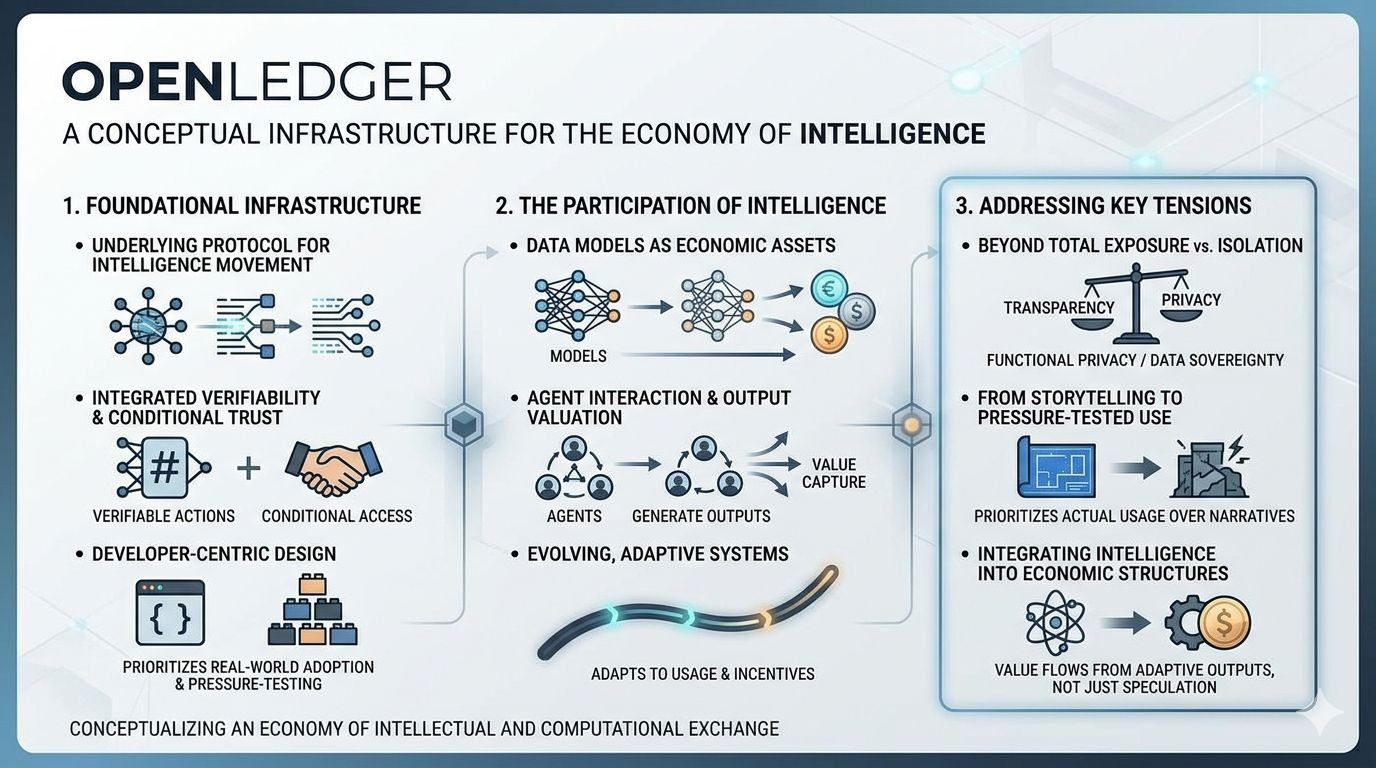
What keeps pulling me back into these ideas is frustration more than excitement. I keep running into the same unresolved problems no matter how polished the branding becomes. OpenLedger exists in a market where transparency has somehow become confused with total exposure. Every system claims openness as if that automatically creates trust, but most of the time it just creates surveillance with better marketing. Then the so-called privacy solutions swing completely in the opposite direction and become unusable, impossible to verify, or disconnected from reality. Somewhere between those extremes, trust keeps breaking down anyway.
That’s part of why OpenLedger feels interesting to me conceptually, even if I’m still skeptical about where it actually leads. I’m tired of projects being designed for storytelling instead of pressure. Everything sounds durable until real usage appears. Infrastructure always looks clean in diagrams. It rarely looks clean when people actually depend on it. Developer experience gets ignored constantly, even though that’s usually where adoption quietly dies long before the public notices. Then token systems get attached to everything whether they make sense or not, as if financialization alone can manufacture importance.
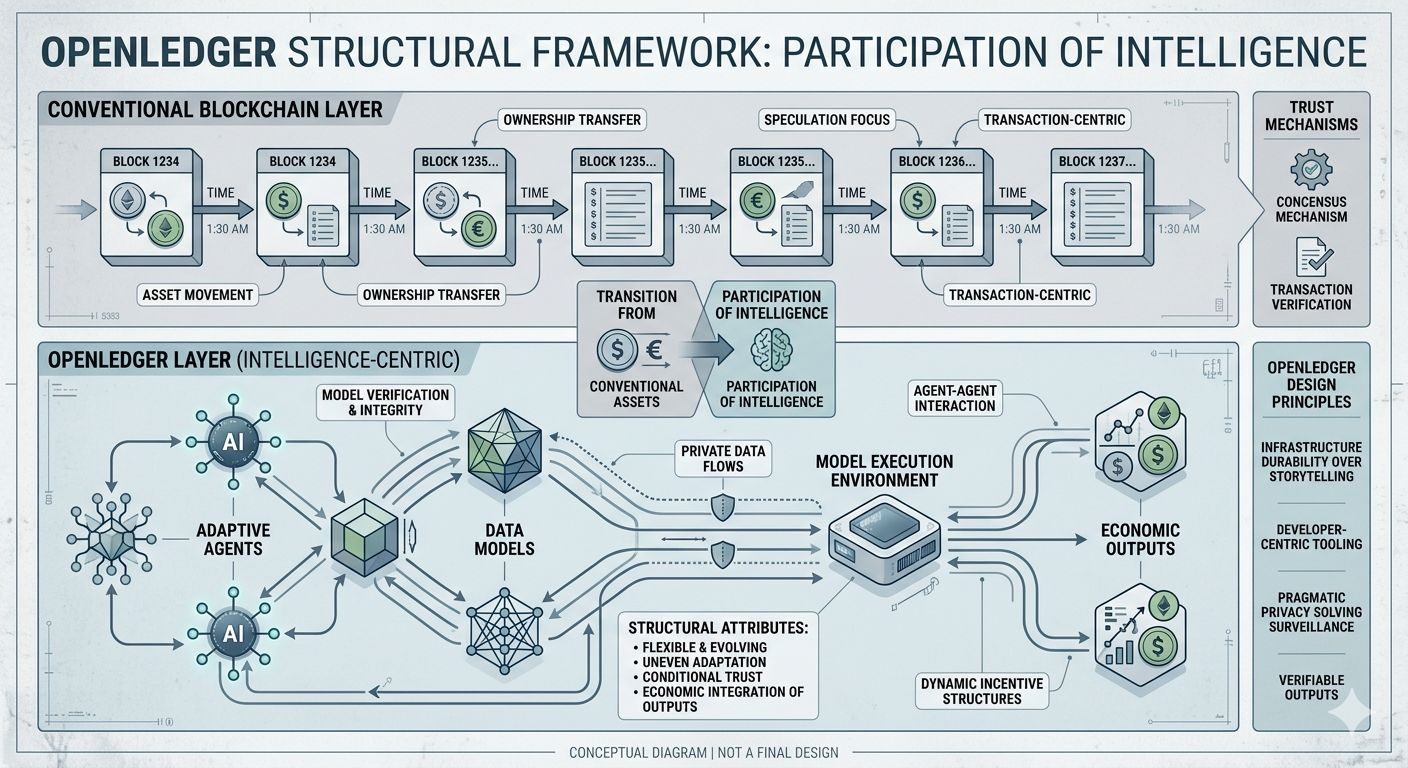
I think what I keep noticing with OpenLedger is that it’s at least pointing toward a different question. Not just how value moves, but how intelligence participates economically. And honestly, that creates as many concerns for me as it does possibilities. Systems built around intelligence don’t behave like static networks. They evolve unevenly. They create strange incentives. Verification becomes harder. Identity becomes unstable. Trust becomes conditional instead of fixed. Most markets already struggle to handle simple coordination problems. Adding adaptive systems into that environment feels messy in ways I don’t think people fully understand yet.
Maybe OpenLedger stays infrastructure. Maybe it becomes something larger. I genuinely don’t know. What I do know is that I’ve stopped trusting polished narratives a long time ago. Big ideas are easy to manufacture now. Ambition is everywhere. Actual usage is where things usually collapse. The gap between vision and reality almost never closes as neatly as people pretend it will. That’s why I pay more attention to breaking points than promises now. And for whatever reason, OpenLedger feels less like another recycled story to me and more like something I’m still trying to figure out carefully instead of immediately dismissing.
#OpenLedger $OPEN @OpenLedger