
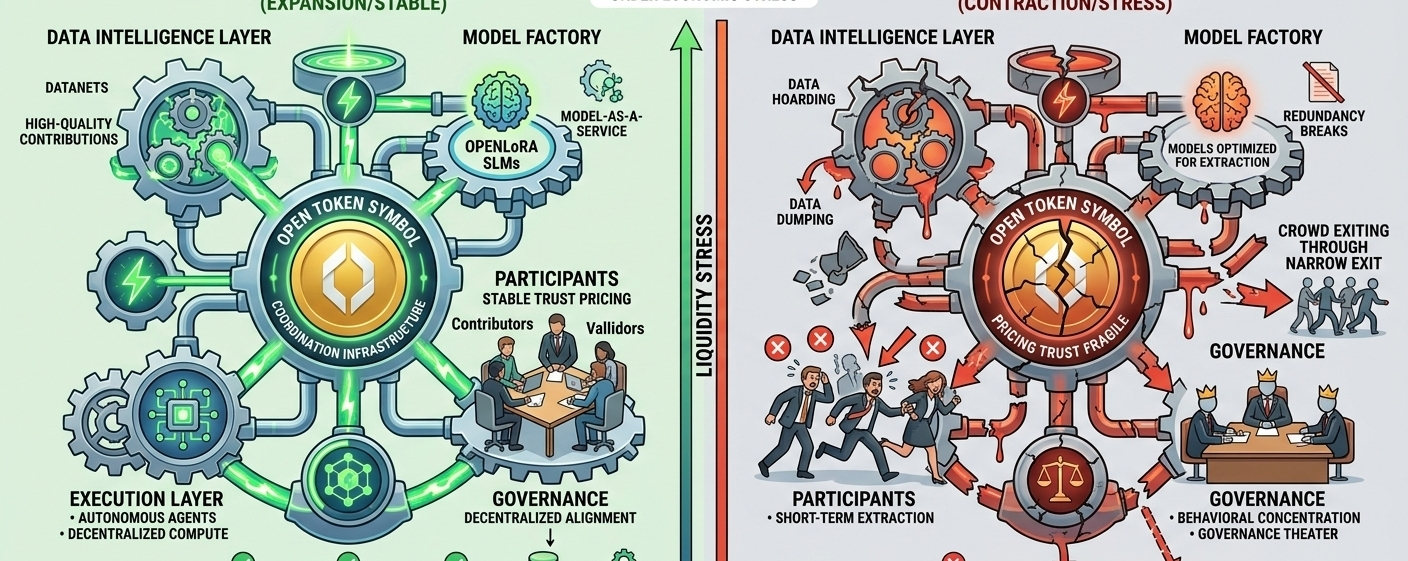
What interests me about systems like OpenLedger is not whether they can coordinate capital, models, data, or machine intelligence under ideal conditions. Most decentralized systems can appear coherent during expansion cycles because rising liquidity conceals inefficiency. Friction becomes invisible when participation itself is profitable. The harder question is what happens when the cost of coordination suddenly exceeds the reward for maintaining it. That is usually where the architecture stops behaving like theory and starts behaving like a market.
I tend to look at these systems through one lens: coordination under liquidity stress. Not technical stress in the narrow sense of throughput or uptime, but economic stress where trust weakens faster than incentives can adapt. In crypto, people often speak as if decentralization removes dependence on institutions. What I have observed instead is that decentralization redistributes dependence into incentive layers that are harder to see. A protocol can eliminate intermediaries formally while recreating them behaviorally through capital concentration, reputation gravity, and asymmetric information. Under stable conditions, that distinction feels philosophical. Under volatility, it becomes operational.
OpenLedger positions the OPEN token less as a speculative asset and more as coordination infrastructure across agents, datasets, models, and execution layers. I think that framing matters because it exposes the protocol to a more difficult category of failure than ordinary token networks face. In a conventional financial protocol, the token primarily coordinates liquidity and security. In a system attempting to coordinate machine intelligence and economic behavior simultaneously, the token also becomes a pricing mechanism for trust. That sounds elegant until markets become uncertain. Then the token stops representing alignment and starts representing doubt.
The first structural pressure point appears when liquidity begins separating from utility. This happens earlier than most protocol designers expect. During optimistic phases, participants tolerate inefficiencies because future upside compensates for present ambiguity. Contributors provide data, compute, models, or validation because they assume the network effect will eventually deepen liquidity. But once volatility increases, contributors stop evaluating the protocol as a mission and start evaluating it as inventory risk. That psychological shift changes everything.
I have watched this transition repeatedly across different narratives. The language around decentralization remains unchanged while participant behavior becomes radically more defensive. In OpenLedger’s case, the issue is not whether contributors can technically monetize intelligence infrastructure. The issue is whether they continue contributing once they realize coordination rewards fluctuate faster than operational costs. Data providers, model builders, and autonomous agents all begin optimizing for short-term extraction instead of long-term network resilience. The protocol may still function mechanically, but the social layer that gave it coherence starts thinning out.
This creates a structural trade-off that I do not think decentralized AI systems fully escape: capital efficiency versus coordination resilience. Systems optimized for efficient market participation usually compress friction aggressively. They minimize idle liquidity, reduce redundancy, and reward fast adaptation. But resilience often depends on inefficiency. Redundant actors, slower consensus, excess liquidity buffers, and persistent unprofitable participation are what absorb shocks. When OpenLedger attempts to make intelligence markets fluid and continuously monetizable, it also risks making them more reflexive. Reflexive systems are efficient while confidence grows and brittle when confidence contracts.
The uncomfortable part is that contributors do not need to leave simultaneously for the system to destabilize. They only need to become uncertain about the persistence of other contributors. Coordination systems fail socially before they fail technically. Once participants suspect others are preparing to withdraw value, behavior changes preemptively. Liquidity fragments. Pricing becomes inconsistent. Long-horizon commitments disappear. What remains is transactional participation without conviction.
That leads into the second pressure point, which is more subtle and potentially more dangerous: governance without enforceable authority. Decentralized coordination systems often assume incentives can replace institutional discipline. I think this assumption works only while economic alignment remains relatively symmetrical. Once asymmetry grows, governance becomes theater unless the protocol can impose costs on behavior that weakens the network.
OpenLedger’s architecture depends on distributed actors behaving in ways that preserve the integrity of shared coordination layers. But distributed actors respond to local incentives first. During periods of market stress, governance participation tends to centralize around the participants with the largest economic exposure and the shortest time horizons. This is not necessarily malicious. It is simply rational behavior under uncertainty.
What fascinates me is how quickly decentralization can invert under pressure. A protocol designed to remove intermediaries often recreates informal centers of influence because coordination itself becomes expensive. Smaller participants stop engaging in governance because the informational burden outweighs the expected return. Meanwhile, large holders, infrastructure operators, and strategic participants gain disproportionate influence simply because they can absorb volatility longer. The protocol remains decentralized procedurally while becoming concentrated behaviorally.
I do not think most markets price this correctly because they focus too heavily on visible decentralization metrics. Validator counts, voting participation, token distribution, and contributor numbers all look persuasive on dashboards. But under economic stress, governance is not determined by how many actors exist. It is determined by who can afford patience. That distinction matters more in systems coordinating AI-related infrastructure because intelligence markets naturally accumulate asymmetry. Better models attract more demand, more demand attracts more liquidity, and more liquidity strengthens network influence. Over time, coordination gravitates toward dominant participants even if the protocol formally permits open participation.
The deeper issue is that decentralized AI coordination introduces latency between contribution and reward. Contributors may provide valuable infrastructure long before markets recognize its value. During stable cycles, this delay feels acceptable because future growth justifies present uncertainty. During contractions, delayed recognition becomes a liability. Participants stop trusting the fairness of reward distribution because they cannot distinguish between temporary underpricing and permanent extraction.
That uncertainty affects behavior more than technical architecture does. People often assume protocols fail because of exploits or design flaws. In reality, many systems weaken because participants stop believing future rewards will justify current exposure. Once that belief erodes, every interaction becomes adversarial. Governance becomes defensive. Liquidity becomes conditional. Coordination becomes transactional.
I keep returning to one question when I study protocols like OpenLedger: what happens when the actors producing the most value no longer believe the network values persistence more than opportunism? I do not mean rhetorically. I mean economically. Because once contributors conclude that short-term extraction is safer than long-term participation, the protocol faces a problem that code alone cannot repair.
And that is usually the moment where decentralized coordination stops looking like infrastructure and starts looking like a crowd trying to leave through the same narrow exit.
