

I Will Be Honest...
I’ve been thinking About something lately.
Yeah... We spend so much time talking about how fast artificial intelligence is Growing that we rarely stop to ask a much simpler question: who actually owns what these systems Create?
It sounds obvious at first. We assume the answer is whoever builds the Model or runs the platform. That is how most people think about technology today. Someone Builds it, people use it, and value flows upward.
But the more I Watch how AI and blockchain are evolving together, the more this feels incomplete.
Every intelligent System learns from something. It learns from data, from patterns, from contributions made by thousands or even millions of people. Yet most of the time, The People who shape that intelligence remain invisible. Their ideas, information, and Effort become part of a machine that eventually creates value somewhere else.
That disconnect feels strange to me.
For years, crypto Has tried to solve trust. It gave us systems where value can move without asking permission. It Created transparency where traditional systems often hide complexity behind closed doors.
AI is now facing a Similar problem, but on a deeper level.
The problem is not Only whether an AI model works. The real question is whether we can trust where it came from, What shaped it, and who deserves credit when it produces something valuable.
Right now, most Systems do not answer that well enough.
A model can Produce useful output, but tracing exactly which data shaped that output is difficult. Knowing who contributed to that intelligence is even harder. And if Value is generated, rewards rarely reach the people who helped create that foundation.
This is where I started Paying attention to OpenLedger.
Not because it Promises some dramatic revolution. We hear too many promises in this space already.
What caught my Attention is that it approaches AI infrastructure from a very different angle. Instead of treating intelligence as something owned by a central builder, it treats intelligence as something assembled through Transparent contribution.
That changes the Conversation.
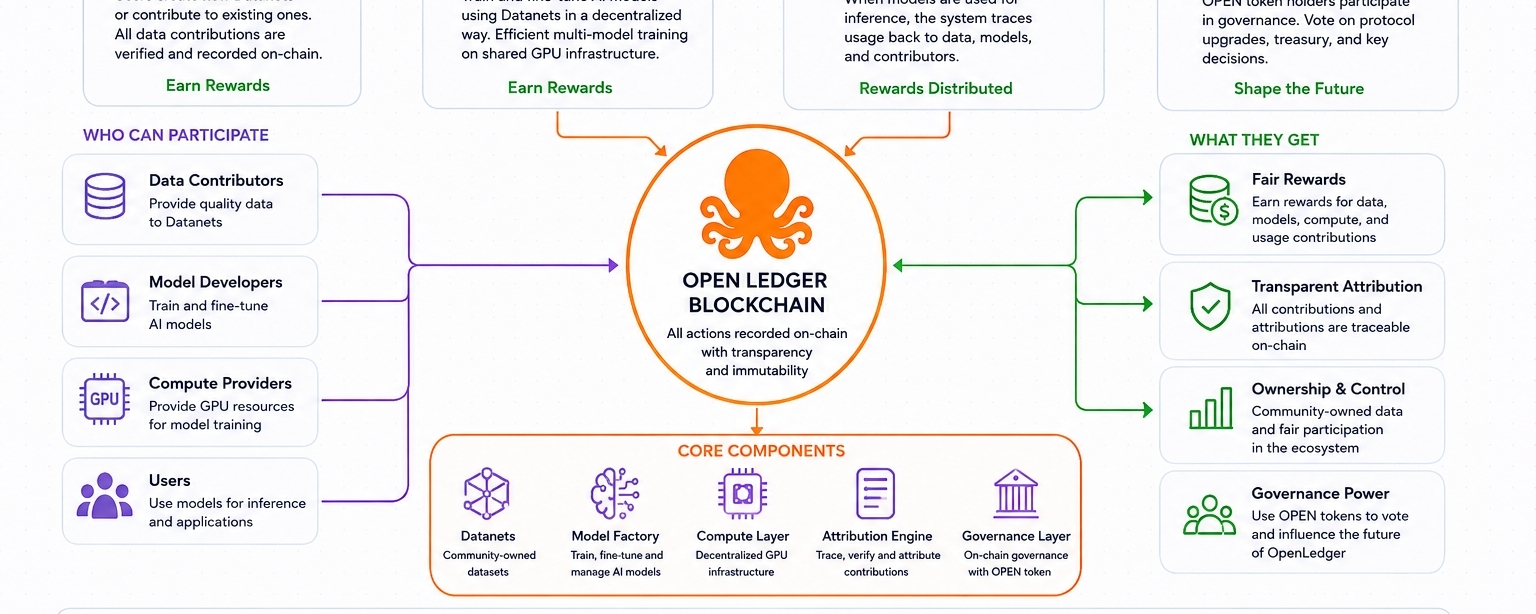
At its core, OpenLedger connects AI model development to Blockchain-based attribution.
The idea is surprisingly simple when you strip away the technical Language.
People contribute Datasets through what the system calls Datanets. These are community-owned pools of Information that can be used to train specialized models. Every contribution is verified and recorded on-chain, creating a visible history of who Added value and when.
Then those Models can be trained and fine-tuned using those datasets.
And here is the part that matters most to me: when a model is actually Used, the system can trace that usage back through its history.
That means Attribution is not lost after training.
If an AI system generates value through inference, OpenLedger is designed to connect that value back to the People and resources that helped create it.
This sounds Technical, but the real-world meaning is much bigger.
It challenges the quiet assumption that intelligence should become More centralized as it becomes more powerful.
Most industries tend to centralize around whoever controls infrastructure. AI has been moving in that direction for years Because compute, data access, and model ownership are expensive to maintain.
But if attribution becomes transparent and automated, something interesting happens.
Participation Becomes economically visible.
Contributors are no longer just background inputs. They become Recognized parts of the system itself.
That could change behavior across entire digital ecosystems.
Researchers might share better datasets because ownership is Protected. Smaller developers might train highly specialized models without losing control of their work. Entire communities could build intelligence Collaboratively without surrendering all upside to a single gatekeeper.
Of course, I also Think there are hard questions here.
The biggest challenge is adoption.
Ideas like this Sound elegant on paper, but systems only matter if people actually use them. Building transparent attribution at scale is not easy. Training infrastructure is Expensive, incentives can become messy, and governance often looks better in theory than in Practice.
OpenLedger’s hybrid on-chain governance model is interesting because it tries to balance flexibility with accountability. But governance systems always reveal their True strength only when difficult decisions appear.
That uncertainty is normal.
If anything, it Makes the project more worth watching.
What I find most interesting is not whether OpenLedger Becomes dominant. It is what the project represents.
It reflects a growing Realization that AI cannot stay separated from Questions of ownership, fairness, and trust.
As intelligence Becomes part of daily digital life, we will need systems that explain its origins and distribute its Rewards more honestly.
Maybe OpenLedger becomes one of the early frameworks that Proves this can work.
Maybe it becomes One experiment among many.
Either way, it points Toward an important shift in thinking.
We may be moving from an internet where intelligence is Consumed to an internet where intelligence is collectively built and transparently attributed.
And that raises Questions I keep coming back to.
What are we really Building when we combine AI and blockchain?
My view is Simple.
Are we creating tools that empower people, or simply rebuilding Old power structures with new technology?
And if intelligence becomes one of the most valuable digital Assets in the world, who should truly own the value it creates?
I think these are the questions that matter now.
The projects Worth watching are not always the loudest ones. Sometimes they are the quiet systems trying to solve the deeper problems before everyone else realizes those problems exist.