
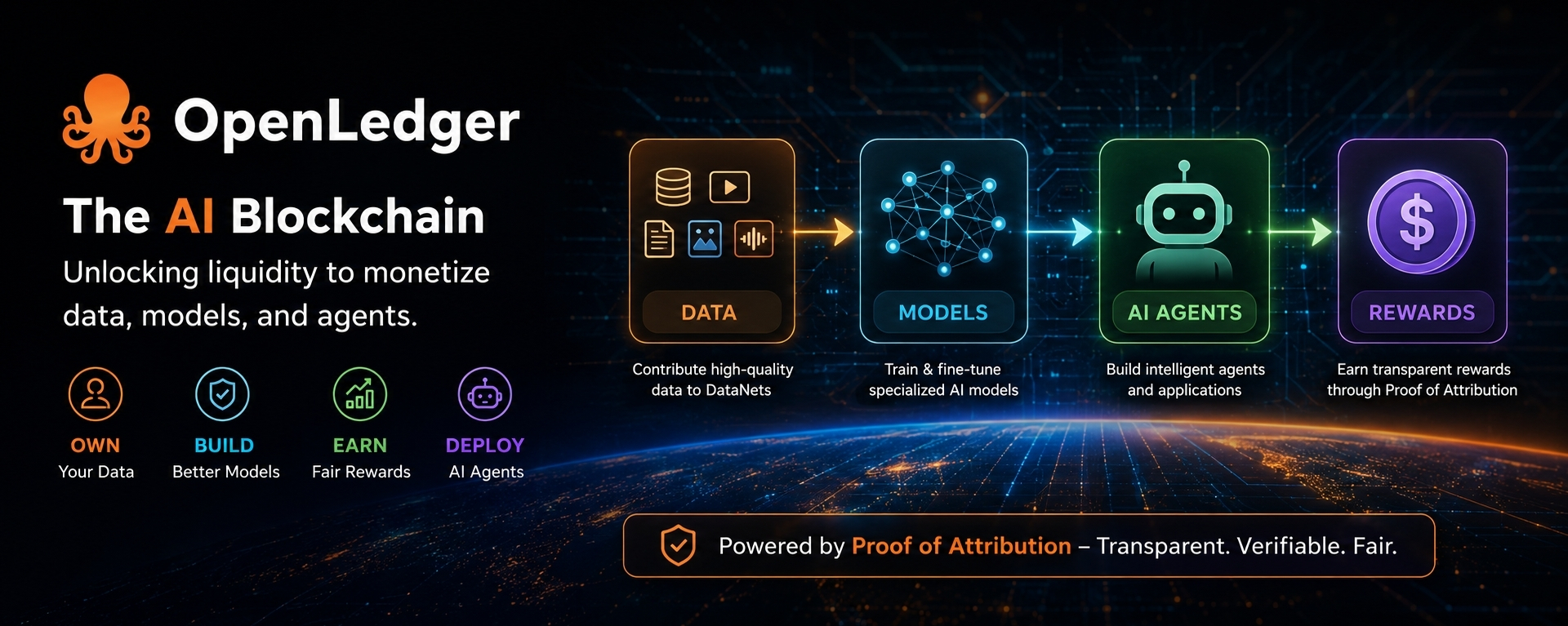

OpenLedger is one of those projects that becomes more interesting when you stop looking at it as just another AI coin and start looking at the problem it is trying to solve. AI is getting bigger every month, but the people and data behind that intelligence are still treated like background noise. OpenLedger is focused on changing that by building a system where data, models, and AI agents can be tracked, used, and monetized instead of being swallowed by a black box.
The strongest thing about OpenLedger is its focus. It is not trying to sound big just for attention. The project is built around a very real issue in AI: value is being created from data, but the ownership of that value is still unclear. A model can become useful because of thousands of data points, expert inputs, community contributions, or specialized knowledge, yet most contributors never receive proper credit. OpenLedger is trying to make that value visible.
That matters because AI does not improve from magic. It improves from data. Clean data, tested data, expert data, and real user activity. A model trained on weak information will always give weak results, even if it looks impressive on the surface. This is why OpenLedger’s approach feels practical. It focuses on the foundation of AI, not just the final output.
OpenLedger gives data a more active role. Instead of treating it like something that simply feeds a model and disappears, the project is building a way for data to become part of an economy. If a dataset helps improve a model, and that model later creates value through an app or AI agent, there should be a way to trace that contribution. That is a powerful shift.
This is especially important for specialized AI. General AI models are useful, but they are not always enough for serious work. A finance model needs strong market data. A healthcare model needs trusted medical information. A coding model needs accurate technical context. A Web3 AI agent needs reliable on-chain knowledge. OpenLedger’s direction makes sense because the future will likely need many focused models, not just one giant model trying to answer everything.
What makes OpenLedger more interesting is that it connects the whole flow. Data contributors, model builders, agent creators, and users can all become part of the same value system. That is different from the current internet model, where users create value and large platforms usually capture most of the upside. OpenLedger is trying to build something more balanced for the AI era.
The project also fits naturally with Web3 because blockchain is useful when ownership, transparency, and rewards need to be tracked. AI has a trust problem, and Web3 has tools that can help solve parts of it. OpenLedger sits right at that intersection. It is not just about putting AI on-chain for hype. It is about using blockchain to give AI data and models a clearer economic structure.
The AI agent side is also important. Agents will only become truly useful when they are backed by reliable models and strong data. A weak agent with poor data is just fast noise. A strong agent with verified inputs can become a real assistant, researcher, trader, analyst, or automation tool. OpenLedger is building toward that second version, where agents are not only active but also connected to traceable value.
I also like that OpenLedger is solving a problem that will become more obvious with time. Right now, many people are still distracted by big AI announcements, new tools, and market hype. But sooner or later, the question of who owns the data and who gets paid for improving AI will become much louder. OpenLedger is already positioning itself around that question.
Of course, this will not be easy. Data quality is hard. Attribution is hard. Reward systems are hard. Keeping spam away is hard. But that is exactly why the idea matters. Easy problems usually do not create strong infrastructure. The harder the problem, the more valuable the solution can become if the project executes well.
OpenLedger feels like a project built around a real gap in the AI economy. It is giving data a price, models a clearer path, and AI agents a stronger foundation. More importantly, it is trying to make sure the people and communities behind AI value are not ignored.
AI is moving fast, but speed alone is not enough. The next stage needs trust, ownership, and fair value flow. OpenLedger is focused on that layer, and that is what makes the project worth paying attention to.