
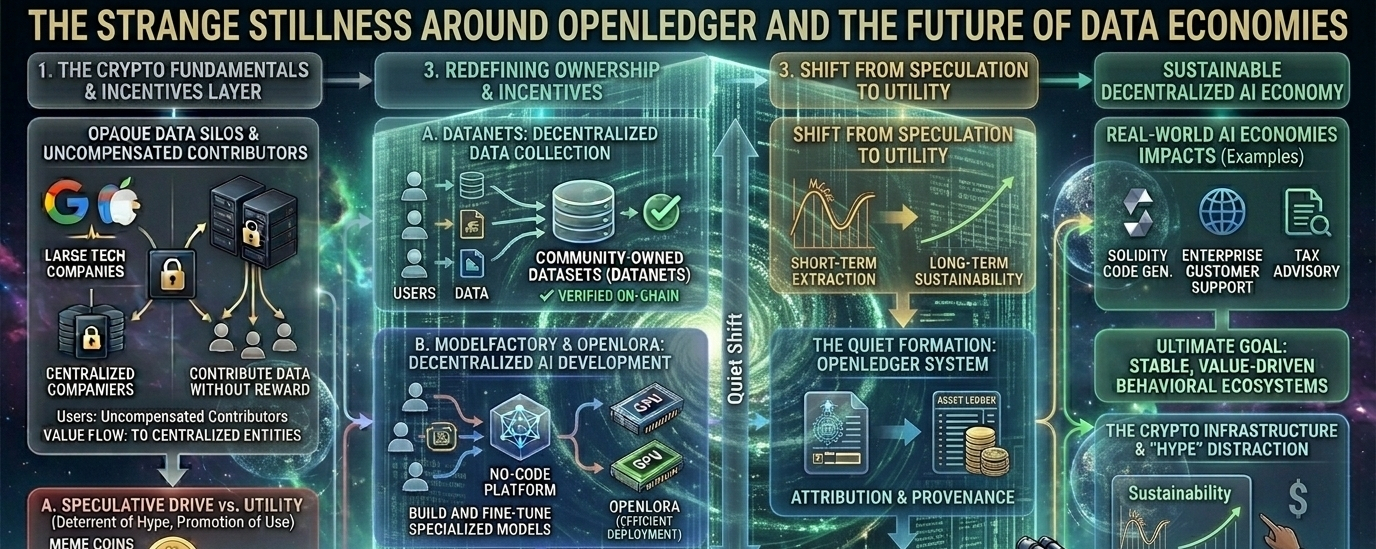
I’m watching OpenLedger the same way I’ve watched dozens of systems appear over the years, slowly gathering language around themselves before anyone fully understands what they are becoming, I’m looking at the space around it more than the project itself, the reactions, the rhythm of people entering and staying, the quiet behaviors that emerge before the narratives harden into certainty, and maybe that’s the only part that still interests me now after seeing so many cycles build themselves on urgency and dissolve into silence. I’ve seen how quickly crypto learns new words and forgets old ones, how every era invents a fresh vocabulary for attention, and now it’s data, agents, models, infrastructure, liquidity attached to intelligence itself, which sounds abstract at first until you notice how naturally people adapt to abstraction when they think value might eventually settle there.
What keeps pulling my attention back toward projects like OpenLedger isn’t really the technology because technology stopped being enough a long time ago. Most systems work well enough on paper. Most architectures sound convincing when diagrams are clean and timelines are optimistic. What matters more now is the feeling underneath the interaction, the atmosphere around participation, the kind of habits the system quietly trains into people before they realize they are adapting themselves around it.
And there’s something familiar here.
Not identical to older cycles, but adjacent to them in a way that feels difficult to ignore. During the DeFi years people convinced themselves they were discovering a new financial structure when most of them were really discovering a new form of compulsive monitoring. Then NFTs arrived and transformed identity into visible positioning. After that came the infrastructure era where everyone suddenly cared about throughput and modularity and execution layers as if technical language itself became a substitute for conviction. AI now enters crypto almost differently, quieter but somehow deeper, because it touches behavior more directly. People already live through recommendation systems, algorithmic sorting, invisible automation. The transition feels less like adoption and more like recognition.
OpenLedger sits somewhere inside that transition, not loudly, not in the way older projects tried to dominate attention, but almost by suggesting that data itself should stop moving invisibly through centralized systems and begin acting like an asset people can orbit around consciously. That idea sounds reasonable when written down. Maybe too reasonable. Crypto has always been strongest when converting invisible processes into visible incentives. But visible incentives also change human behavior in ways projects rarely predict.
I keep thinking about what happens when every interaction starts carrying extractable value. Not because it’s dystopian exactly, but because it changes the texture of attention itself. People begin adjusting naturally. They contribute differently when contribution becomes measurable. They think differently when models, data, and activity all sit inside systems waiting to assign worth. Quiet curiosity can slowly turn performative without anyone noticing the transition happen.
And still, I can’t dismiss it entirely.
Because there’s also something honest about acknowledging the systems already operating underneath modern life. Most people already produce value constantly without ownership over any of it. Their preferences, habits, writing, timing, movement, reactions, patterns. Entire economies feed on invisible participation. So when a project like OpenLedger talks about monetizing models or agents or data liquidity, part of me understands why the idea resonates even if the language around it still feels unfinished. It reflects a broader exhaustion people have with being passive raw material for systems they never see clearly.
But crypto also has a habit of translating legitimate discomfort into speculative structure before it fully understands the emotional consequences. That’s the part I keep returning to while observing all this. The space is very good at building markets around unresolved feelings. Ownership, freedom, decentralization, permanence, identity. The language changes every few years but the emotional gravity underneath often stays surprisingly similar.
I notice how many people now interact with projects less like users and more like anticipatory participants. Everyone is waiting slightly ahead of the present moment. Waiting for incentives. Waiting for recognition. Waiting for the ecosystem to mature. Waiting for behavior to become economically meaningful later. Sometimes I wonder whether the entire industry quietly survives on delayed emotional settlement more than actual utility.
And maybe that’s why I pay attention to smaller details now. The silence between announcements. The pace people return after initial excitement fades. Whether conversations become more human over time or more mechanical. Whether communities develop memory or just repetition. Whether anyone still explores without expectation of extraction.
The strange thing about systems built around intelligence and data is that they can appear alive very quickly. Activity itself creates the illusion of depth. Dashboards move, models evolve, agents interact, metrics expand. But movement is not always meaning. I’ve watched enough online ecosystems to know that complexity can mask emptiness for surprisingly long periods of time.
At the same time, simplicity can hide something real.
Some projects survive not because they dominate attention but because they quietly become part of routine behavior. They stop announcing themselves. They settle into the background of people’s habits almost invisibly. I still don’t know whether AI blockchain systems can actually reach that state naturally or whether they remain too self-conscious, too aware of their own architecture to feel fully lived-in.
OpenLedger feels suspended somewhere inside that uncertainty right now. Not fully speculative noise, not fully proven infrastructure either. More like an unfinished environment forming around larger shifts that nobody completely understands yet. And maybe that’s why I keep watching instead of deciding. Because certainty in this space usually arrives too early, long before the real patterns appear.
I’ve learned to trust duration more than momentum anyway.
The projects that matter tend to reveal themselves slowly, almost reluctantly, after the noise moves somewhere else. And the ones built mostly from narrative usually become strangely quiet once attention stops feeding them. Right now it’s still difficult to tell which direction this belongs to. Some days it feels like another system trying to financialize human activity with cleaner language. Other days it feels like an early glimpse of how digital participation may eventually reorganize itself around ownership and intelligence in ways people are only beginning to notice.
So I keep looking at it from a distance, not close enough to believe completely, not far enough to ignore it either, just watching the patterns settle, waiting to see what remains once the excitement starts thinning out and the system has to exist without constantly explaining itself.
