
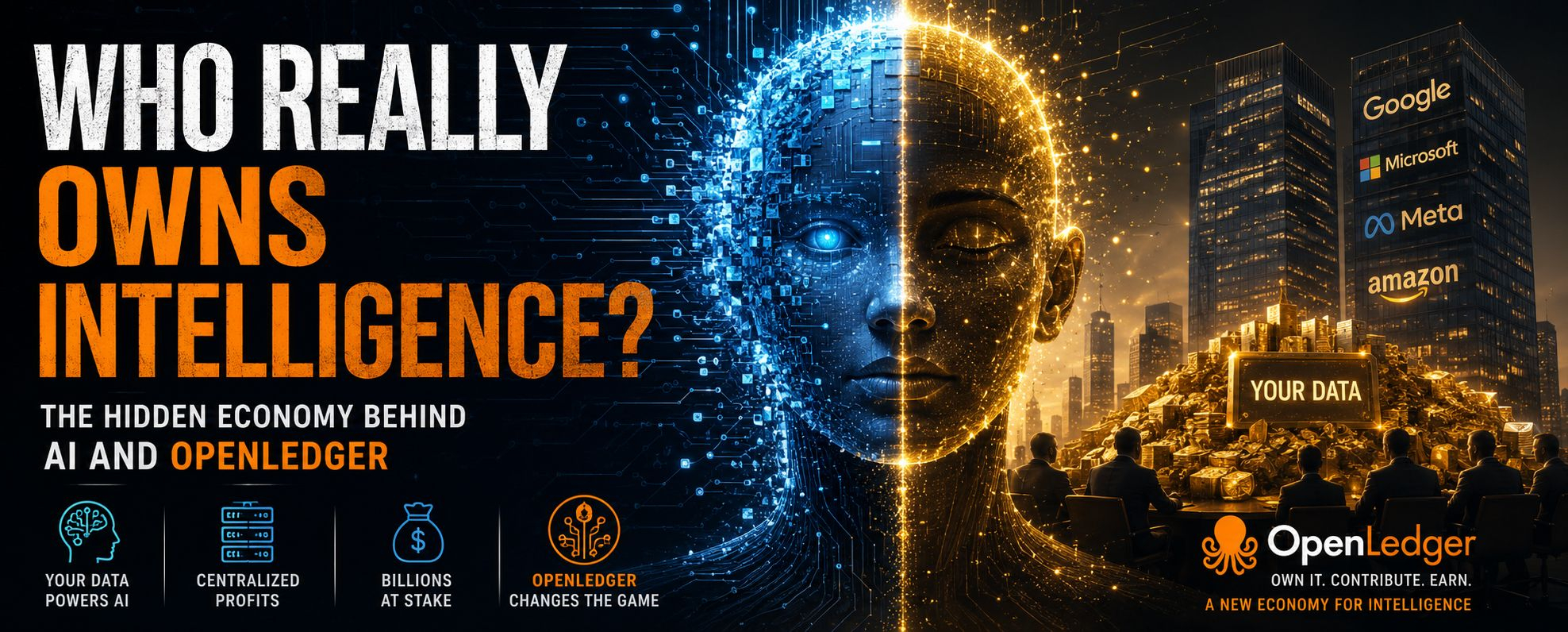
When I look at the conversation around AI and blockchain, I do not see OpenLedger as just another crypto project trying to attach itself to a trend. I see something more uncomfortable, more ambitious, and honestly, more important than most people realize right now.
The AI industry keeps telling us the future belongs to whoever builds the biggest model. More GPUs. More compute. More parameters. Faster inference. But the deeper I watch this space, the more I feel the real battle is not about intelligence itself. It is about ownership.
Who owns the data? Who owns the outputs? Who owns the economic value generated by AI systems trained on billions of human interactions?
Right now, the answer is painfully centralized.
Every day, people unknowingly contribute to AI systems through conversations, images, code, articles, reviews, and behavioral patterns. Entire communities are effectively training future intelligence models without ever participating in the upside. I think that is the hidden contradiction at the center of modern AI. The people creating the raw intelligence layer remain mostly invisible while the economic rewards concentrate at the top.
That is why OpenLedger caught my attention.
OpenLedger positions itself as an AI blockchain focused on unlocking liquidity around data, models, and autonomous agents. On the surface, that sounds like standard Web3 language. But when I looked deeper, I realized the project is trying to solve something much larger than token speculation. It is attempting to build an economic framework where intelligence itself becomes traceable, monetizable, and programmable.
And honestly, that changes the entire conversation.
Most AI systems today operate like black boxes. Data goes in, intelligence comes out, and nobody truly knows how value should be distributed across the chain of contributors. OpenLedger’s approach revolves around attribution systems, Datanets, and on-chain infrastructure designed to reward participants whose data or models contribute to AI outcomes.
What interests me is not the technology alone. It is the philosophical shift underneath it.
For years, the internet created a massive extraction economy around data. Platforms became trillion-dollar companies largely because they captured and monetized human behavior at scale. People generated the value, but platforms owned the economics.
I think OpenLedger is trying to challenge that structure by asking a dangerous question:
What if data itself became an asset people could actually own?
That sounds simple, but I think it has enormous implications.
Because the next phase of AI is probably not just about larger models anymore. The real bottleneck is becoming high-quality, specialized, trustworthy data. Public internet scraping is reaching saturation. Synthetic data can only go so far before models start recycling their own hallucinations. Eventually, AI systems need verified human expertise again.
Healthcare data. Scientific research workflows. Localized language patterns. Financial behavior. Industrial systems. Legal reasoning.
These are not just datasets anymore. I increasingly see them as economic infrastructure.
And if those datasets become economically valuable, then attribution becomes one of the most important unsolved problems in AI.
That is where OpenLedger becomes intellectually interesting to me. Instead of focusing only on building another AI application, it is trying to create rails for an entirely new intelligence economy.
I think most people underestimate how disruptive that idea could become.
Because once autonomous AI agents begin interacting with financial systems, ownership structures become extremely complicated. If an AI model generates value using data contributed by thousands of participants, who deserves compensation? The company? The model creator? The data providers? The inference layer? The validators? The users directing the agent?
Right now, centralized AI companies avoid this problem because they own the entire stack vertically. But decentralized AI systems force these questions into the open.
That is why I think attribution may eventually become more valuable than the models themselves.
And this is where OpenLedger’s vision starts feeling less like crypto speculation and more like early infrastructure experimentation for the next internet economy.
What I find especially fascinating is the project’s attempt to create liquidity around AI components that normally stay trapped inside closed ecosystems. Today, datasets sit inside corporations. Models stay behind APIs. AI agents operate within centralized applications.
OpenLedger seems to imagine a future where those components become modular economic units instead.
Data contributors earn. Model creators earn. Agents transact. Infrastructure providers earn. Everything becomes composable.
In some ways, I see similarities with what decentralized finance did to traditional money markets. DeFi did not invent money. It transformed financial relationships into programmable systems. OpenLedger appears to be exploring whether intelligence itself can become programmable in the same way.
But I also think the project raises uncomfortable questions that most AI narratives avoid.
Because financializing intelligence changes human behavior.
If every dataset, conversation, image, or idea becomes economically traceable, then creativity itself starts turning into infrastructure. I honestly do not think society is prepared for that shift yet. We already live in an attention economy where engagement is monetized aggressively. A fully tokenized AI ecosystem could intensify that dynamic even further.
People imagine liberation through decentralized AI. But I also see the possibility of hyper-financialized human expression.
That tension is what makes this entire space fascinating to me.
And technically, I think OpenLedger still faces enormous challenges that should not be ignored. Attribution in AI is incredibly difficult. Machine learning systems are probabilistic and deeply entangled. Proving exactly how much influence a specific dataset had on a model output is far more complex than most whitepapers make it sound.
There is also the scalability issue. AI workloads demand enormous computational resources, while blockchains remain relatively inefficient environments for high-performance computation. I think many decentralized AI projects underestimate how difficult it is to compete with centralized infrastructure at scale.
Then there is the incentive problem.
Whenever financial rewards exist, systems attract manipulation. If contributors earn rewards for datasets, many participants will inevitably optimize for quantity instead of quality unless verification mechanisms are extremely sophisticated.
So I do not think OpenLedger’s future is guaranteed at all.
But I also think many critics miss the larger point.
Even if specific implementations fail, the core problem OpenLedger identifies is real and growing rapidly. AI is becoming one of the most economically powerful technologies humanity has ever created, yet the ownership structure surrounding it remains incredibly primitive.
That is not sustainable long term.
The deeper AI integrates into finance, healthcare, labor markets, education, and governance, the more dangerous centralized intelligence monopolies become. I think people are starting to feel that tension instinctively, even outside crypto communities.
That is why decentralized AI narratives continue gaining traction. Not because every project will succeed, but because society increasingly recognizes that intelligence concentration may become one of the defining power struggles of this century.
And personally, I think OpenLedger sits directly inside that larger historical transition.
Maybe it succeeds. Maybe it evolves into something completely different. Maybe the market moves faster than its infrastructure can handle.
But I cannot ignore the bigger idea underneath it:
For the first time in history, humanity is trying to turn intelligence itself into an economic network.
