

I Will Be Honest...
I’ve been thinking About something lately that feels strangely ignored in the AI Conversation.
Yeah... Everyone talks about faster models, bigger GPUs, And smarter agents. But very few People stop to ask a much simpler question: where does the intelligence Actually come from?
Not the Compute. Not the interface. The knowledge itself.
Every AI system learns from people somewhere. Writers, researchers, communities, developers, experts, random internet Users all of them leave pieces behind that eventually become training Data. Yet most of the time, The People who shape these systems are invisible once the model is deployed.
That part has Been bothering me more than I expected.
We are entering a world where AI can generate code, answer legal questions, Create business strategies, and even imitate human reasoning. But underneath all of it sits an uncomfortable Reality: Most systems still treat data like an endless free resource Instead of something tied to real human contribution.
And maybe That is where the deeper problem starts.
Crypto was Supposed to improve ownership and coordination on the internet. AI was supposed to improve access to knowledge and productivity. But when both Industries collide, we suddenly face a question neither side fully solved yet: how do we track contribution in Systems that learn from millions of people?
I think this is why projects like OpenLedger Caught my attention.
Not because it promises another “AI revolution.” Honestly, the industry already uses that phrase too casually. What interested Me more was the direction of the Thinking behind it.
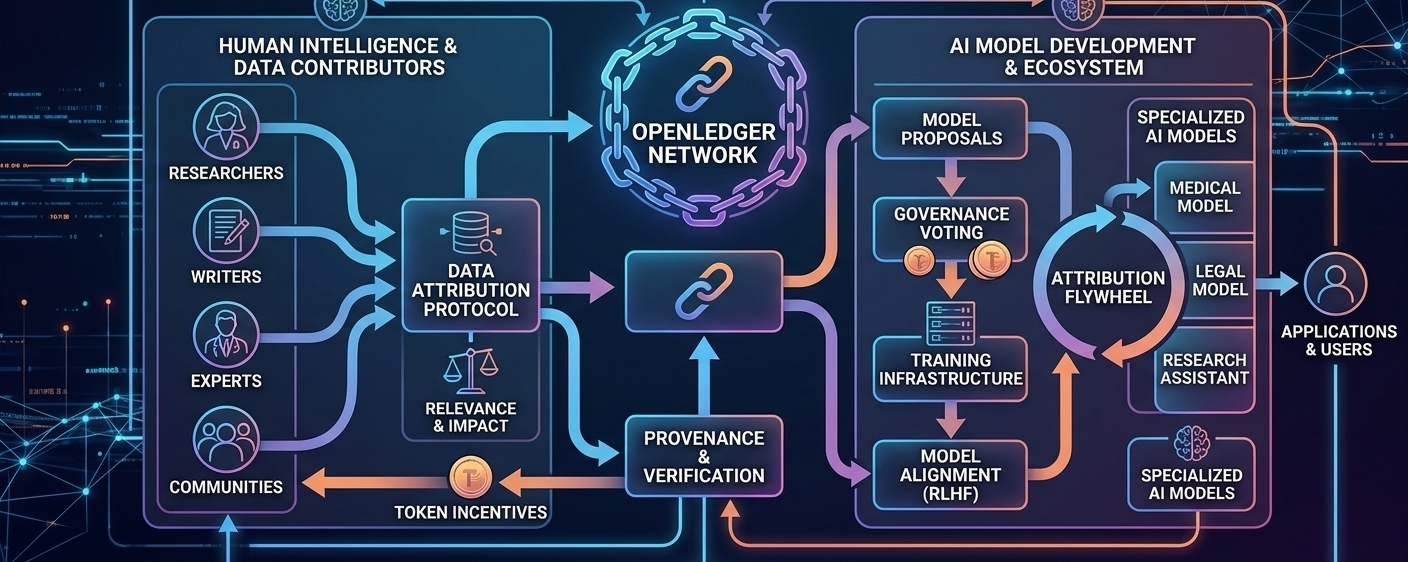
OpenLedger Seems to approach AI less like a closed product and more like an ecosystem where data, models, Governance, and rewards are connected together through attribution.
That word Matters more than people realize.
Most AI discussions today focus on outputs. Better responses. Better automation. Better agents. But OpenLedger appears to focus heavily on the origin layer where data comes from, Who contributes, who validates quality, and how value moves back through the system instead of only upward.
The interesting Part is that the structure tries to make this process transparent Instead of hidden.
From what I studied in the whitepaper, model proposals move through governance Where participants vote using tokens. Data contributors are rewarded based on relevance and impact rather Than simple volume. Human feedback becomes part of model alignment through RLHF systems, and Contributors can earn rewards if their feedback genuinely improves model Behavior.
In simple terms, the system is trying to turn AI Development into something more accountable and collaborative.
That sounds easy when written in a whitepaper. In Reality, it is incredibly difficult.
Because once incentives enter AI systems, Manipulation also enters. Low-quality data floods in. People optimize for rewards instead of usefulness. Governance becomes political. Validators become biased. And measuring “valuable contribution” is far harder than measuring transactions On a blockchain.
I think OpenLedger understands this challenge Better than some projects do. The emphasis on attribution, verifiability, and specialized datasets suggests they Are aware that AI quality is not just about scale anymore. It is about trust.
And trust is Becoming one of the most valuable resources in digital systems.
One thing I found especially interesting is the Idea of specialized models connected to domain-specific data. That feels more realistic to me than chasing One universal intelligence model for everything. Real-world industries usually require context, Nuance, and expert information. A medical model, legal model, or research assistant cannot rely purely on Generalized internet data forever.
That creates a future where smaller but highly Trusted models may become more important than giant generic ones.
If that happens, systems for tracking contribution Suddenly become critical infrastructure.
Another part that stayed in my mind was the flywheel idea between AI and blockchain. Usually, these narratives feel forced together. But here, the relationship At least makes practical sense. Blockchain handles transparency, incentives, and coordination. AI handles utility and intelligence generation. One strengthens The other if adoption grows naturally.
Still, I remain cautious.
I do not think token incentives automatically solve fairness. In fact, they sometimes Create entirely new problems. Wealth concentration can influence governance. Strong contributors May still become overshadowed by larger holders. And decentralized Systems often struggle when idealism meets real economic pressure.
But I also think ignoring these experiments would be shortsighted.
Because the current model of AI ownership Already feels unstable.
A handful of entities controlling the data pipelines, Training infrastructure, feedback loops, And deployment layers may produce efficient systems, but not Necessarily sustainable ones. Especially when creators increasingly realize their information, writing, research, and Behavior are continuously feeding these systems.
That tension is Only going to grow.
What OpenLedger seems to propose is not merely Another AI marketplace. It feels more like an attempt to build economic memory into AI itself a way to Remember who contributed, who improved the system, and who helped shape the intelligence over time.
Whether that Works at scale is still uncertain.
But I think the Direction itself matters.
Because the Next phase of AI may not be defined only by intelligence. It may be defined by legitimacy.
People want systems they can verify. Developers Want transparent infrastructure. Contributors want recognition. Enterprises want trusted datasets. Regulators want accountability. And users increasingly want to know Whether AI systems are built responsibly or simply trained behind closed Doors.
Maybe that is why this conversation feels bigger Than one project.
It touches something fundamental about the Internet we are building now.
Are we creating Systems that only extract value from people, Or systems that can return value back to the people who Make intelligence possible in the first place?
And if AI eventually becomes part of everyday life, Who should actually benefit from that future?
My view is Simple.
The companies With the largest infrastructure?
The people who provide the data?
The validators Who improve model behavior?
Or all of them together?
I do not think The industry has fully answered these questions yet.
But I do think projects like OpenLedger Are forcing the conversation into the open, and that alone makes Them worth watching carefully.
Because Sometimes the most important technologies are not the ones that Grow the fastest.
They are the ones that quietly redefine what fairness Looks like before the rest of the World notices.