
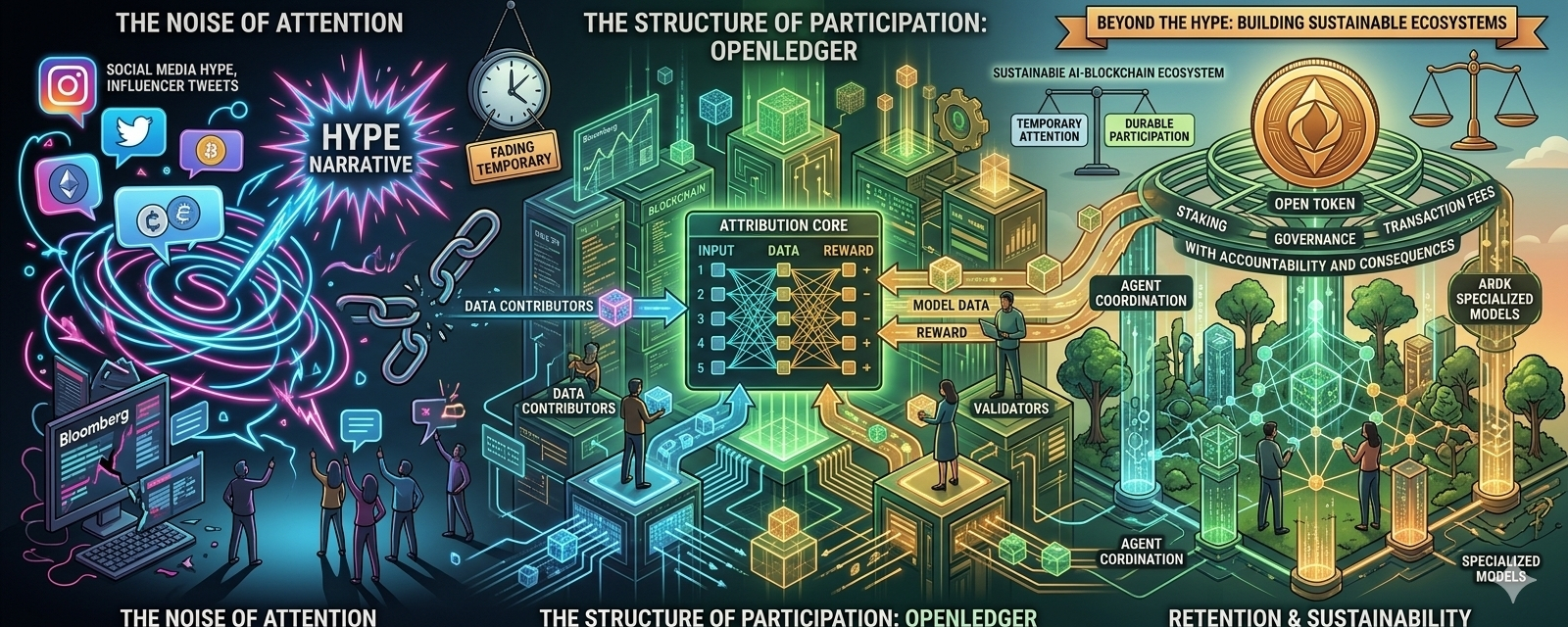
@OpenLedger A few years ago, I probably would have discovered a project like OpenLedger the same way most people discover things in crypto — through noise. A sudden flood of posts, influencers pretending they had “high conviction” after reading two threads, communities repeating the same phrases until they sounded true simply because they were everywhere. Back then, visibility itself felt convincing to me. If everyone was talking about something, I assumed there had to be substance underneath it. Over time though, especially after watching entire narratives explode and disappear within months, the way I look at projects changed completely. I stopped paying attention to how loud a project was and started paying attention to quieter things instead. Who is actually participating? What happens when rewards slow down? Does the ecosystem still function when speculation cools off? Does the token do anything meaningful beyond being traded? Those questions matter more to me now than market excitement ever will.
That is roughly the mindset I was in when I first came across OpenLedger. It was not through some massive launch campaign or dramatic announcement. I kept seeing small mentions from people discussing AI infrastructure in a more technical and grounded way than usual. Not hype-driven conversations, but discussions around data ownership, attribution, coordination, and incentives. The project described itself as an AI blockchain designed to unlock liquidity around data, models, and AI agents, and honestly, at first glance, that kind of description almost pushes me away now. Crypto has attached itself to AI so aggressively that most “AI projects” feel interchangeable after a while. The language starts sounding polished long before the systems themselves are proven. But the deeper I looked into OpenLedger, the more it felt like the project was at least trying to solve an actual structural problem instead of simply borrowing the AI narrative because it is currently fashionable.
The thing that stood out most to me was not the artificial intelligence angle itself. It was the idea of attribution. Most AI systems today depend heavily on enormous amounts of data, yet the people contributing that data usually disappear once the models become valuable. Platforms capture the value, users provide the inputs, and almost nobody inside the process really owns anything meaningful. OpenLedger seems built around the idea that this imbalance eventually becomes unsustainable. Instead of treating data as invisible fuel, the network tries to track how data contributes to model outcomes and then ties rewards back to those contributions. In theory, that creates an ecosystem where participation itself becomes economically visible. That may sound abstract at first, but structurally it is one of the more important ideas inside the project because it changes the role people play in the network. Contributors are not supposed to exist only as temporary users feeding a machine. They become part of the machine’s economy itself.
That distinction matters more than most crypto projects acknowledge. One thing experience teaches you very quickly is that there is a huge difference between holders and participants. Markets constantly blur the two together, but they are not remotely the same thing. Holding a token is passive exposure. Participation is active contribution. OpenLedger only becomes meaningful if people continue building datasets, training models, governing systems, and interacting with applications long after the early excitement fades away. Otherwise, the network risks becoming just another speculative ecosystem where activity exists mainly to sustain market attention rather than create internal value. Crypto has become extremely good at manufacturing temporary engagement. Real ecosystems are much harder to build because they depend on behavior that survives without constant stimulation.
The OPEN token itself becomes interesting only when viewed through that lens. What caught my attention was that the token seems woven into the operational structure of the network rather than floating above it as a purely speculative asset. It functions in staking, governance, transaction fees, incentives, and participation mechanisms tied to AI models and contributors. That does not automatically make it valuable, of course. Plenty of projects force tokens into ecosystems artificially just to justify their existence. But there is an important difference between a token being inserted into activity and a token actually coordinating activity. OpenLedger appears to be aiming for the second category. Contributors, validators, and AI agents interact with systems involving rewards, accountability, and performance-based mechanics. That part matters because incentives without consequences usually create shallow ecosystems very quickly. If everyone gets rewarded regardless of quality, the network eventually fills with low-effort participation designed only to extract value from the system itself. OpenLedger’s focus on attribution and accountability at least suggests an awareness of that problem.
At the same time, this is exactly where caution becomes necessary. Crypto projects often sound strongest during their conceptual phase because concepts are easier to scale than functioning systems. OpenLedger’s entire thesis depends heavily on attribution actually working in practice. That is not a simple challenge. Measuring meaningful contribution inside AI systems becomes incredibly difficult as complexity increases. Specialized models are manageable. Massive generalized intelligence systems become much harder to map cleanly. The project seems aware of this limitation, which honestly makes it feel more grounded than many others in the same category. Instead of pretending to solve every AI problem simultaneously, the ecosystem appears more focused on modular infrastructure, specialized models, and coordinated data participation. That restraint actually gives me more confidence than exaggerated ambition usually does. Mature systems tend to grow outward from something functional. Weak systems often start by promising universality before proving durability anywhere.
Another thing I kept thinking about while studying OpenLedger was how much crypto still struggles with the difference between narrative and usage. Narrative attracts people quickly. Usage keeps them there. Those are entirely different forces. A project can dominate social media for months and still collapse the moment rewards dry up because nobody was truly using the system for anything meaningful. That is why retention matters so much to me now. Retention reveals truth eventually. If contributors continue showing up after the speculative phase cools down, something real may exist underneath the surface. If activity disappears alongside incentives, then most of the ecosystem was probably artificial from the beginning. OpenLedger will eventually face that exact test like every serious crypto project does.
What gives me some level of cautious respect toward the project is that it seems more interested in coordination than performance theater. The ecosystem is trying to build relationships between datasets, models, AI applications, governance, and contributors in a way where participation can theoretically sustain itself internally. That is much harder than attracting temporary attention. Attention is rented in crypto. Utility has to be earned repeatedly. And honestly, after being in this space long enough, I trust projects that focus on infrastructure problems far more than projects obsessed with branding themselves as revolutions.
Still, none of this guarantees success. Good ideas fail all the time in crypto. Sometimes markets move too quickly. Sometimes infrastructure arrives before demand exists. Sometimes systems become too complicated for normal users to care about. OpenLedger still has to prove that contributors stay engaged over time, that attribution remains meaningful at scale, and that the network can create real internal value without depending entirely on speculation to maintain momentum. Those are difficult challenges, but they are the right challenges to be solving.
In the end, I think the real test for OpenLedger will not happen during the loud phase while AI remains the dominant narrative across markets. The real test comes later, when the excitement settles down, timelines move on to the next obsession, and participation becomes a choice instead of a trend. That is usually when the truth about a crypto project finally becomes visible. Real ecosystems continue functioning quietly after attention fades. Artificial ones slowly empty out once nobody is watching anymore. And after years of seeing both outcomes play out again and again, that is the only signal that truly holds my attention now.