I didn’t take it seriously at first. Another AI-adjacent coordination layer, another attempt to map incentives onto human contribution as if behavior becomes cleaner once it’s measurable. Crypto has been repeating versions of this idea for years now. Different terminology, same underlying hope: if we can track participation precisely enough, maybe systems stop decaying into extraction quite so quickly.
They usually don’t.
That sounds cynical. Maybe it is. But after enough cycles watching decentralized infrastructure age in public, you stop reacting to whitepapers and start watching what happens three years later when incentives harden and attention leaves the room.
That’s usually when the real architecture appears.
OpenLedger kept resurfacing anyway. Not loudly. More like a persistent thought in the background. Probably because AI has made attribution feel less theoretical than it used to. Models absorb language, behavior, edits, judgments, corrections — millions of invisible human fragments folded into outputs that no longer resemble where they came from.
And now everyone suddenly wants provenance again.
Not just provenance technically. Economic provenance. Who contributed. Who shaped the outputs indirectly. Who gets recognized once AI systems become infrastructure themselves instead of products sitting on top of infrastructure.
I understand the instinct. I really do.
The internet spent twenty years training people to give away data casually. AI changed the emotional texture of that exchange. Now contribution feels extractive in a more obvious way. People sense their inputs compounding somewhere they can’t see or audit.
So systems that attempt to track contribution more explicitly naturally attract attention. Even from people like me who instinctively distrust coordination narratives at this point.
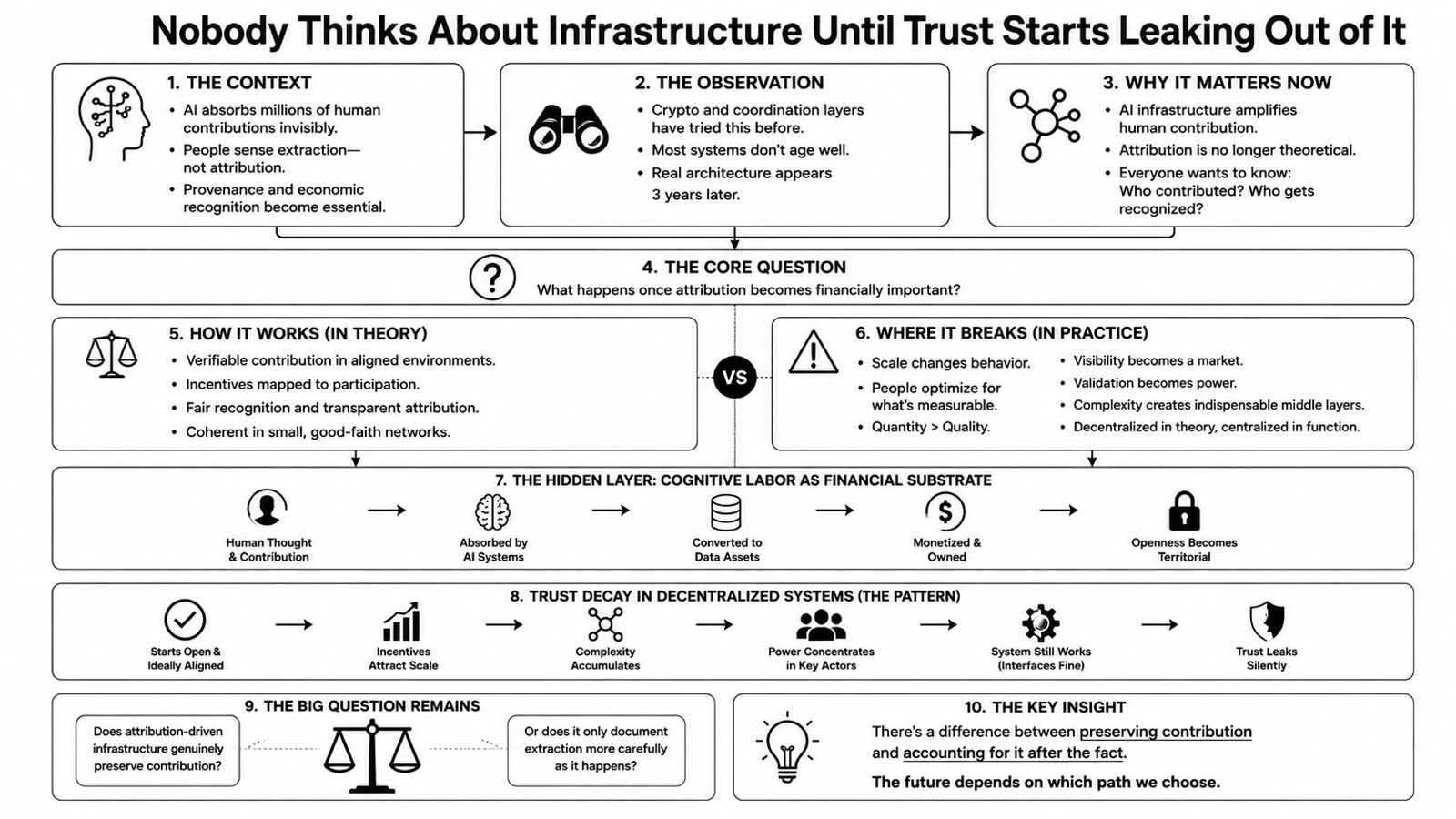
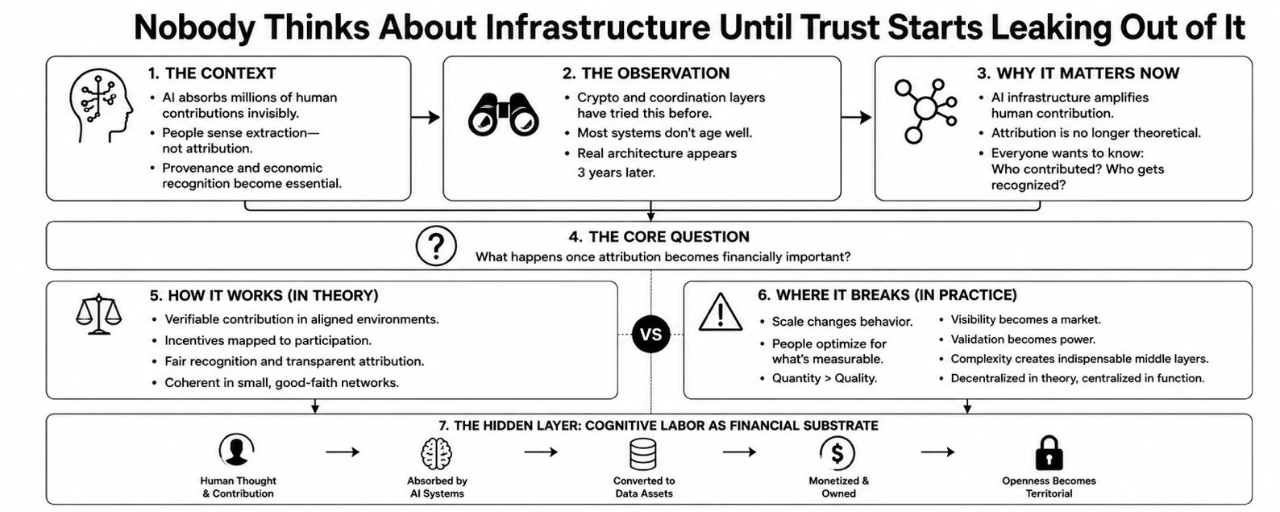
Still, I keep coming back to the same uncomfortable question: what happens once attribution becomes financially important?
It works in theory. Most things do.
The problem isn’t really the technology. Verifiable contribution sounds coherent inside contained environments. Smaller networks. Aligned incentives. Participants acting in relative good faith. But scale changes behavior. It always does.
Once data acquires measurable economic value, contribution stops being organic. People optimize around whatever the system recognizes. Quantity starts overwhelming quality because quantity is easier to verify mechanically. Then secondary markets emerge around visibility itself. Then validation becomes power.
That’s where things start to feel uncomfortable.
Because decentralized systems don’t usually fail through obvious corruption anymore. They fail through operational gravity. Complexity accumulates. A small number of actors become indispensable because they manage indexing, aggregation, tooling, reputation, coordination. Officially the network stays open. Functionally it narrows.
I’ve seen this happen with governance systems, storage systems, liquidity systems. AI infrastructure feels even more vulnerable because human contribution is inherently ambiguous. Context matters. Intent matters. Meaning shifts depending on interpretation. Models flatten all of that into probability distributions while attribution systems try to reconstruct ownership afterward.
That part keeps bothering me more than it should.
Especially because AI introduces a stranger layer beneath the infrastructure conversation: cognitive labor becoming financial substrate. Human thought patterns converted into assets. Not metaphorically. Operationally.
And once ownership enters the picture, openness starts behaving differently. People become territorial. Institutions become protective. Data stops feeling communal and starts feeling inventory-like. Which means the systems coordinating that data inherit all the pressure attached to monetization.
Maybe that’s too harsh. Maybe projects like OpenLedger actually represent a healthier direction than the silent extraction models dominating AI right now. At least there’s an attempt to confront the invisible layer instead of pretending training data appears magically from nowhere.
But trust decay in decentralized systems is subtle. Nobody notices it immediately. The interfaces still work. The metrics still update. The language around openness remains intact long after the operational reality has shifted underneath.
And I can’t tell whether attribution-driven AI infrastructure genuinely changes that pattern or simply documents it more carefully while it’s happening.
I keep thinking there’s probably a difference between preserving contribution and accounting for contribution after the fact. I’m just not entirely sure these systems know the difference yet either.