
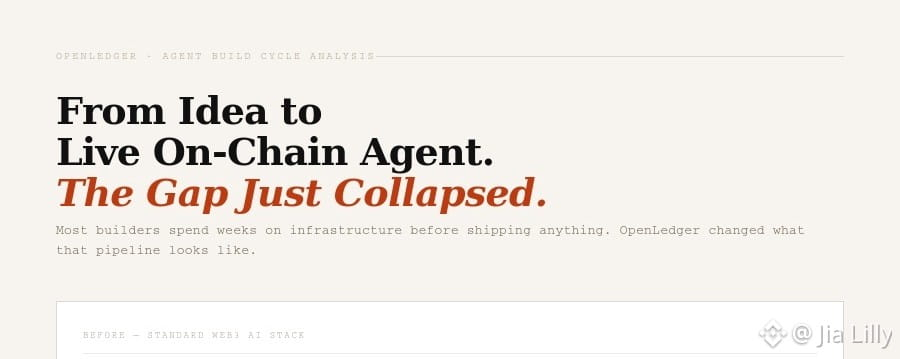

I've been sitting with this for a while now and I think most people are still sleeping on what's actually happening with the build cycle on OpenLedger.
Not the token. Not the price. The build cycle.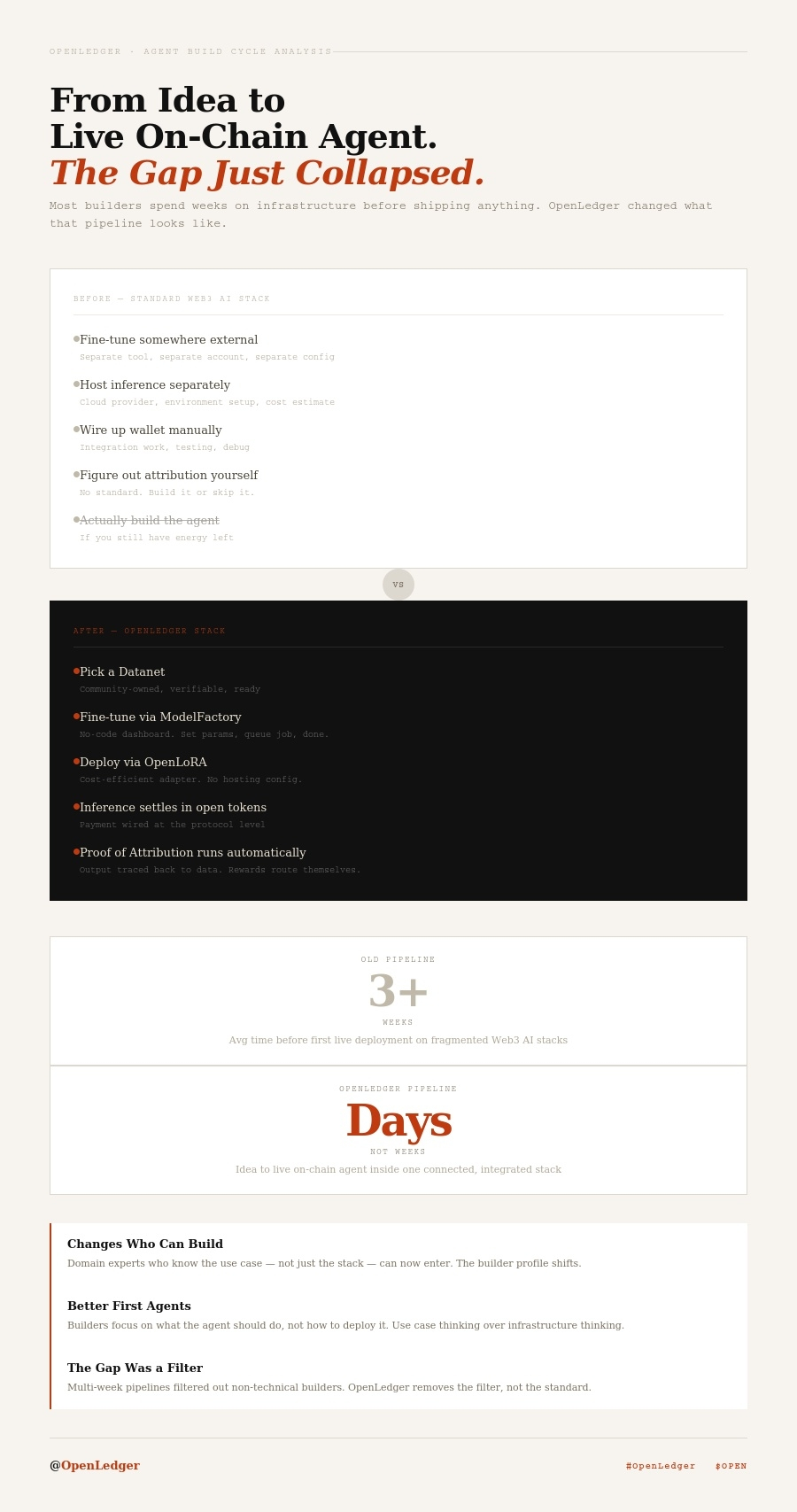
There's this assumption in Web3 AI that getting an agent live is a multi-week thing. You fine-tune somewhere, host it somewhere else, wire up your wallet separately, figure out attribution manually, pray the inference doesn't break. I've watched people spend three weeks on that pipeline for something that should've taken three days. The friction isn't technical incompetence. It's architecture. Most stacks weren't designed to collapse that distance.
OpenLedger is designed specifically to collapse it.
ModelFactory handles fine-tuning without writing a single line. You pick a Datanet, set parameters, queue the job, name the model. OpenLoRA adapters handle cost-efficient deployment. Inference settles in open tokens. Proof of Attribution traces the output back to whoever contributed the data. That's the full cycle. Idea to live on-chain agent, inside one connected stack.
And here's what I keep thinking about. It's not just speed for speed's sake.
Speed at this layer changes who can build. Right now the people building on-chain agents are mostly the people who can absorb a month of infrastructure work before they ship anything. Compress that to days and the builder profile starts changing. Domain experts who actually understand the use case, not just the stack, start entering. A DeFi analyst who's never deployed a model can now fine-tune one on market stress data and push it live. That's a different kind of agent than what dev-first pipelines produce.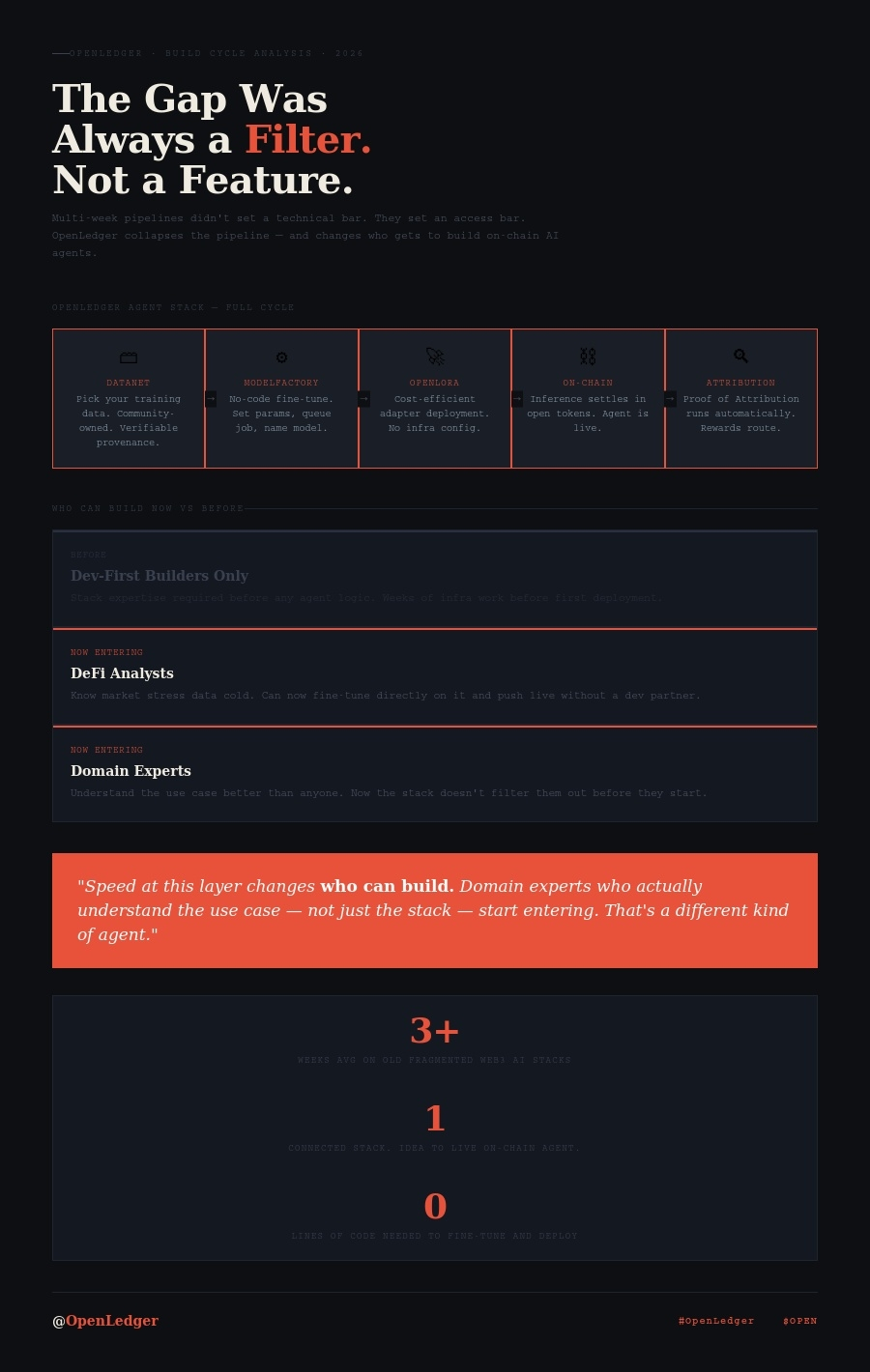
The gap between idea and live wasn't a technical problem. It was a filter. OpenLedger is removing the filter.
That's why the speed matters more than people are treating it right now.
