
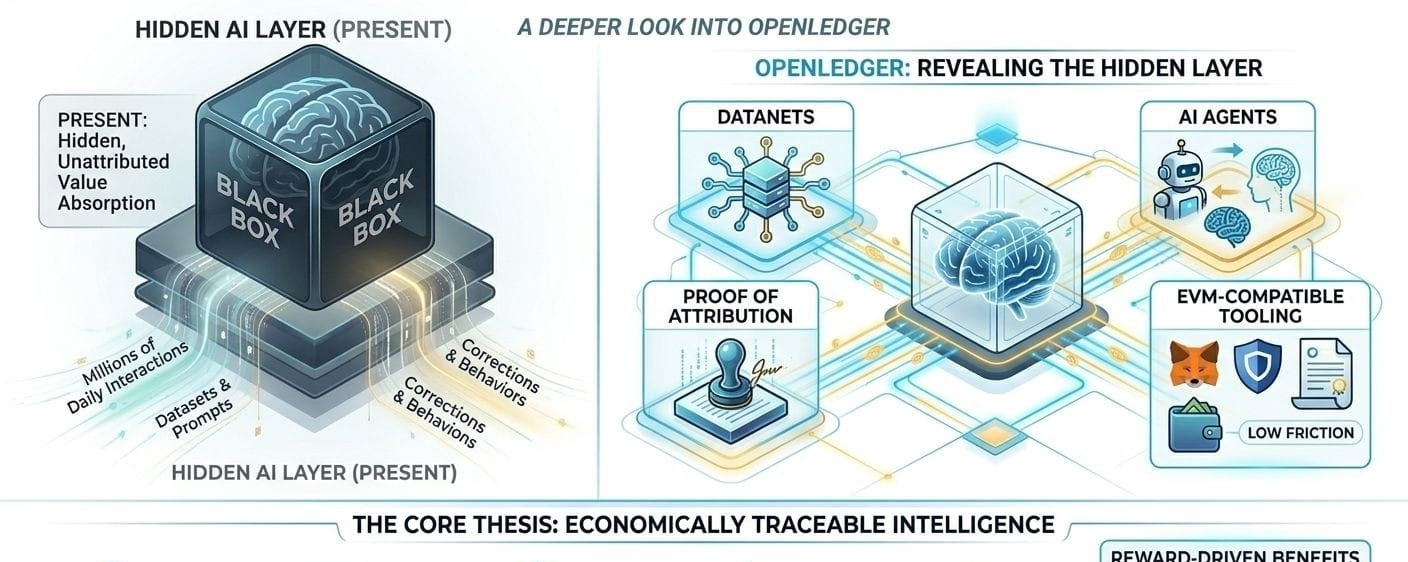
I want to talk about something that's been bothering me for months.
Not token price. Not market cap. Something more structural.
Every major AI breakthrough of the last five years was built on the same foundation human knowledge, human creativity, human labor, accumulated over decades and made freely available on the internet.
Books. Research papers. Code repositories. Forum discussions. Creative writing. Medical literature. Legal analysis. Personal blogs.
All of it scraped, processed and fed into models that now generate billions in revenue.
The people who created that foundation?
They were never asked. They were never paid. Most of them don't even know their work is inside the models that are slowly replacing them.
This isn't a conspiracy. It's not even illegal yet. It's just what happens when an industry moves faster than the economic frameworks designed to govern it.
But here's the crack in the foundation.
AI is no longer just a consumer product.
It's moving into healthcare. Finance. Legal services. Insurance. Infrastructure. Defense.
In these industries, "we don't know where our training data came from" is not an acceptable answer. It's a liability.
Imagine a medical AI that recommends a treatment protocol. It's wrong. A patient is harmed. The hospital asks: what data influenced this recommendation? Who contributed it? Was it verified? Was it biased?
If nobody can answer those questions if the entire contribution chain is invisible then accountability becomes impossible. Impossible accountability means unbounded legal exposure.
This is the crack.
AI built its intelligence on an invisible foundation. As long as AI stayed in the consumer entertainment space, invisibility was fine. The moment AI entered regulated industries which is happening right now, faster than most people realize invisibility became a structural problem.
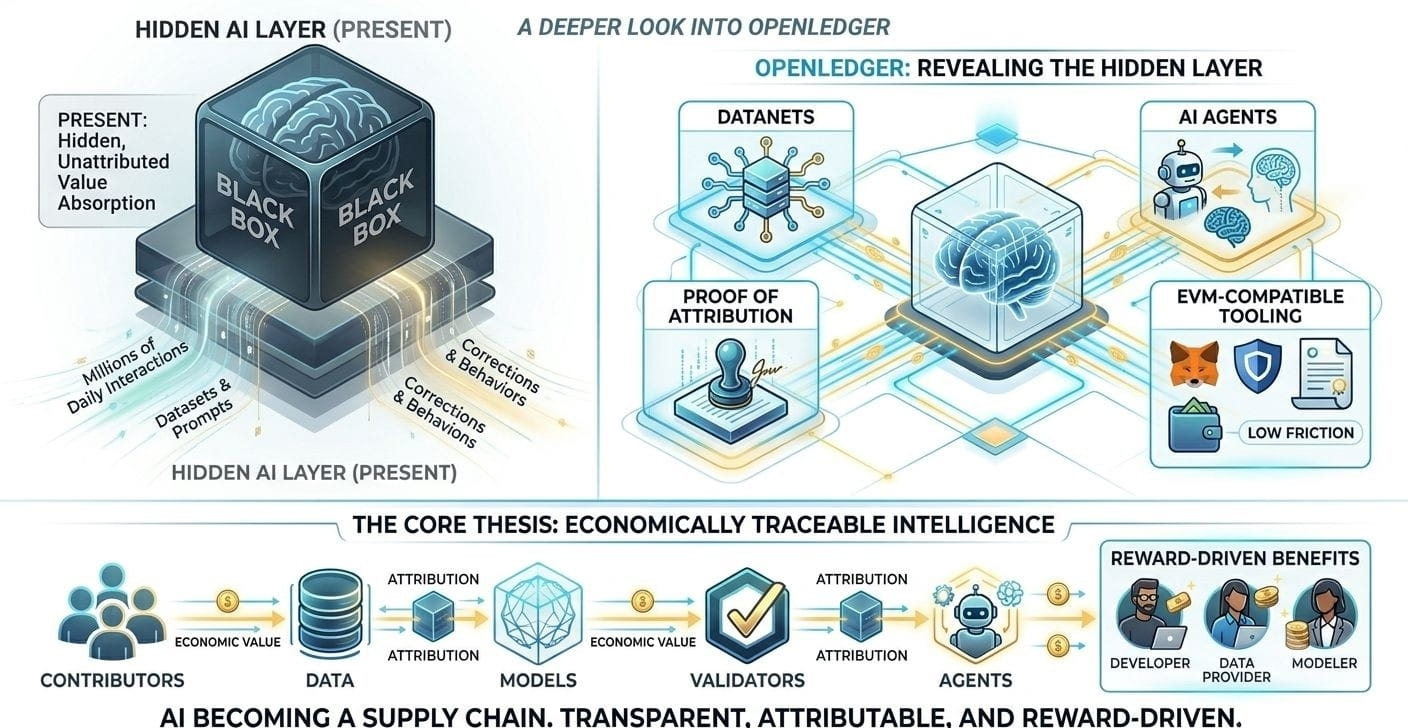
This is where OpenLedger becomes interesting in a way most "AI blockchain" projects don't.
Most AI crypto projects are solving for speed. More compute. Faster inference. Cheaper deployment.
OpenLedger is solving for something harder.
Provenance.
Proof of Attribution doesn't just track who contributed data. It creates a cryptographic record of how that data influenced model outputs. Every dataset. Every training step. Every inference. Recorded on-chain and traceable.
That sounds technical. The implications are anything but.
It means for the first time, the invisible foundation of AI becomes visible. Auditable. Accountable.
And because it's on-chain — because the record exists independent of any single company's database it can't be quietly edited when inconvenient.
Now let me be honest about what's hard.
Measuring data influence at scale is genuinely difficult. Modern AI models don't maintain neat ingredient lists. They absorb patterns probabilistically across billions of parameters. Determining exactly which data contributed to which output at the scale of frontier models is an unsolved technical problem.
OpenLedger's current implementation works best with specialized, smaller models. How it scales to larger systems is still an open question.
There's also the adoption challenge. Enterprises are conservative. They don't adopt new infrastructure because the thesis is elegant. They adopt it when the pain of not adopting becomes greater than the friction of changing.
That tipping point hasn't arrived yet.
But it's coming.
The New York Times lawsuit against OpenAI. Getty Images versus Stability AI. The EU AI Act's transparency requirements. Pending legislation across multiple jurisdictions demanding AI companies disclose training data provenance.
The legal and regulatory pressure on AI's invisible foundation is building simultaneously in courts, parliaments, and boardrooms across the world.
OpenLedger isn't building for a hypothetical future.

It's building for a present that's arriving faster than most people expect.
Here's the question I keep sitting with.
Every major technology transition eventually produces infrastructure that nobody noticed building until it was everywhere.
TCP/IP. SSL certificates. SWIFT. The cloud's underlying settlement rails.
None of these were exciting when they were being built. They were boring. Technical. Hard to explain at dinner parties.
But they became the invisible architecture that everything else ran on.
AI needs that architecture for attribution and provenance. Right now, it doesn't exist at scale.
OpenLedger is one of the few projects seriously attempting to build it.
Whether it succeeds depends on technical execution, enterprise adoption, regulatory timing, and a dozen other variables that nobody can fully predict.
What I do know is this.
The crack in AI's foundation is real. It's getting wider. And the industry that figures out how to fill it how to make AI's invisible foundation visible, auditable, and economically fair will be building infrastructure that lasts for decades.
That's either the most important bet in this cycle.
Or an elegant idea that arrives too early to matter.
I honestly don't know which one yet.
But I know the crack is there.
I know most people haven't looked down to see it.
Do you think AI's data problem gets solved by regulation, by infrastructure, or does it never really get solved at all?