
I want to start with something most people in this space treat as background noise but that I think is actually the most important unsolved problem in artificial intelligence right now.
Every major AI model that exists today was trained on human created data. Writers, researchers, developers, artists, domain experts who shared their knowledge online over decades. None of them were asked. None of them were compensated. The models learned from their work, generated billions in commercial value, and the people whose contributions made that possible received nothing in return.
I am not framing this as a moral argument. I am framing it as a structural problem with a predictable consequence. When contributors receive no value from systems that use their work, they eventually stop contributing openly. Research communities are already restricting access. Writers are pulling content. Developers are adding blocks against AI scraping. The pipeline that fed the first generation of large models is slowly closing, and nobody in the industry is talking seriously about what comes after.
OpenLedger's answer is that this cannot be solved at the policy level. Policies get lobbied away. Protocol mechanics do not. The Proof of Attribution system is their attempt to embed compensation directly into the infrastructure of AI, and honestly it is the part of this project I have spent the most time sitting with.
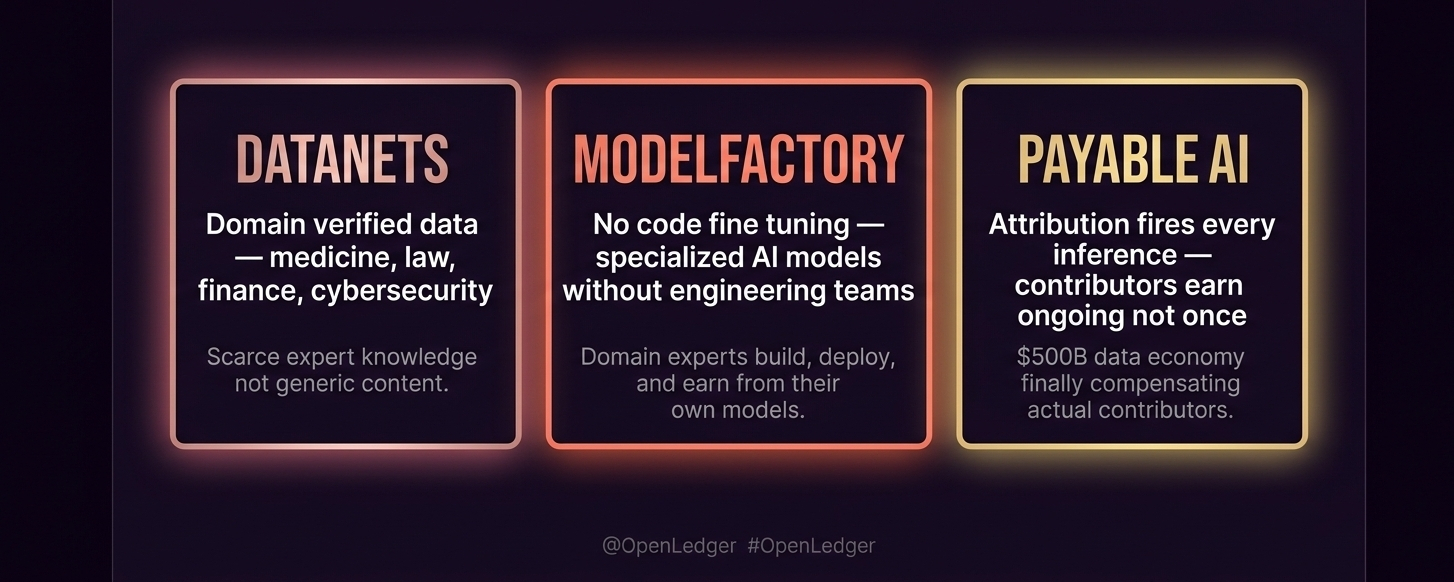
Here is what it actually does. Every time an AI model on the @OpenLedger network generates an output, the system traces the lineage of that output back through the model to the specific datasets that influenced it. It records that attribution on-chain as a permanent event and automatically distributes $OPEN tokens to contributors whose data had verified influence on that specific output. This happens at the inference level. Every single model call. Not a monthly settlement, not a governance decision. Automatic and verifiable every time.
The technical specificity is what pulled me away from the price chart and toward the actual protocol documentation. The June 2025 whitepaper describes two distinct approaches depending on model size. For smaller models, influence function approximations mathematically estimate how much each training data point contributed to a specific output. For large language models, suffix array based token attribution checks output tokens against compressed training data to detect memorized content spans. These are different engineering problems requiring different solutions. Treating them separately rather than describing a single universal mechanism tells me this was designed by people who have actually worked with AI systems at scale, not people writing around a concept they do not fully understand.
Datanets are where contributors actually enter this ecosystem. Rather than a generic data marketplace, OpenLedger created domain specific networks medicine, law, finance, cybersecurity where contributors upload verified expert datasets relevant to their field. The domain specificity matters enormously. General purpose data is abundant and cheap. Verified clinical reasoning data from practicing physicians, precise legal analysis from working attorneys that category of data is scarce and genuinely valuable for training specialized language models. A physician who contributes clinical notes to a medical Datanet earns OPEN every time a model trained on those notes runs an inference, not once when they uploaded the file. That ongoing revenue stream changes the incentive for contributing entirely.
ModelFactory completes the loop on the production side. It is a no-code fine-tuning tool that lets domain experts build specialized language models without an engineering team. A medical institution could upload clinical datasets, fine-tune a clinical reasoning model through ModelFactory, deploy it on the network, and earn inference fees every time the model gets queried. The data contributor earns from attribution. The model builder earns from inference fees. Both payments move through the same protocol. OpenLoRA reduces the deployment cost of these specialized models by up to 99 percent compared to standard approaches.
The Story Protocol partnership from January 2026 added a legal layer to the technical one, establishing a standard for licensing creative works for AI training with automated payments to rights holders on-chain. When I read this alongside the January 2026 attribution engine upgrade which specifically addressed keeping data-output links intact as models are fine-tuned the picture that emerges is of a team building not just a system but an entire economic and legal infrastructure for AI data.
Whether that infrastructure becomes necessary depends on how AI regulation develops. The EU AI Act, ongoing lawsuits around training data, and emerging data rights frameworks are all still in motion. OpenLedger is building for a regulatory future that has not fully arrived. That is simultaneously a risk and an opportunity and I hold both honestly.
Now I have to argue against my own reading because I think that is the only genuinely useful thing I can offer here.
The first counterargument is computational. Attribution at inference level adds overhead to every model call. As the network grows that overhead grows with it. The whitepaper acknowledges the tradeoff between accuracy and processing speed but does not fully resolve what happens under high throughput conditions at real scale. This is a genuine engineering concern that has not yet been stress tested in production with meaningful volume.
The second counterargument is about incentive quality. The attribution system is only as valuable as the quality of data being attributed. There is a natural pull for contributors to upload large volumes regardless of quality because more contributions mean more potential rewards. Without aggressive curation this creates a noise problem where low quality contributions dilute the reward pool and reduce the signal value of the entire dataset. OpenLedger mentions quality controls in its documentation but whether those controls hold across dozens of specialized Datanets over time is something only sustained real usage will reveal.
The signals I would track from here are specific. First the attribution engine update logs, because what gets fixed in production reveals where the actual problems are. Second inference call volume independent of active incentive campaigns, because that is the cleanest measure of whether the system is being used for real work. Third enterprise adoption in sectors where data provenance has regulatory relevance such as legal AI and medical diagnostics, because those use cases represent structural demand not speculative interest. And fourth whether any significant model developer publicly credits OpenLedger Datanets as part of their training pipeline, because that external validation would be the strongest signal that the attribution infrastructure is working as designed.
The problem Proof of Attribution is trying to solve is real. The technical approach is more serious than most things I have seen at this stage. Whether it works at scale is what I am still patiently watching for.