Wait, so... 🤔
It was 1999 Cricket World Cup... South Africa needed one run off the final ball to tie the semifinal, and they got it... But they were still eliminated... because nobody on the field truly understood how the Duckworth-Lewis calculation worked at that exact moment..... A whole team lost not because they played badly, but because the system governing them was invisible. That image stayed with me when I started looking at OPEN. Because that is exactly what is happening with AI right now. Billions of decisions being shaped by models that most people cannot read, question, or challenge.... OPEN says it wants to change that... I decided to take it seriously enough to actually dig in. 👀
The claim that sits at the center of this project is worth stating plainly. The idea is that AI systems should not just be powerful. They should be "auditable." Anyone interacting with an AI model should be able to trace, at least in principle, why a particular output was generated. That sounds obvious when you say it out loud... But in the current landscape of closed-weight models and proprietary pipelines, it is almost nowhere to be found. Most projects in this space talk about AI and blockchain in the same breath and produce nothing but "white paper fog." What made me slow down with OPEN is that the question it is asking feels genuinely difficult. Not difficult in a vague, markety way... Difficult in the way that real infrastructure problems are difficult. 🔍
Here is the thing I kept returning to. Transparency in AI is not a toggle... You do not just flip a switch and suddenly a model becomes explainable. The research community has been wrestling with interpretability for years, and the honest answer from people doing that work is that we still do not fully understand why large language models produce the outputs they do. So when a project positions itself as a "transparency layer" for AI, the first question I have is not about tokenomics. It is whether the technical architecture actually addresses this problem or simply frames it in blockchain language and calls it solved. 😬
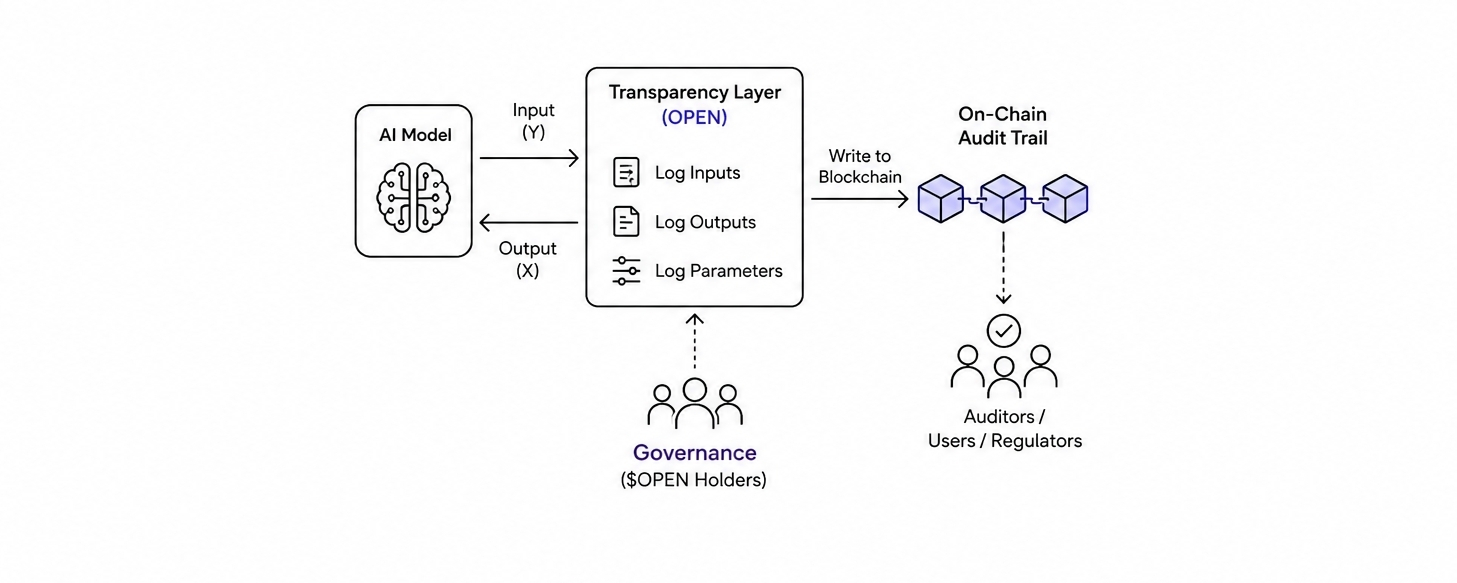
From what I could evaluate, OPEN is building in the direction of "on-chain accountability" for model behavior. The angle here is that if you log model inputs, outputs, and decision parameters on a verifiable ledger, you at least create a foundation for auditability. That is not the same as full interpretability... and I think it is important not to confuse the two. Knowing that a model said X given input Y is recorded on chain does not automatically tell you "why" the model said X. But it does mean X cannot be quietly changed or denied afterward... And in certain contexts, that distinction matters enormously. 💡
I want to be careful here because this is where a lot of people either oversell or dismiss too quickly. The "oversell" version says OPEN solves the black box problem. Nah, I do not think that is accurate... and I would be skeptical of anyone who claims it is. The "dismiss" version says on-chain logging is trivial and adds no real value. That also seems wrong to me. There is a meaningful middle ground where creating an immutable record of AI behavior starts to build the kind of accountability infrastructure that regulators, enterprises, and eventually ordinary users will need. It is a foundational layer... not a finished product. 🧱
What I found genuinely interesting is the governance angle. If token holders have a say in how the transparency standards evolve, then you have a mechanism where the people most affected by AI outputs have some structural input into how those outputs are evaluated. That is a legit idea... Whether it functions in practice depends entirely on how participation is distributed and whether governance devolves into whales making decisions while retail just watches. That question I cannot answer from the outside... and I think anyone who tells you they can is straight up guessing. 🐋
The part that deserves honest scrutiny is adoption. A transparency protocol is only as meaningful as the AI systems that integrate with it. Right now, the major frontier labs have little incentive to plug into external accountability layers... Their competitive advantage lives partly in opacity. So the near-term use case for OPEN is probably not "GPT-5 logging its reasoning on chain." It is more likely smaller model deployments, enterprise use cases with compliance requirements, and DeFi applications where AI is being used to execute financial logic. That is a real market... It is just a different one than the headline framing might suggest. 📊
I have been in this space long enough to know that the gap between a compelling problem statement and a working protocol is where most projects quietly disappear... The question I am sitting with is not whether AI transparency matters. It obviously does. The question is whether the incentive structure, the technical design, and the timing are aligned well enough for this specific project to survive the distance between "idea" and "adoption." I do not have a clean answer... But the question itself is serious enough that I think dismissing OPEN as another narrative play would be the lazy take. Sometimes a project earns a second look not because the outcome is certain, but because the problem it is pointed at is real. 🎯
South Africa didn't lose in 1999 because they weren't good enough... They lost because the system deciding their fate wasn't "legible" to them. That's not just a cricket story. That's increasingly the story of how AI shapes outcomes for people who never get to see the logic. Whether OPEN actually changes that is still an open question... But it's asking the right one.✊