
The narrative surrounding Artificial Intelligence (AI) in crypto has exploded over the past year, but most projects suffer from the same fundamental flaw: they are simply repackaging cloud compute. Renting out GPUs is a commodity business. The true bottleneck for the future of decentralized AI isn't just hardware—it’s verifiable data, model attribution, and decentralized coordination.
This is exactly where @OpenLedger is positioning itself as a foundational layer, moving beyond generic narratives to build concrete infrastructure for what they call the Intelligence Economy. With the $OPEN token fueling this ecosystem, the project introduces a highly technical yet deeply necessary framework for decentralized AI development.

🧠 The Core Innovation: Proof of Attribution & Data Ownership
In the traditional AI landscape, tech giants scrape public and private data to train massive Large Language Models (LLMs). The creators of that data receive zero compensation, and users have no way of knowing how a model reached a specific output.
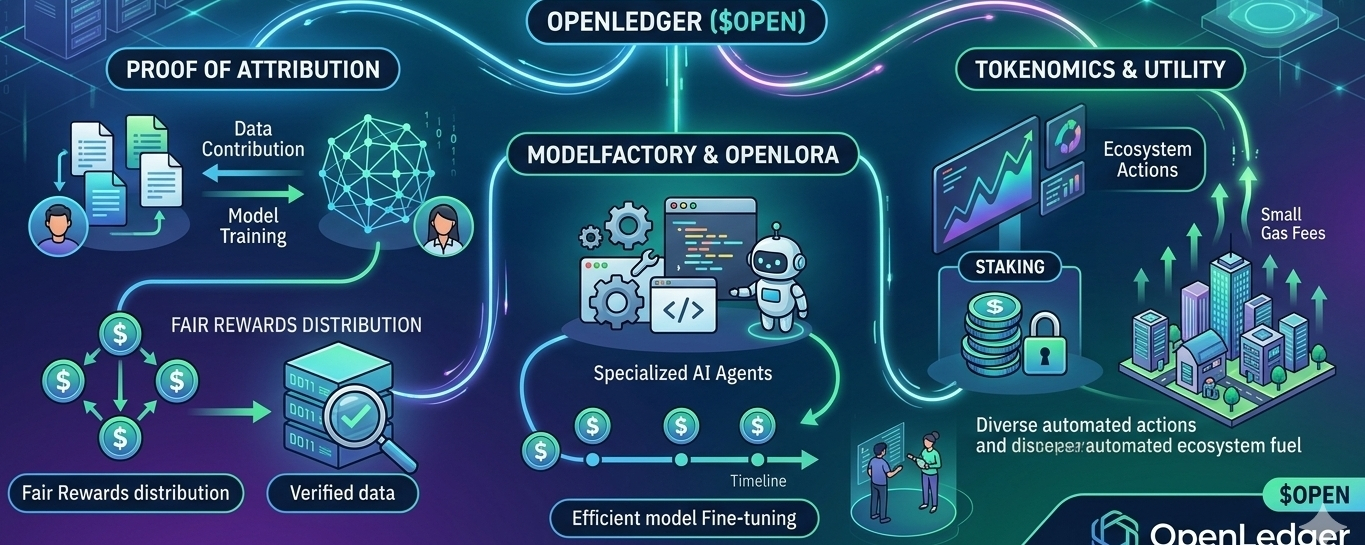
OpenLedger solves this through Proof of Attribution. This protocol-level mechanism creates a transparent ledger for data contribution:
Fair Monetization: When you contribute high-quality data or compute resources to the network, the protocol tracks exactly how much your input influenced an AI model's training or fine-tuning.
Verifiable Outputs: Users can trace the provenance of data, ensuring that AI agents are operating on untampered, high-fidelity information sets.
Data Sovereignty: It shifts control back to data creators, establishing a marketplace where data is treated as an intellectual property asset rather than free cargo for corporate scraping.
🛠️ Unleashing Developers with ModelFactory & OpenLoRA
Building and fine-tuning an LLM from scratch is prohibitively expensive for independent development teams. OpenLedger lowers this barrier to entry dramatically through its decentralized developer tooling suite:
ModelFactory: A streamlined on-chain environment that allows developers to host, deploy, and manage AI models natively within a Web3 ecosystem.
OpenLoRA (Low-Rank Adaptation): This framework allows for the efficient fine-tuning of massive models without needing to retrain billions of parameters. Developers can inject specific datasets into base models, creating specialized, hyper-efficient AI agents for DeFi tracking, smart contract auditing, or automated trading at a fraction of the traditional cost.
By bridging these tools on-chain, @OpenLedger enables the creation of autonomous AI agents that can interact with smart contracts, manage specialized tasks, and settle microtransactions natively.
📊 Tokenomics: What Powers the $OPEN Utility?
An infrastructure project is only as strong as its underlying token utility. Within the OpenLedger network, $OPEN acts as the core economic fuel required to sustain operations:
Gas & Transaction Fees: Every on-chain data verification request, model fine-tuning process, or AI agent interaction requires gas fees settled in $OPEN.
Staking for AI Agents: To prevent malicious behavior and ensure network uptime, developers and node operators must stake OPEN tokens to run active AI agents or validation infrastructure.
Incentive Alignment: High-performing data providers, data validators, and compute contributors are rewarded directly in $OPEN, creating a self-sustaining loop of value generation.
📈 Looking Forward: The Long-Term Play
As the Web3 AI sector matures, speculative hype will inevitably give way to structural utility. Projects that focus purely on marketing will fade, while protocols building deep data layers and developer toolkits will become the backbone of decentralized intelligence.
With its focus on verifiable data models, developer flexibility, and a robust economic model, OpenLedger is tackling the structural problems that hold back true Web3 AI integration. Keeping a close eye on the development milestones of @OpenLedger and the liquidity framework of OPEN could be highly rewarding for those tracking the intersection of blockchain and the intelligence revolution.
What's your take on the decentralized AI narrative? Are you tracking infrastructure plays like OPEN, or focusing purely on consumer AI applications? Let's discuss in the comments below! 👇