


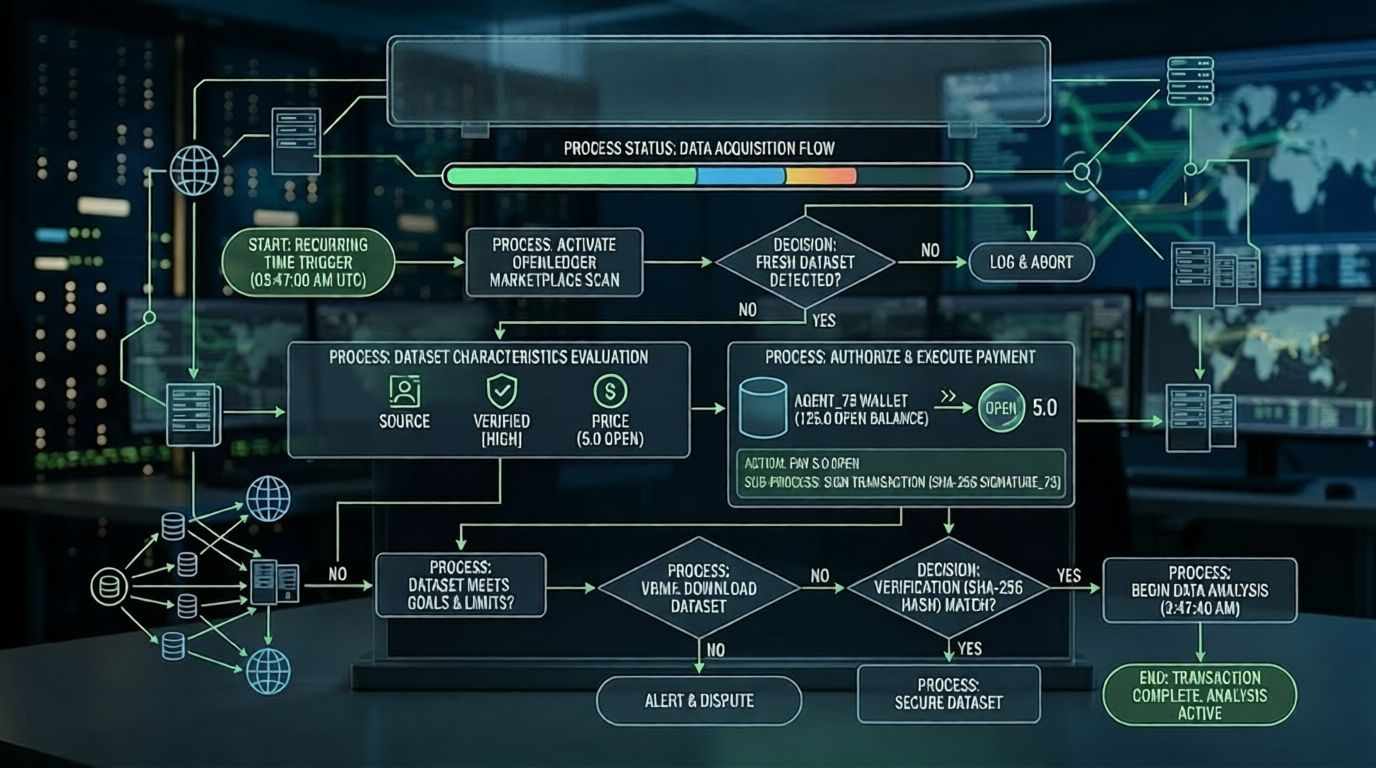
An AI agent wakes up at 3:47 AM...
Not because someone pressed a button.. Because its code says to check data prices every four hours. The agent scans @OpenLedger data marketplace. Finds a fresh dataset that just appeared. Verified. High quality. Reasonable price.
The agent does not call a human for approval. Does not send an email. Does not wait for morning. It authorizes a payment from its own wallet. Completes the purchase. Downloads the data. Begins analysis.
No human involved in the entire transaction.
This is not science fiction. This is how OpenLedger enables autonomous agent economies.
Let me explain what an agent actually is in this context.
An autonomous agent is software that acts on behalf of a user or organization without continuous human direction. It observes conditions. Makes decisions. Executes actions. Reports results. A simple agent might monitor a price and send alerts. A complex agent might manage an entire supply chain, negotiating with multiple counterparties simultaneously.
The difference between a bot and an agent matters. A bot follows fixed rules. If X happens, do Y. No flexibility. No learning. No adaptation. An agent operates with goals, not just rules. It chooses how to achieve outcomes. It learns from results. It changes strategies when circumstances shift.
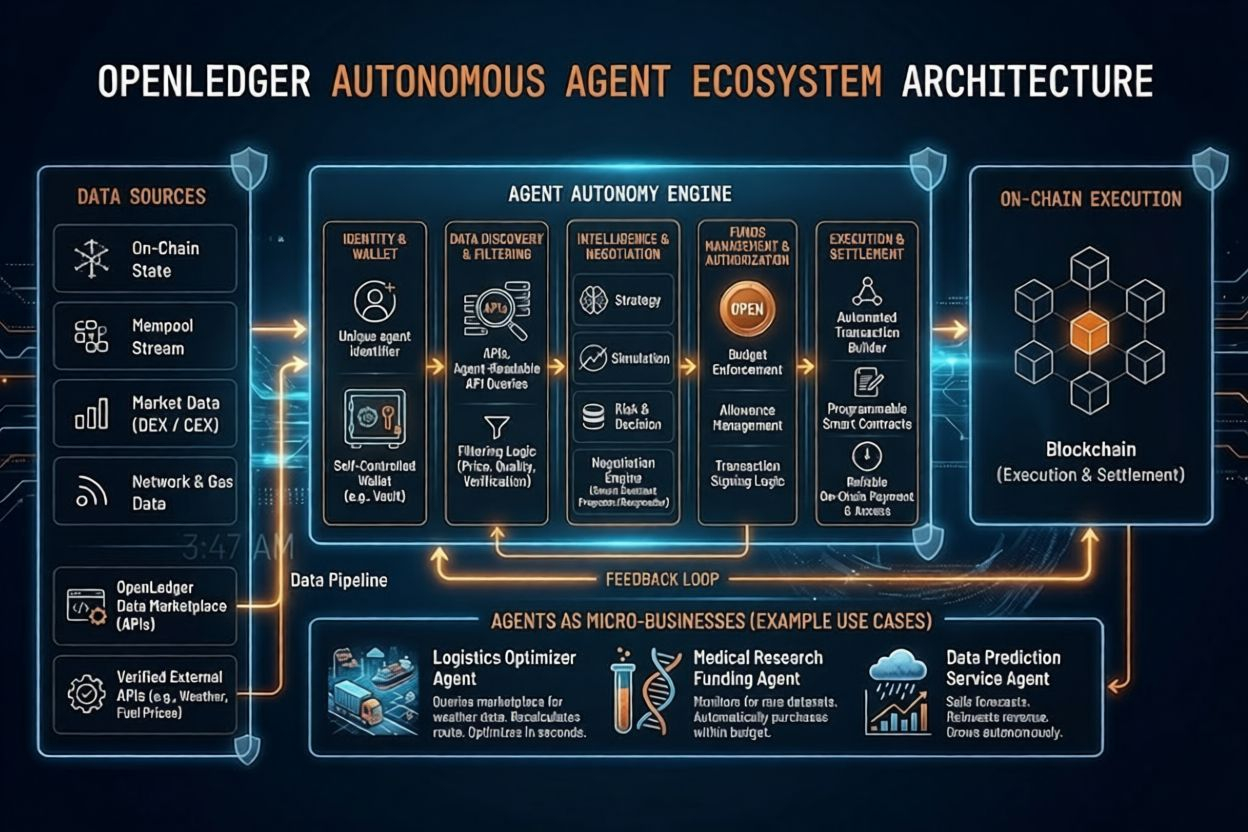
OpenLedger provides the infrastructure agents need to transact.
The first requirement is identity. An agent needs a recognized presence on the blockchain. OpenLedger assigns each registered agent a unique identifier. Not a wallet controlled by a human clicking buttons. A wallet controlled by the agent's own logic. The agent holds its own keys. Signs its own transactions. Manages its own funds.
This is a radical shift from normal blockchain usage. Today, most transactions come from humans using wallets. OpenLedger flips this. Agents become first-class participants, not second-class afterthoughts.
The second requirement is funds. An agent with empty wallets cannot buy anything. Users or organizations fund agent wallets with OPEN tokens. The agent then spends within programmed limits. Some agents receive recurring allowances. Others hold a balance that depletes with each purchase. Others earn revenue by selling services and replenish their own wallets.
The funding model determines what agents can do. A well-funded agent operates freely. A restricted agent focuses on low-cost activities. Designers choose based on use case.
The third requirement is discovery. An agent cannot buy data if it cannot find data. OpenLedger's marketplace includes agent-readable APIs. Agents query available assets. Filter by price, quality, verification status, and other metadata. Compare options across multiple sellers. Select the best fit without human browsing.
This discovery layer turns OpenLedger from a human marketplace into an agent marketplace. Humans can still participate. But agents do not need humans to find value.
The fourth requirement is negotiation. Simple purchases need fixed prices. Complex transactions need negotiation. An agent might want a volume discount for buying ten datasets. Or a time-limited exclusive license. Or a service agreement where payment depends on results.
OpenLedger supports programmable negotiation through smart contracts. Agents propose terms. Counterparties accept, reject, or counteroffer. All without human intervention. The contract executes when both sides agree.
The fifth requirement is execution. Once terms are set, the transaction must complete reliably. OpenLedger's smart contracts handle payment, access, and verification automatically. The agent sends OPEN tokens. The contract releases the purchased asset. The blockchain records everything. No disputes. No delays. No human paperwork.
Consider a real example.
A logistics company deploys hundreds of agents to optimize shipping routes. Each agent monitors weather data, fuel prices, and port conditions. An agent notices a storm approaching a major port. It predicts delays. Immediately queries OpenLedger for alternative route data. Finds a dataset from a local logistics provider. Pays 5 OPEN tokens. Downloads the data. Recalculates routes. Implements changes.
All within seconds. All without a human staring at a screen.
The company saves thousands of dollars because agents reacted faster than any human could.
Now consider a different example.
A research institution trains AI models on rare medical datasets. They need continuous data feeds, not one-time purchases. They deploy agents that monitor OpenLedger for new relevant datasets. Each agent has spending limits approved by the institution. When a suitable dataset appears, the agent purchases it automatically. The institution receives the data instantly without manual procurement.
Researchers spend time analyzing instead of shopping.
The agent economy on OpenLedger creates new business models.
An agent could sell its own outputs. A weather prediction agent charges a small fee per forecast. Other agents pay automatically. The prediction agent earns revenue. Replenishes its own wallet. Expands its operations. Runs indefinitely with minimal human oversight.
This turns software from a cost center into a profit center. An agent is not just a tool. An agent is a micro-business.
Security questions always come up. Autonomous agents spending money sounds risky. OpenLedger addresses this through programmable limits. Each agent operates within boundaries set by its creator. Maximum spend per transaction. Maximum spend per day. Approved counterparty lists. Restricted asset categories.
If an agent tries to violate these limits, the transaction fails. The blockchain enforces rules. No agent can overspend itself into oblivion unless the creator allows it.
Verification adds another layer. OpenLedger maintains reputation scores for agents. An agent that pays promptly earns good standing. An agent that attempts fraudulent activity loses standing. Other agents check standing before transacting. Bad actors find no counterparties.
The network polices itself.
What about agent identity verification? A malicious actor could deploy an agent that impersonates a trusted entity. OpenLedger requires identity registration linked to verified users or organizations. Anonymous agents have limited capabilities. Verified agents operate freely. Trust is earned, not assumed.
The long term vision extends beyond simple buying and selling. Agents could form temporary alliances. Pool funds for large purchases. Share access to expensive datasets. Split costs proportionally. Dissolve when no longer needed. All managed through smart contracts, not human meetings.
An agent consortium might bid on a premium dataset that no single agent could afford alone. The consortium forms. Agents contribute OPEN tokens. The consortium purchases the dataset. Members access according to contribution levels. The consortium disbands. All automated.
OpenLedger makes this possible by treating agents as real economic participants, not simulated ones.
The agent economy is early. Most agents today are simple. Limited capabilities. Low transaction volumes. OpenLedger provides infrastructure for what comes next. As AI improves, agent capabilities expand. As capabilities expand, transaction volumes grow. As volumes grow, the network becomes more valuable.
This is not hype. This is architecture. Build the rails. The trains will come.
OpenLedger builds rails for autonomous agents. Not someday. Now.