

Zip Ties
I’ve been around enough live-service infrastructure disasters to know when a system is being described by the marketing team instead of the people who actually have to keep it alive. You develop a nose for it after a while. Somebody says “decentralized AI economy” and I immediately start thinking about dead worker nodes, runaway queue depth, and some poor backend engineer staring at Grafana at 3:17 AM wondering why Redis memory usage suddenly tripled for no obvious reason.
That’s why projects like OpenLedger are interesting to me. Not because of the vision. Everybody in this space has a vision. The interesting part is the ugly infrastructure reality hiding underneath all the clean language about AI liquidity and decentralized coordination.
Because let’s be honest. The second real traffic hits these systems, ideology gets shoved into a locker by operational physics.
People still picture “AI blockchain” like it’s some magical autonomous machine where models live on-chain and agents all cooperate in a beautiful trustless ecosystem. I’ve seen enough distributed systems to know that if someone tells you everything is decentralized, it usually means there’s a giant centralized panic button hidden somewhere behind the curtain.
And there probably has to be.
AI workloads are brutal. They don’t care about your whitepaper. Inference systems want low latency, aggressive caching, GPU locality, fast memory access, predictable scheduling. Blockchains want consensus, replication, verification, fault tolerance. Those worlds do not naturally fit together. One side is trying to shave milliseconds off execution time while the other intentionally slows everything down so strangers can agree on state.
Eventually you stop pretending both goals are equally important. One wins.
Most of these systems quietly make the same compromise. The blockchain handles accounting. Ownership. Staking. Rewards. Reputation. Settlement. Fine. Those are slower-moving trust problems. Consensus helps there. But nobody sane is running heavy AI inference directly through blockchain execution unless they enjoy operational self-harm.
I’ve watched teams try similar ideas before. Always ends the same way. Costs spike. Throughput tanks. Latency becomes embarrassing. Then somebody starts building “temporary” off-chain execution layers that somehow become permanent six months later.
That’s the part crypto people rarely admit out loud. The reality is much messier. Most “decentralized AI” platforms end up depending heavily on traditional cloud infrastructure because they don’t really have another choice yet. Kubernetes clusters. Regional load balancing. Managed databases. Autoscaling GPU pools. CDN routing. Edge inference layers.
Because users do not care about architectural purity once response times feel sluggish.
I learned that years ago building multiplayer backend systems. Players say they want fairness and transparency right up until matchmaking takes an extra second. Then suddenly they’re threatening to uninstall your game on Reddit. Humans are wired to notice latency emotionally. Doesn’t matter whether you’re shipping games or AI infrastructure. Slow systems feel broken even when technically they aren’t.
And AI traffic patterns are nasty compared to most web systems. One model trends for six hours and suddenly your inference workers are drowning. Queue depth explodes. Retry storms hammer downstream services. Autoscaling reacts too slowly because cloud scaling itself has startup latency. Then somebody makes a rushed config change under pressure and accidentally melts another part of the stack trying to save the first one.
Classic distributed systems domino effect. I’ve seen this go wrong so many times it almost feels predictable.
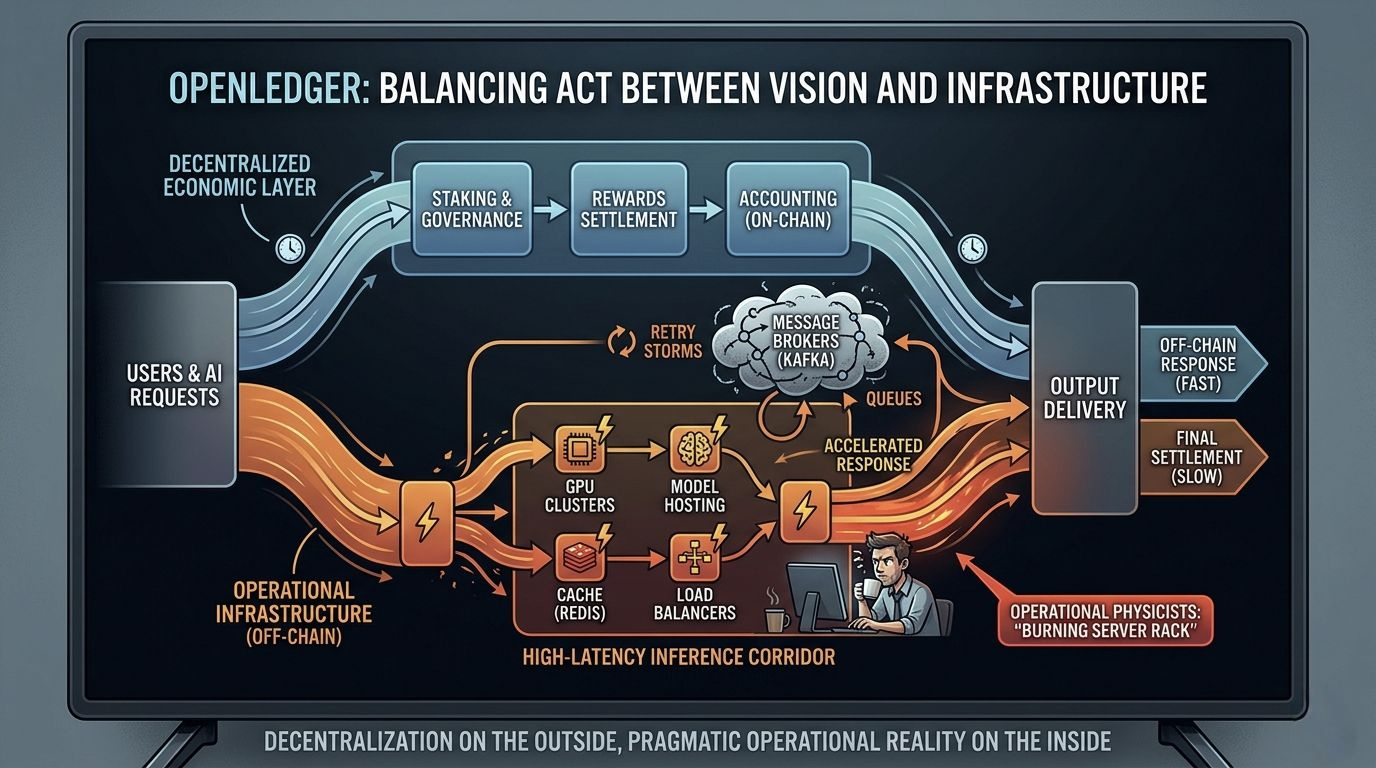
The backend architecture underneath OpenLedger is probably far more centralized than people imagine, even if the economic layer is decentralized. Honestly, it almost has to be. Event-driven systems become unavoidable at scale. Once you’re coordinating inference requests, staking events, model updates, payouts, permissions, and agent activity simultaneously, synchronous architectures start collapsing under their own weight.
So you end up with Kafka streams everywhere. Message brokers multiplying like weeds. Worker queues feeding other worker queues. Tiny microservices that seemed like a good idea until half the engineering team spends their lives debugging distributed tracing across twelve services because one malformed payload poisoned a consumer group three regions away.
That’s the kind of thing architecture diagrams never capture properly. The emotional damage.
And then there’s Redis. Every large-scale distributed platform eventually becomes spiritually dependent on Redis whether the engineers intended it or not. Caching hot state. Rate limiting. Session coordination. Temporary inference storage. Queue management. Everybody thinks they’re using Redis “lightly” right until it falls over and suddenly the entire company discovers the production system was balanced on top of volatile memory and optimism.
I still remember one outage where a cache invalidation bug turned our primary database into a smoking crater within twenty minutes. Beautiful architecture on paper. Absolute disaster in production.
That’s why I laugh a little when people act like blockchain replaces traditional infrastructure. It doesn’t. If anything, it adds another layer of operational complexity on top of systems that were already hard to manage. You still need relational databases because transactional integrity matters. PostgreSQL survives every hype cycle for a reason. Boring systems that behave predictably under pressure tend to outlive visionary abstractions.
Then AI systems pile on more infrastructure. Vector databases. GPU schedulers. Event streaming pipelines. Observability stacks. Object storage layers. API gateways. Regional inference routing. Retry orchestration. Suddenly your “AI blockchain” looks less like a protocol and more like twenty interconnected failure modes pretending to cooperate peacefully.
And latency becomes this constant psychological war against user perception. Blockchains are not fast. Doesn’t matter how much optimization people talk about. Consensus introduces delay. Finality introduces delay. Network propagation introduces delay.
So everybody starts cheating a little.
Requests execute off-chain immediately while settlement happens later. Outputs stream token-by-token to create the illusion of responsiveness while the backend is still scrambling to finish the actual work. Systems acknowledge requests optimistically before infrastructure fully catches up because users interpret immediate feedback as competence.
Honestly, that’s not even unethical. That’s survival design.
The API layer is where decentralization usually starts unraveling in practice, though. Somebody still has to maintain stable developer tooling. Authentication. SDKs. Abuse prevention. Billing. Rate limiting. Monitoring. You can decentralize ownership, maybe even compute eventually, but operational accountability always collapses toward a smaller control surface.
Because when production catches fire, committees don’t fix outages. Engineers do.
That’s another thing I think people underestimate about decentralized infrastructure. Debugging distributed failures across systems you don’t fully control is miserable. Pure misery. At least in centralized environments, somebody usually has root access and authority to make decisions quickly. In decentralized architectures, governance itself can become part of the outage response timeline.
And AI workloads are especially unforgiving under pressure. GPU memory exhaustion cascades brutally fast. Queue retries amplify traffic. One overloaded model can poison adjacent services if isolation boundaries aren’t designed carefully. I’ve watched autoscaling systems accidentally create instability because new capacity arrived slower than traffic acceleration. By the time extra nodes spun up, retry storms had already buried the cluster.
That kind of scar tissue changes how you read infrastructure claims.
Which is why I don’t really look at OpenLedger as some clean decentralized AI future. I look at it as a balancing act between economic decentralization and operational pragmatism. And maybe that’s the only honest architecture available right now.
The systems that survive long-term usually aren’t the most ideologically pure. They’re the ones willing to compromise intelligently. The ones that hide complexity well enough that users never realize how many moving parts are barely cooperating underneath.
Because under real load, every distributed system eventually stops being a philosophy and starts becoming an operations problem.
And operations problems don’t care what was written in the whitepaper. @OpenLedger #OpenLedger $OPEN
