
When i first started exploring artificial intelligence deeply, i honestly thought the entire competition was only about building smarter models. Every headline talked about faster systems, bigger companies, massive GPU investments, and trillion-dollar predictions about the future of AI. But the more i started researching the industry, the more i noticed something that felt completely hidden behind all the hype. The real power was never only inside the models themselves. The real power was inside the data feeding those models every single second.
i started noticing that almost every person connected to the internet is unknowingly contributing to artificial intelligence. Every search, every image upload, every comment, every correction, every conversation, every online behavior pattern slowly becomes training material for AI systems. Yet the people creating that value are usually ignored while giant corporations continue building billion-dollar businesses from collective human intelligence. That thought stayed in my mind for a long time because the more i looked at the AI industry, the more unfair the structure started feeling.
That is exactly what pulled my attention toward OpenLedger (OPEN). When i first came across the project, i honestly expected another ordinary crypto narrative trying to use AI as marketing. But when i started researching deeper, i noticed OpenLedger was approaching artificial intelligence from a completely different perspective. Instead of asking how to build bigger AI systems, the project was asking who should actually own the value created by artificial intelligence in the first place.
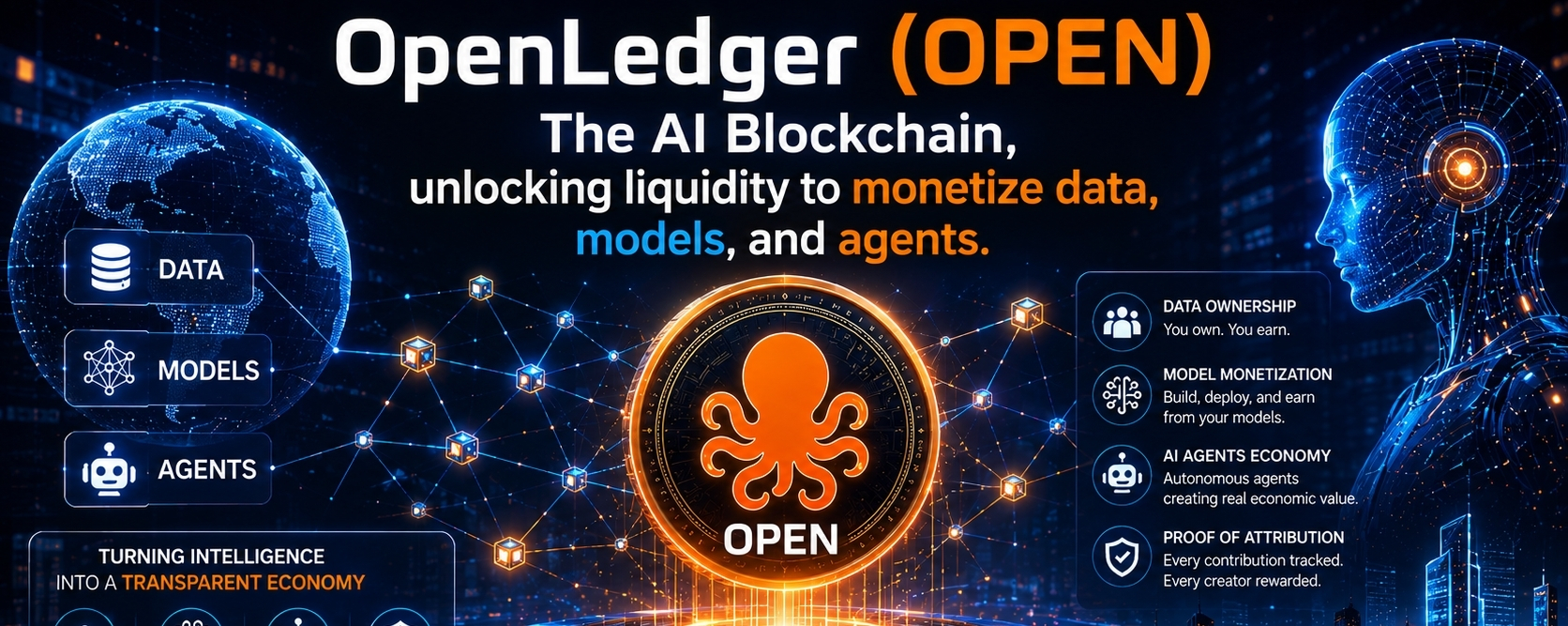
The more i explored OpenLedger, the more i started realizing this project is trying to build an entirely new economic layer around AI itself. Most people still think AI is simply software, but i m noticing something much bigger happening quietly in the background. AI is slowly transforming into an economy. Data has become valuable. Models have become valuable. AI agents are becoming valuable. And OpenLedger seems focused on building the infrastructure where all of those things can be owned, tracked, monetized, and rewarded transparently.
What fascinated me most was the idea of attribution because that is where modern AI becomes extremely controversial. Right now most AI systems work like giant black boxes. Millions of people contribute data unknowingly, models train on that information, companies monetize the outputs, and almost nobody knows where the real value originally came from. OpenLedger appears to be trying to solve that exact imbalance by creating systems where contributions can actually be traced and rewarded. When i started understanding that vision, i realized this project is not simply talking about blockchain or AI separately. It is trying to redesign ownership itself inside the intelligence economy.
The more i started thinking about it, the more i noticed how massive this shift could eventually become. For years people believed oil was the world’s most valuable resource. Then attention became the internet’s biggest currency through social media platforms. But now i m noticing intelligence itself may become the next global commodity. Whoever controls intelligence infrastructure could eventually control enormous economic power across industries, governments, communication systems, finance, healthcare, education, and even labor markets.
That is why OpenLedger’s focus on monetizing data and AI agents feels far more important than most people currently understand. We are entering a future where AI agents may eventually perform real economic work independently. They could write code, analyze markets, automate businesses, manage research, negotiate transactions, create content, and make decisions without constant human supervision. Once that happens, entirely new systems of ownership and payment become necessary. Who owns the outputs of an AI agent? Who gets rewarded when a model improves? How do contributors receive value from the intelligence they helped create? These questions are no longer futuristic theories anymore. They are becoming practical infrastructure problems for the next generation of technology. #openledger
When i started noticing OpenLedger talking about “payable AI,” the phrase honestly stayed in my head for days because it perfectly explains where the internet may be heading. Today people use AI systems for free while corporations monetize everything behind the scenes. Tomorrow people may expect AI ecosystems to automatically distribute value back toward contributors, creators, developers, validators, and data providers. That changes AI from an extractive system into a participatory economy where intelligence itself becomes programmable.
i also think timing matters here. The AI industry is centralizing incredibly fast. A small group of companies currently controls most advanced compute infrastructure, proprietary datasets, and large-scale models. History shows that whenever technology becomes too centralized, economic imbalance usually follows. The internet originally promised openness too, yet eventually most digital power became concentrated inside a handful of platforms. i started noticing OpenLedger feels like an attempt to stop artificial intelligence from following the exact same path before it becomes impossible to reverse. $OPEN
The deeper i researched the project, the more i realized OpenLedger is not simply building another blockchain ecosystem. It is trying to build a future where intelligence itself becomes liquid, ownable, and economically connected to the people creating it. Maybe the project succeeds and becomes foundational infrastructure for decentralized AI economies. Maybe it struggles in an industry moving faster than almost any technology revolution in history. But regardless of the outcome, i genuinely believe OpenLedger is asking one of the most important questions of this entire AI era.
If humanity is collectively helping train artificial intelligence every single day, then why should only a few corporations own all the value created from it?
And honestly, the more i keep watching AI evolve globally, the more i m noticing that question is only becoming more powerful with time. @OpenLedger