
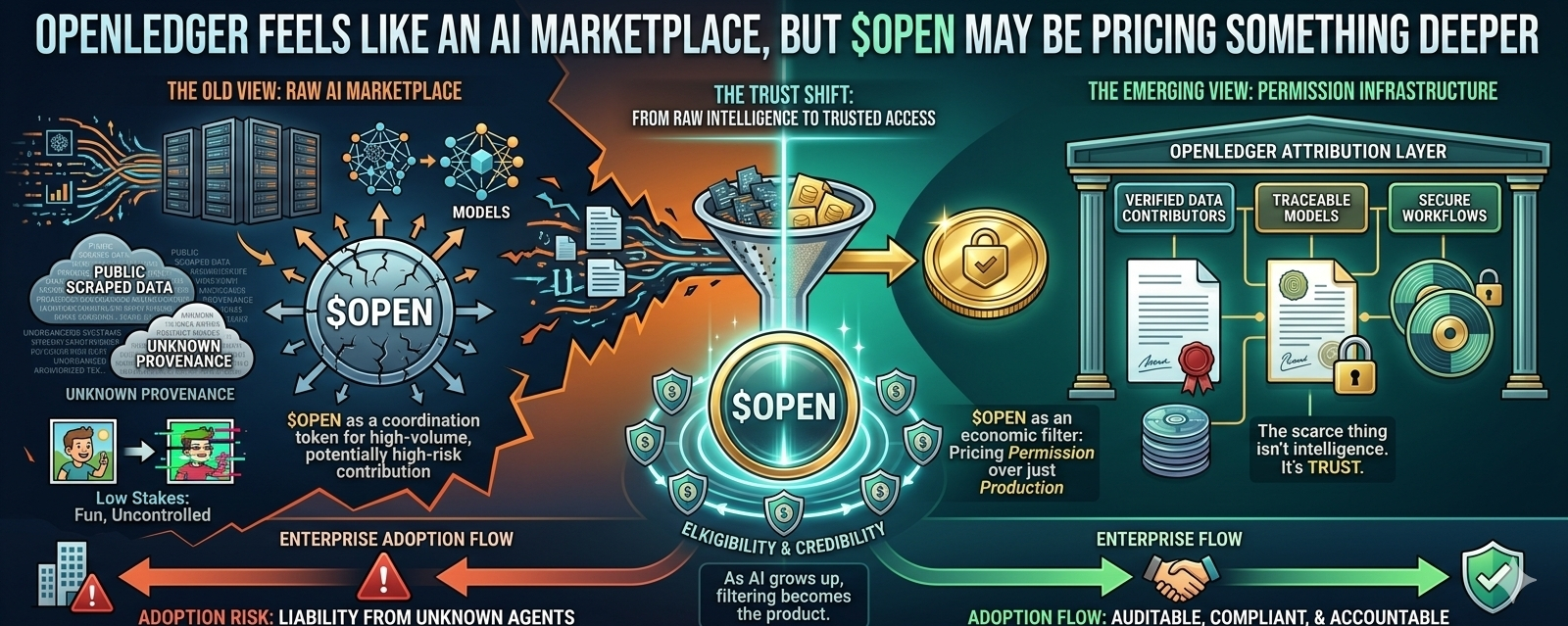
@OpenLedger A few years ago, every conversation around digital infrastructure seemed to come back to scale. Faster networks, larger clouds, stronger compute, bigger systems. The market loved that idea because it was simple. If something could process more, it looked more valuable. AI followed the same path almost naturally. Bigger models became the symbol of progress. More GPUs became the symbol of power. Even now, most people still trade AI through that lens because it is easy to understand and easy to repeat.
But the more I think about real AI adoption, the less convinced I am that raw capacity is the main story. Practical systems do not always reward the biggest machine. Sometimes they reward the system that can be trusted closest to important workflows. That is where access control starts to matter, not just as a software feature, but as an economic layer. Who is trusted enough to contribute? Who is allowed near sensitive data? Who can participate when the output has real consequences? That question feels much more important than the market is currently pricing.
OpenLedger is often described like an AI marketplace. Contributors bring data, builders use intelligence resources, and OPEN helps coordinate incentives around that activity. That is a clean narrative, and crypto markets like clean narratives because they fit old mental models. But I am not sure “marketplace” fully captures what OpenLedger could become. The harder problem may not be matching AI supply with demand. The harder problem may be deciding who is qualified to supply anything in the first place.
That sounds small until you move beyond casual AI use. If someone uses AI to generate profile pictures, mistakes are annoying, maybe even funny. Nobody is calling a compliance team because a cartoon image came out weird. But once AI starts supporting insurance approvals, legal reviews, suspicious payment checks, enterprise documents, customer access decisions, or internal operations, everything changes. Suddenly the questions become serious. Where did the data come from? Who had the right to use it? Can the model’s behavior be traced? Who trained it? Who carries responsibility if something breaks?
These are not just technical questions. They are business survival questions. Crypto people sometimes underestimate how much large organizations care about boring details. Builders may love open experimentation, but legal teams, compliance departments, and procurement officers do not move that way. They need proof, auditability, licensing clarity, accountability, and controlled exposure. In that environment, intelligence alone is not enough. Trust becomes the part that decides whether intelligence can actually be used.
That is where OpenLedger starts to feel more interesting to me. Not because it is simply promising more intelligence. Intelligence is becoming more available across the market. Models keep improving, compute gets more competitive, and open-source systems keep narrowing the quality gap. But trust does not scale as easily. Trust is slower, heavier, and harder to fake. If OpenLedger is only paying contributors for useful data, that is understandable, but it is not automatically special. Plenty of token systems have tried to create contribution markets before, and many of them struggled because incentives can create activity without creating real necessity.
The more important possibility is that OpenLedger is not only pricing contribution. It may be pricing eligibility. That difference matters. Two datasets can both be useful for training, but they are not economically equal. One might come from scraped public sources with unclear ownership and uncertain usage rights. Another might come from verified contributors with documented provenance, clear permissions, and known conditions. Technically, both can improve a model. Economically, one carries future risk while the other reduces future friction. That gap is where value can accumulate.
The same logic applies to AI agents. Everyone talks about autonomous agents like deployment is only a matter of better capability. Maybe capability will keep improving, but serious operators will not let unknown agents touch financial systems, contracts, customer records, or internal workflows just because they appear competent. Competence without trust becomes liability. So the scarce thing may not be intelligence itself. The scarce thing may be trusted permission.
That is a very different way to think about infrastructure. Open systems usually begin with broad participation and idealistic energy. Then scale introduces noise, abuse, manipulation, uncertainty, and hidden costs. Over time, filtering becomes the real product. Payments went through this. Cloud infrastructure went through this. Identity systems went through this. Even social platforms, despite all their talk about openness, eventually built invisible trust, ranking, and visibility systems. AI may follow the same pattern, and if it does, the layer that controls trusted participation could become extremely important.
This is why OpenLedger’s attribution architecture may matter more than it first appears. Attribution sounds like a reward mechanism. A way to pay contributors fairly and track who provided value. That may be true, but attribution can also become permission infrastructure. It can create a record of who contributed what, under which conditions, with what history, and with what trust profile. Once that exists, the system no longer treats every participant as equal by default. It starts assigning differentiated economic credibility.
Of course, that framing comes with risks. Some people will see it as less decentralized, and that concern is valid. Permission markets can turn into gatekeeping systems if governance is weak. Once trust status has economic value, politics enters the system. Who decides what counts as trusted? Who gets excluded? Can reputation be gamed? Does the token support real infrastructure, or does it become just another toll booth? These are serious questions, not small details.
There is also the adoption problem. Enterprise demand does not appear just because crypto people find a design elegant. Big organizations adopt new infrastructure when the pain becomes too expensive to ignore. That may take longer than token markets expect. Many companies may choose traditional AI vendors simply because contracts, procurement, and liability terms are easier to understand than tokenized coordination layers. And even if OpenLedger solves a real problem, that still does not automatically mean OPEN captures all the value. Crypto has made that mistake many times before. A useful protocol and a valuable token are not always the same thing.
Still, I keep coming back to the same point. The market may be asking the wrong question. People are asking whether OpenLedger can become a strong AI marketplace. That might be too narrow. The bigger question is whether AI is moving into a phase where trusted access becomes more valuable than raw intelligence supply. If that shift happens, then the valuable layer is not just compute, models, or data volume. It is controlled participation. And in mature markets, the systems that control trusted participation often become some of the stickiest infrastructure layers of all.