
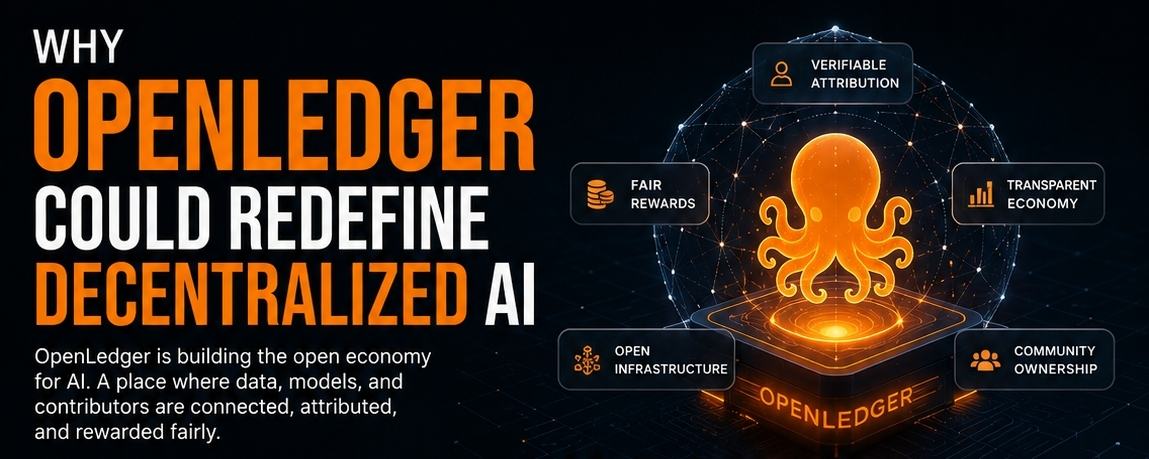

For a while, I thought decentralized AI was just trying to imitate centralized AI with blockchain added on top.
Same models. Same structure. Same power dynamics.
Just distributed differently.
But the more I explored OpenLedger, the more that assumption started breaking apart.
Because OpenLedger doesn’t seem obsessed with replacing centralized servers. It feels more focused on rebuilding the economic structure behind intelligence itself.
And honestly, that may matter more than the models.
Right now, AI operates like a closed loop.
Users generate interactions. Contributors provide data. Developers build applications. Models improve over time.
But eventually most of the value flows back toward the platforms controlling the infrastructure.
The strange part is that intelligence is rarely created in isolation anymore.
Every useful AI system depends on layers of participation most people never see directly. Datasets shape behavior. Validators secure networks. Communities refine domain knowledge. Developers build specialized tools around existing models.
Yet very few of those participants stay connected to the long term value their contributions help create.
That’s where OpenLedger started feeling different to me.
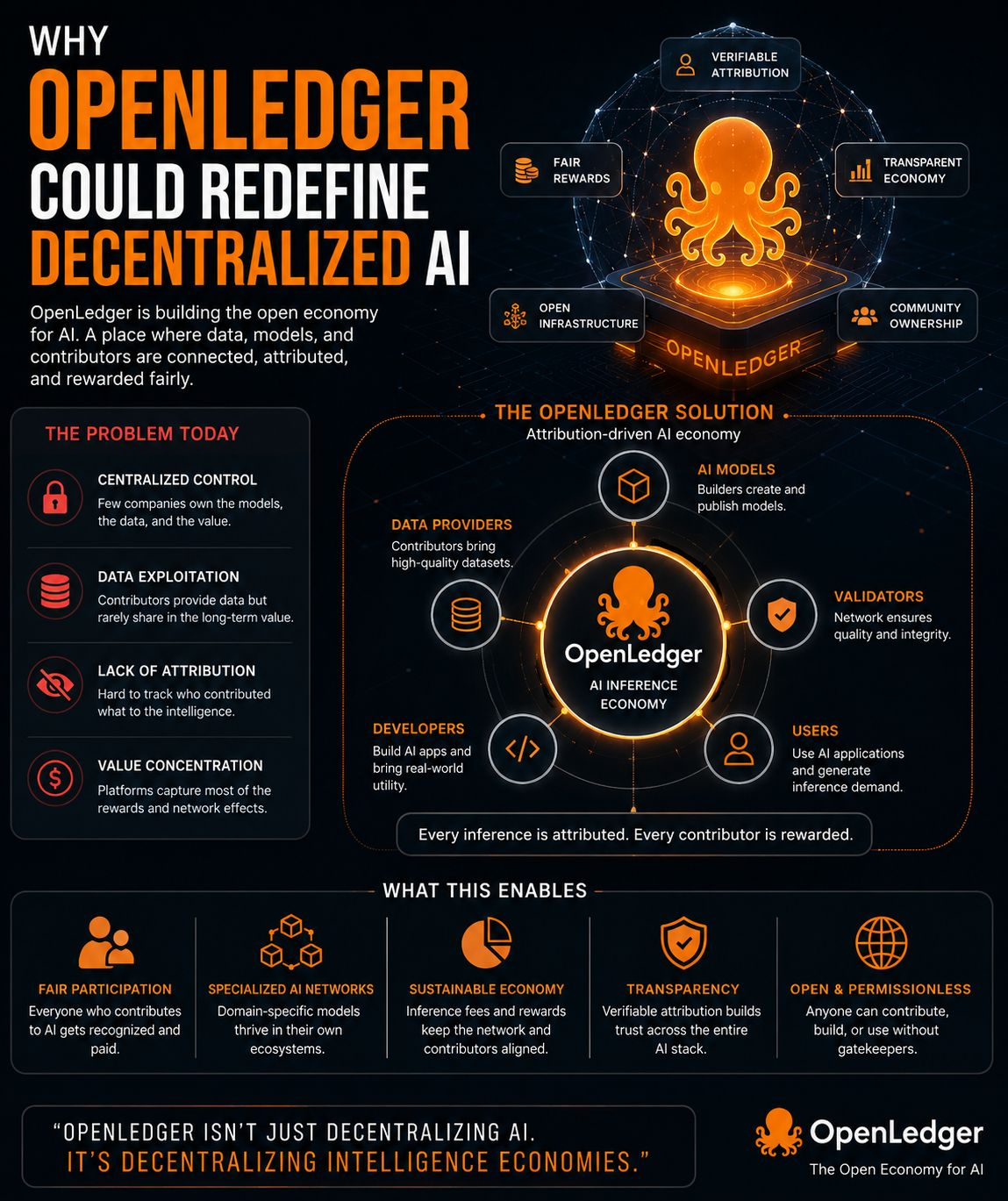
Its architecture revolves heavily around attribution and inference economics. Instead of treating AI outputs like disconnected responses, the network attempts to connect intelligence generation back to the participants involved in producing it.
At first, I thought this was just another incentive narrative.
But after thinking about it longer, I realized the implication is much larger.
Because if attribution becomes reliable infrastructure, AI may stop evolving around only giant closed ecosystems. Smaller specialized networks could survive independently because contributors continue participating in the economic activity generated from usage itself.
That changes the entire direction of decentralized AI.
And honestly, specialization probably reflects reality better anyway.
Most intelligence in the real world is contextual.
A healthcare system doesn’t need gaming logic. A financial model doesn’t need social behavior analysis. A scientific research agent doesn’t need meme culture understanding.
Human expertise naturally evolves through narrow environments with highly specific feedback loops. OpenLedger seems aligned with that same idea through domain-specific AI ecosystems where knowledge, incentives, and contribution remain economically connected.
That subtle shift feels more important than people realize.
Because the current AI race is mostly focused on scale.
Bigger models. Bigger compute. Bigger funding rounds.
But scale alone doesn’t solve coordination.
And coordination may become the real bottleneck of decentralized intelligence systems.
Who contributed the data? Who improved the outputs? Who validates model behavior? Who receives value from inference activity?
Most existing AI systems barely answer these questions transparently.
OpenLedger tries to turn those invisible relationships into part of the infrastructure itself.
Another thing that stood out to me is how the project approaches data ownership.
In most traditional AI pipelines, data disappears once it enters training systems. Contributors lose visibility almost immediately while centralized platforms absorb the long term economic value generated from future usage.
OpenLedger attempts to preserve that connection through attribution-driven participation models.
If that works at scale, datasets stop behaving like disposable fuel and start functioning more like productive digital infrastructure tied directly to network activity.
That creates a completely different relationship between contributors and AI ecosystems.
The blockchain layer here also feels surprisingly practical.
Not ideological.
It acts more like a coordination framework between independent actors who otherwise wouldn’t trust each other. Developers, validators, contributors, applications, and AI systems all need aligned incentives if decentralized intelligence is going to scale sustainably.
And honestly, that’s probably the hardest challenge in the entire sector.
Not building intelligence.
Coordinating it.
Of course, execution still matters more than vision.
Attribution systems are difficult. Economic incentives can break. Specialized ecosystems need real adoption before network effects become sustainable.
But conceptually, OpenLedger feels early in a category that may become far more important over time.
Not because it promises louder AI narratives.
Because it quietly questions whether intelligence itself should remain trapped inside closed platforms at all.
