
There’s something about OpenLedger that keeps pulling my attention back, but not for the obvious reasons. It’s not the idea of monetizing data or agents—that part makes sense. It’s the quieter layer underneath, the part that doesn’t announce itself but ends up shaping everything anyway.
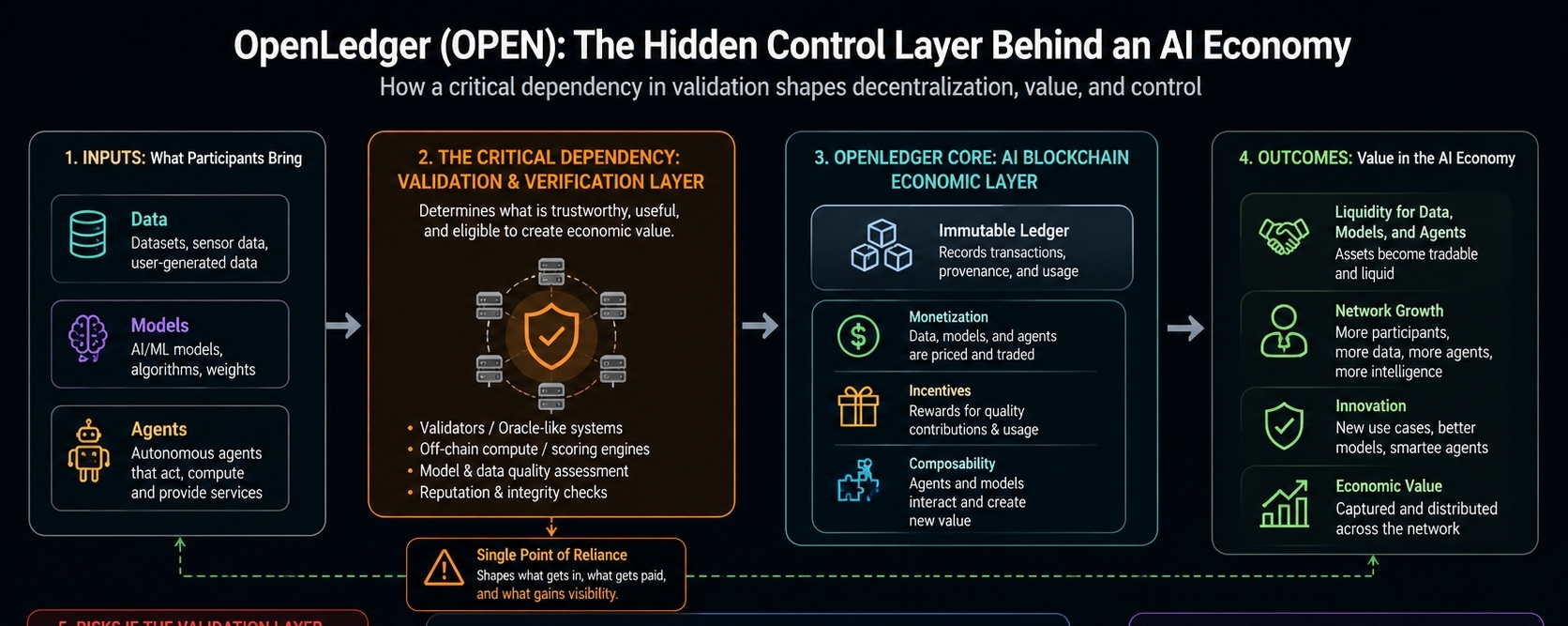
If you think about it honestly, a system like this can’t run on pure openness. Somewhere, something has to decide what counts as valid. Whether a dataset is usable, whether a model’s output is trustworthy, whether an agent actually delivered what it promised. That decision point isn’t flashy, but it’s everything. It’s where value stops being theoretical and starts becoming real.
And that’s the part that doesn’t feel fully decentralized.
Even if OpenLedger allows anyone to build, deploy, and participate, the moment validation enters the picture, freedom starts bending a little. You’re not just creating—you’re aligning. You’re shaping your work in a way that fits whatever mechanism is judging it. Over time, you don’t even question it. You just adapt. That’s how invisible constraints usually work—they don’t block you, they guide you.
I’ve seen this pattern before. Systems that promise openness often end up relying on small, critical layers that most people don’t notice. Access points, data feeds, infrastructure providers—things that aren’t technically “centralized,” but function like gravity wells. Everything flows through them. Everything depends on them.
OpenLedger feels like it could be building something similar, just at a deeper level. Not around transactions, but around intelligence itself. And that changes the weight of the problem. Because if the layer that evaluates data and models becomes too influential, it doesn’t just affect efficiency—it shapes what the system believes is worth anything at all.
Governance is supposed to balance this out, but it rarely feels as simple as it sounds. Voting systems exist, yes, but influence tends to collect in predictable places—early adopters, large holders, people who understand the system better than everyone else. From the outside, it looks open. From the inside, it can feel like the important decisions are already leaning in certain directions.
Even ownership starts to feel different when you look closely. You can bring your data, your models, your agents—but only if they fit. Only if they pass. So you’re not just participating, you’re adjusting yourself to be accepted. And that subtle shift matters more than it seems.
I think that’s the part that stays with me the most. Not whether OpenLedger is decentralized in a technical sense, but whether it actually lets new participants shape the system in a meaningful way. Or if, by the time you arrive, the rules that define value are already quietly in place.
Because when control moves into places that are harder to see, it doesn’t feel like control anymore. It just feels like the way things are.