
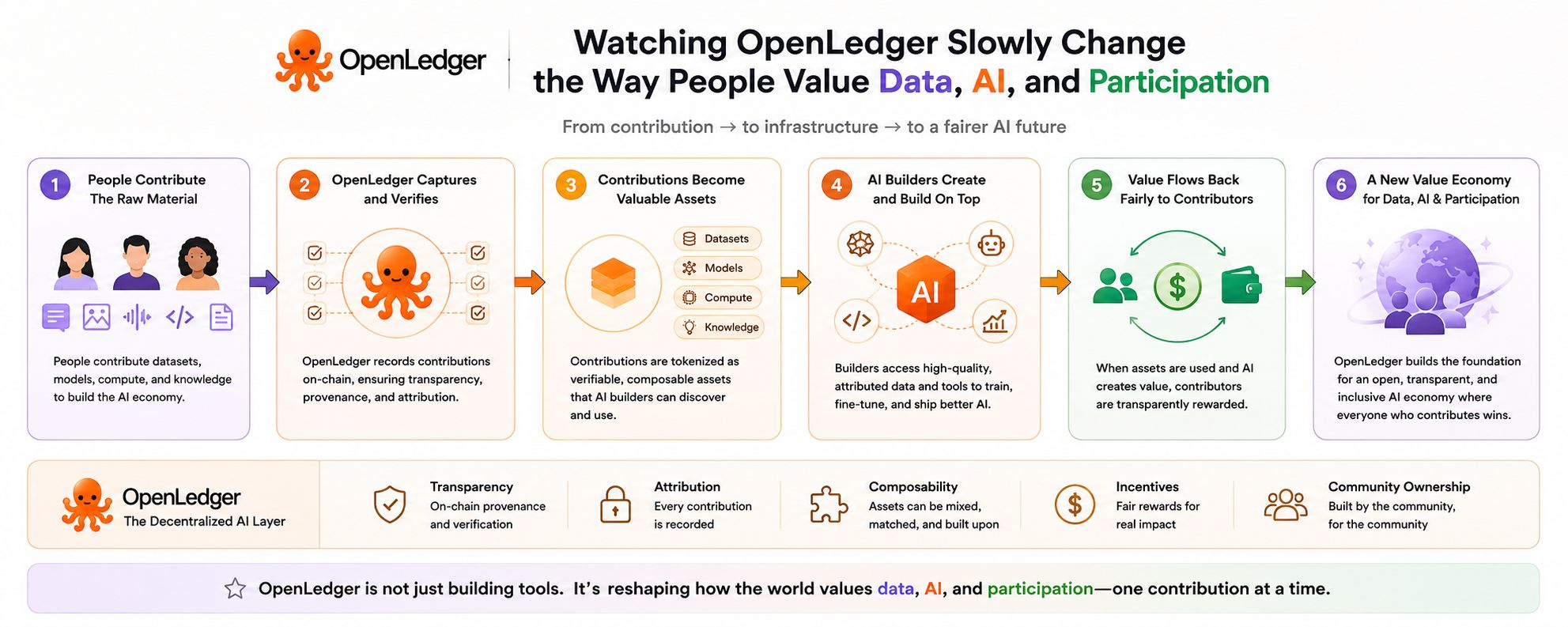

I’ve been quietly following projects like OpenLedger for long enough to notice how differently people behave once the early excitement fades. In the beginning, everything feels slower and more honest somehow. People ask questions because they actually want to understand things. They explore ideas without immediately trying to turn every interaction into an opportunity. There’s a certain openness in those early days that rarely lasts as long as people expect it to.
What caught my attention about OpenLedger wasn’t really the big promises around AI or blockchain. I think I’ve heard too many of those already. It was more the deeper idea underneath it — this attempt to give value to things that usually stay invisible. Data, models, agents… these are things people interact with constantly now, yet most people still don’t fully understand who benefits from them the most. I keep thinking about that imbalance more than the technology itself.
At first, communities around these systems often feel surprisingly genuine. People contribute because they’re curious, or because they want to be part of something early before it becomes crowded. There’s less pressure to perform. Conversations feel less polished. But slowly, almost quietly, the atmosphere changes. Once rewards become visible, people naturally begin adjusting themselves around them.
I don’t even think that shift comes from bad intentions. It just seems to happen whenever a system starts attaching value to participation. Someone who originally joined out of interest begins paying attention to what gets recognized. Then other people notice the same patterns. Before long, contribution becomes less natural and more strategic. You can almost feel the difference without anyone openly saying it.
I’ve noticed this especially in spaces where ownership and monetization are central ideas. The promise sounds fair at first. If people create value through their data or their work, shouldn’t they benefit from it somehow? That part makes sense to me. But the longer I watch these systems evolve, the more I wonder who actually decides what counts as valuable in the first place. That part always feels less visible.
The conversation around AI agents feels similar. People talk about them as if they’ll eventually operate like independent economic actors, creating value constantly in the background. Maybe they will. But I can’t help noticing how quickly these conversations move from curiosity into competition. Once people believe something will become financially important, the entire mood around it changes. Patience disappears first.
What I keep seeing, over and over, is how incentives slowly shape behavior without people fully realizing it. Communities begin with ideas, but eventually they organize themselves around rewards. Metrics start replacing instincts. People become more careful with how they present themselves, what they contribute, even what opinions they share publicly. The system teaches them what matters, even if nobody says it directly.
Recognition changes people just as much as money does. Maybe even more sometimes. I’ve seen people chase visibility in decentralized spaces with the same intensity others chase salaries. Titles, early access, reputation — these things quietly become their own form of currency. And despite all the talk about openness, certain people still end up closer to influence than everyone else. That pattern never fully disappears.
That’s probably why I look at OpenLedger with interest, but also with caution. Not because I think the idea is empty, but because I’ve learned that systems built around fairness often reveal new forms of imbalance later on. Sometimes unintentionally. Sometimes because human behavior naturally bends toward advantage once incentives become clear enough. I don’t think technology really changes that part of us as much as people hope it will.
The older I get, the less convinced I am by certainty in this space. I’m more interested now in the small shifts — the way communities slowly evolve, the way motivations quietly change, the way people adapt themselves to systems without even noticing it happening. And maybe that’s the part I keep coming back to with projects like OpenLedger. Not whether the vision is completely right or wrong, but what it reveals about the people trying to build a future around it.