

I have been watching the crypto market for a long time, and one thing keeps repeating every cycle. The projects getting the most attention are not always the ones solving the biggest problems. Markets move fast, narratives spread even faster, and sometimes people become more focused on price movement than actual usefulness.
That was the feeling I had when I started noticing more discussions around OpenLedger and its token OPEN. The idea immediately attracted attention because it combines two of the strongest narratives in the market right now, AI and blockchain. On the surface, it sounds like the kind of project people want to believe in.
But experience has taught me that interesting ideas and necessary products are not always the same thing.
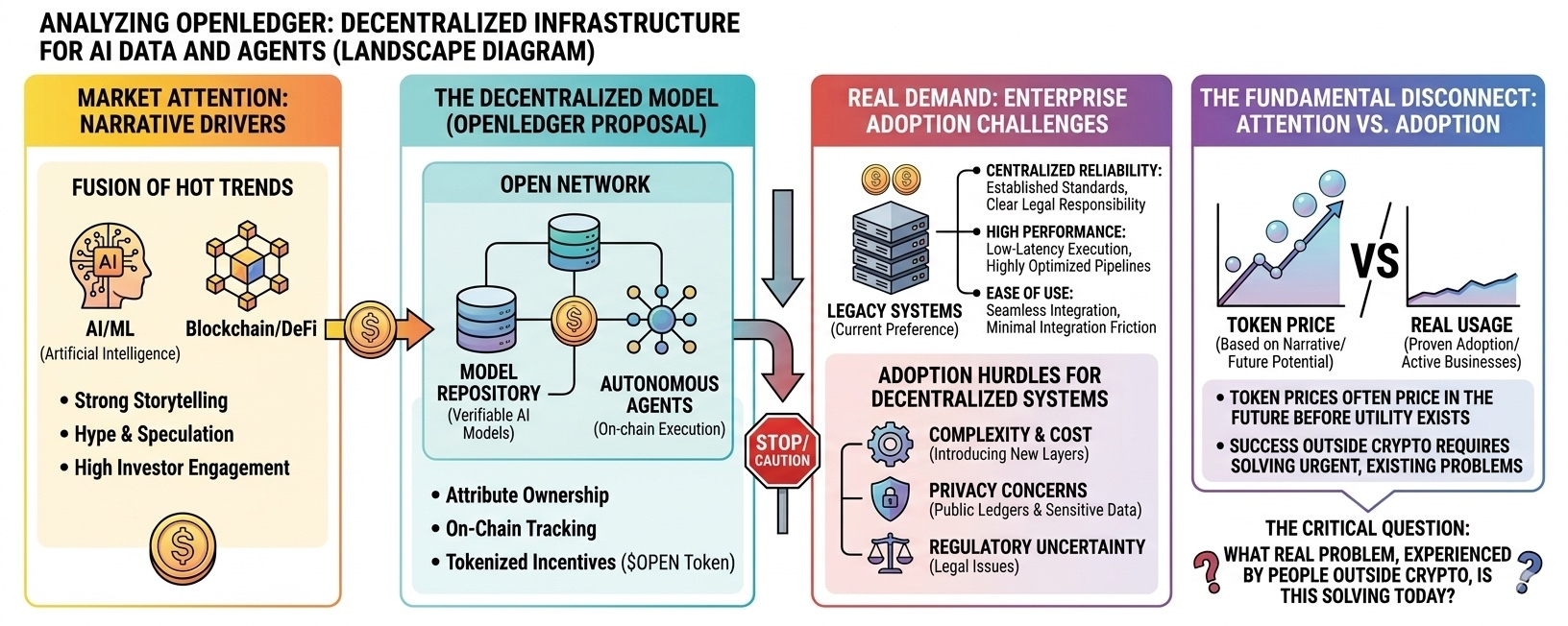
So instead of following excitement on social media, I tried to understand the industry OpenLedger wants to enter. The project talks about creating infrastructure where data, AI models, and autonomous agents can be monetized and tracked through blockchain systems. It sounds ambitious, but ambition alone does not guarantee adoption.
When I looked into opinions from people working around AI systems and enterprise infrastructure, the reactions were much more careful than the crypto timeline. Most were not rejecting the idea completely, but many questioned whether blockchain actually improves the systems businesses already use every day.
One developer explained that large companies prefer centralized systems because they are faster, easier to maintain, and legally easier to manage. If something fails, responsibility is clear. Introducing decentralized layers may create extra complexity without solving an urgent problem.
Privacy was another concern. Many AI systems depend on sensitive information and private datasets. Companies may not feel comfortable placing parts of that structure onto transparent blockchain networks, even if the goal is attribution and ownership tracking.
Others focused on efficiency. In AI infrastructure, speed matters. Existing systems are already highly optimized. For companies to replace working systems with blockchain-based alternatives, the advantage would need to be extremely clear.
This is where I think many crypto projects struggle. Sometimes the industry assumes traditional businesses are waiting for decentralization, when in reality most businesses simply want systems that are reliable and cost effective.
Crypto historically succeeded most when it solved problems inside its own ecosystem. Decentralized trading, stablecoins, and wallet infrastructure made sense because crypto users directly needed those tools. Outside crypto, the challenge becomes harder because many industries already operate with systems that work well enough for their needs.
That does not mean OpenLedger cannot grow into something important. AI attribution and ownership could become much bigger topics in the future, especially if AI agents eventually handle economic activity on a large scale. If that happens, infrastructure focused on transparency and attribution may become valuable.
But that future still remains uncertain.
I think this is important for investors to remember because token prices and real adoption are not the same thing. Markets often price narratives before actual usage exists. A token can rise because people believe in the story long before businesses truly depend on the product.
That is why buying OPEN today feels less like investing in proven adoption and more like betting on a possible future where this infrastructure becomes necessary.
Maybe that future arrives.
Maybe existing systems remain dominant.
Right now, nobody truly knows.
After years of watching this market, I keep coming back to one simple question before getting carried away by excitement.
What real problem, experienced by people outside crypto, is this solving today?