

The Fastest Chains Might Not Be the Ones That Last
A few years ago, blockchain conversations felt simple.
Every project wanted to prove it was faster than the last one. Higher TPS. Lower fees. Faster finality. Faster execution. Faster everything. The entire industry started sounding like a competition between benchmark charts.
And honestly, for a while, I bought into that too.
It felt logical. If a network could move information faster and cheaper, then obviously it was better infrastructure… right?
I don’t think that anymore.
That shift happened gradually after spending more time around real operational discussions instead of marketing threads. The more incidents, audits, and late-night reviews I watched unfold, the more I noticed something uncomfortable:
The biggest problems almost never started because a chain was too slow.
They started because somebody had too much access for too long.
A wallet still had permissions nobody remembered approving. An automation key never expired. A signer had broader authority than the team realized. An AI workflow kept executing after the original conditions had already changed.
And suddenly the conversation in the room had nothing to do with throughput.
Nobody cared about TPS at that point.
People were just trying to figure out whether the system could still be trusted.
That’s when I started looking at blockchain infrastructure differently. Speed still matters, of course. Nobody wants inefficient systems. But speed alone doesn’t make infrastructure mature. Sometimes it just means mistakes spread faster.
A fast chain can still be fragile.
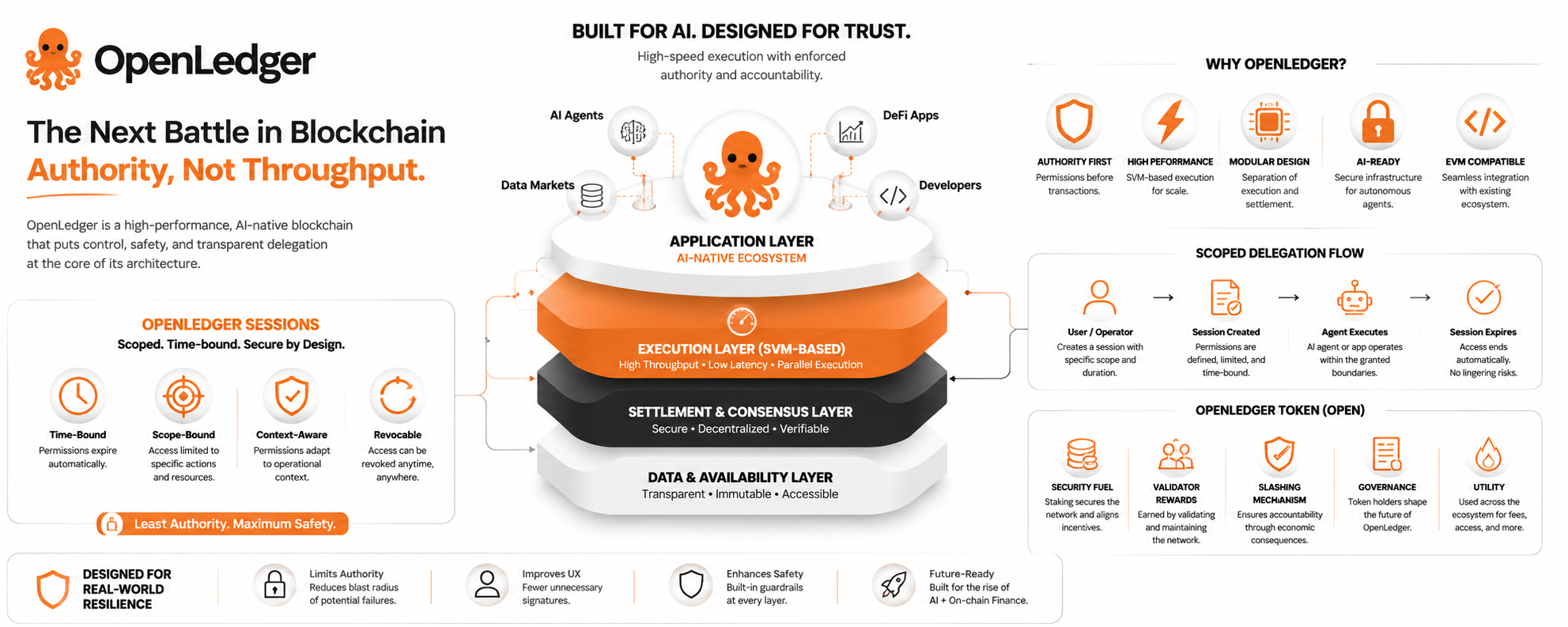
That’s why OpenLedger became interesting to me, though probably not for the reasons people usually expect. It wasn’t the “AI blockchain” label or the performance claims that stood out first. What caught my attention was the way the project seems to think about permissions and operational control.
It feels like infrastructure designed by people who understand that authority is where most failures begin.
That matters more than the industry likes to admit.
Crypto has spent years optimizing execution while quietly accepting very loose permission models underneath. We normalized wallet approvals that stay active indefinitely. We accepted interfaces that encourage people to click through signatures without reading carefully. We treated constant prompts as if they were security, even though repeated prompts usually just train people to stop paying attention.
Humans adapt to friction. Eventually they stop thinking and start reacting.
That’s dangerous in any system handling value.
And it becomes even more dangerous once AI agents enter the picture.
Right now, everyone talks about autonomous systems like they’re automatically the next evolution of crypto infrastructure. AI agents routing liquidity, managing positions, executing trades, interacting across protocols — all of that sounds exciting until you ask a very basic question:
What happens if those systems have too much authority?
Because an always-active agent with broad wallet access is not some futuristic breakthrough. In a lot of ways, it’s just permanent exposure running at machine speed.
That’s why I think scoped permissions matter so much.
The OpenLedger Sessions model — where permissions are limited by scope, context, and time — feels less like a UX feature and more like an acknowledgment of reality. Access should expire. Authority should narrow. Systems should assume humans will eventually make mistakes and design around that fact instead of pretending perfect behavior is realistic.
That’s what mature infrastructure does.
Not because it distrusts users, but because it understands pressure changes behavior.
And pressure always shows up eventually.
Markets become volatile. Validators fail. Bridges break. Automation loops behave unpredictably. Teams get overwhelmed. People rush decisions.
Every infrastructure system eventually encounters moments where human judgment becomes imperfect. That’s the real test. Not whether a chain performs beautifully under ideal conditions, but whether it can limit damage once conditions stop being ideal.
I think the industry still underestimates how quickly trust disappears when nobody can clearly explain who has authority and why.
Once that uncertainty enters the system, performance metrics stop sounding impressive very fast.
Nobody cares about sub-second finality during a containment call.
They care about whether permissions were restricted properly. Whether access could be revoked quickly. Whether the architecture assumed failure would happen eventually.
That’s the difference I increasingly see in projects like OpenLedger. The focus feels less obsessed with endless acceleration and more concerned with operational discipline. The architecture seems to recognize that scalability without boundaries eventually becomes risk.
And honestly, that feels like a more realistic way to think about the future of blockchain.
Because eventually every ecosystem reaches the same point: complexity grows faster than human attention can keep up with it.
When that happens, the systems that survive won’t necessarily be the ones that move the fastest.
They’ll be the ones that know how to limit authority before small mistakes turn into irreversible failures.
#OpenLedger @OpenLedger $OPEN #OpenLedgers
