

I was lying awake on the roof a few nights ago because the heat still had not settled even after midnight. The electricity had gone again, the whole street was quiet except for a few motorcycles passing in the distance, and I kept scrolling through AI infrastructure discussions trying to figure out why most of the sector still feels intellectually hollow despite all the excitement around it.
Everything in crypto suddenly wants to become “AI-powered.”
But the deeper I look, the more it feels like most people are talking about intelligence without talking about coordination.
And those are two completely different problems.
Human civilization itself was never built because one person became infinitely intelligent. Societies scaled because humans learned how to coordinate memory, labor, trust, incentives, and information across networks larger than any single individual could manage alone.
That same pattern may eventually apply to AI.
Which is why OpenLedger started becoming interesting to me in a way most AI projects do not.
Not because it promises some god-level superintelligence. Not because of flashy demos. Not because of another cycle of AI buzzwords attached to tokens.
But because underneath everything, the project seems to understand a much deeper issue:
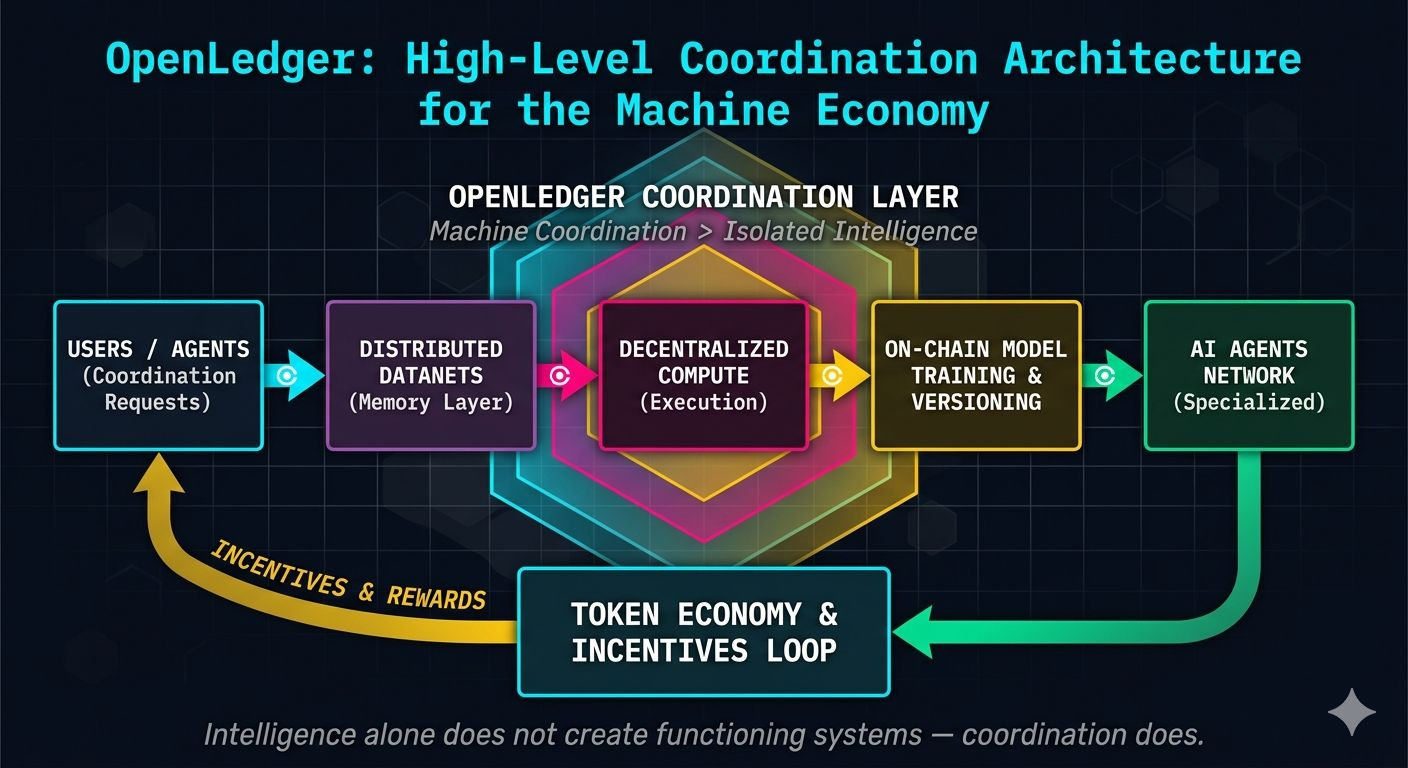
Intelligence alone does not create functioning systems.
Coordination does.
That realization completely changes how you look at AI infrastructure.
Right now, most of the industry still operates through centralized concentration.
The strongest models sit behind a handful of corporations. The compute remains heavily controlled. The datasets are mostly opaque. Even the so-called decentralized AI projects often depend on centralized cloud architecture underneath the branding.
So despite all the futuristic language around autonomous systems, most AI today still behaves like feudal infrastructure pretending to be open innovation.
That contradiction has been bothering me for months.
Then I started reading deeper into OpenLedger’s architecture, and for the first time in a while, a project felt less focused on dominating intelligence and more focused on organizing it.
The distinction matters more than people think.
Because the future may not belong to one perfect model.
It may belong to systems capable of coordinating millions of imperfect specialized intelligences efficiently.
That feels much closer to how biology itself works.
The human brain is not one giant undivided processor doing everything equally. Different regions specialize in different tasks while constantly exchanging information across networks. Memory, reasoning, perception, language, emotional processing — none operate independently, but none fully control the system either.
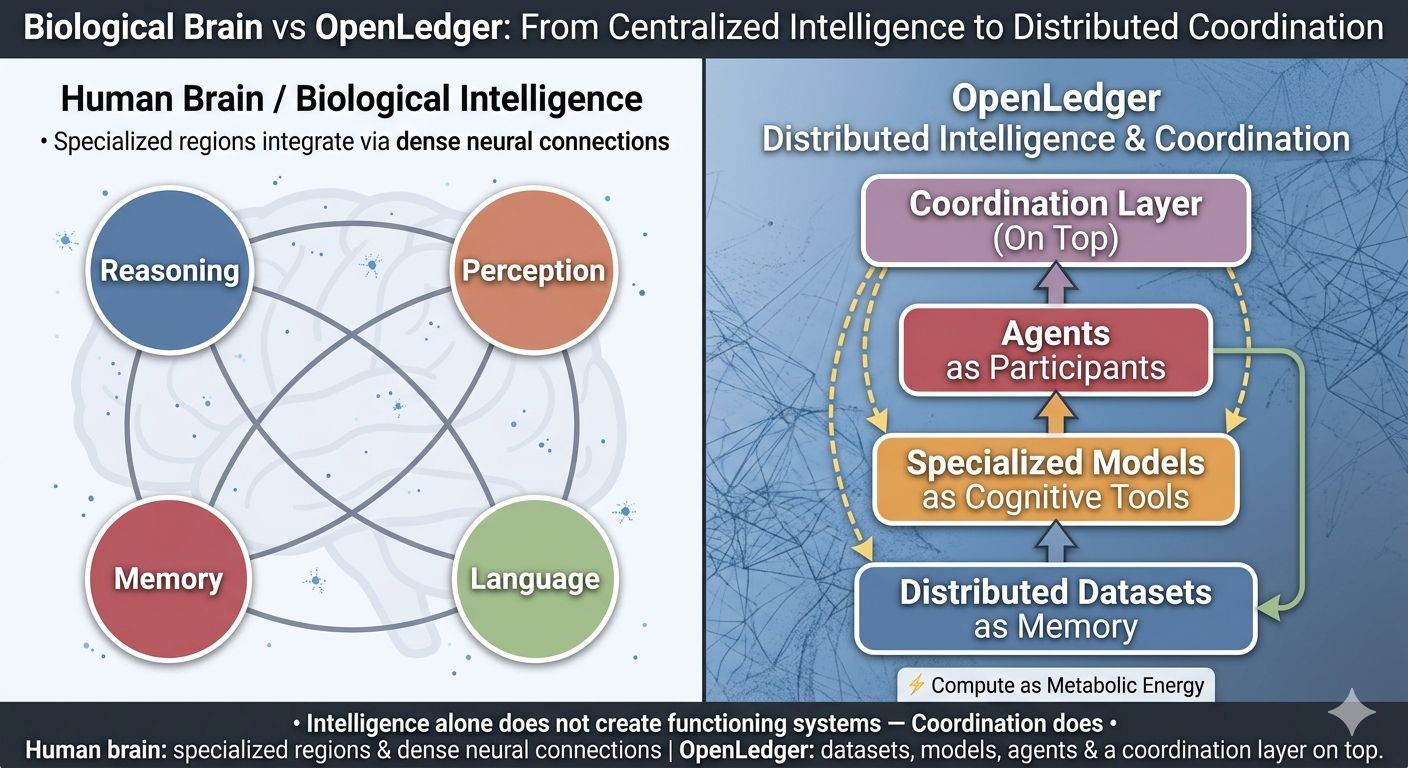
OpenLedger oddly resembles that kind of architecture philosophically.
Datasets become distributed memory layers. Compute acts like metabolic energy. Models function more like specialized cognitive tools. Agents become participants inside an economic network instead of isolated applications.
And coordination sits above all of them.
That is the part many people underestimate.
Crypto historically became very good at financial abstraction but much weaker at sustainable coordination. Almost every cycle eventually collapses into incentive distortion because speculation grows faster than utility.
Liquidity enters. Narratives expand. Tokens pump. Users farm incentives. Attention leaves.
Then the ecosystem slowly empties itself out.
We watched it happen repeatedly across DeFi, NFTs, GameFi, SocialFi, and even parts of modular infrastructure already.
AI could absolutely fall into the same trap.
And honestly, in many areas it already is.
A huge percentage of AI crypto right now feels less like infrastructure and more like narrative packaging around existing APIs and cloud systems.
That is why OpenLedger caught my attention.
The ecosystem at least appears aware that machine economies cannot function long term without shared coordination layers.
If autonomous agents eventually operate economically, they will need access to resources they do not own themselves.
Data. Models. Inference. Verification. Identity. Payments. External tools.
No single entity can scale infinitely across all those layers alone.
Which means future AI systems may increasingly depend on open coordination environments rather than vertically integrated monopolies.
That is where OpenLedger starts feeling less like a blockchain project and more like infrastructure for distributed cognition.
Still, theory is always easier than reality.
And I think people sometimes underestimate how difficult decentralized coordination actually becomes once real economic pressure enters the system.
Open systems sound beautiful philosophically. But open systems are also fragile.
You need contributors who remain incentivized even during slow market conditions. You need developers building because infrastructure genuinely matters, not because grant programs temporarily create artificial activity. You need token economics supporting participation without turning everything into pure speculation.
Most importantly, you need actual usage beyond crypto-native imagination.
Because the market today has become incredibly efficient at monetizing future narratives before products fully exist.
Especially in AI.
People no longer invest only in adoption. They invest in possibility itself.
Sometimes that creates breakthrough infrastructure early. Sometimes it creates ghost economies inflated entirely by expectation.
And honestly, I still do not know where OpenLedger ultimately lands between those two outcomes.
But I do think the project is positioned near a very real structural shift already happening quietly underneath the surface.
AI models themselves are commoditizing faster than expected. Open-source systems continue improving rapidly. Raw intelligence is becoming more abundant.
Which means the real bottleneck may gradually shift away from intelligence generation and toward intelligence coordination.
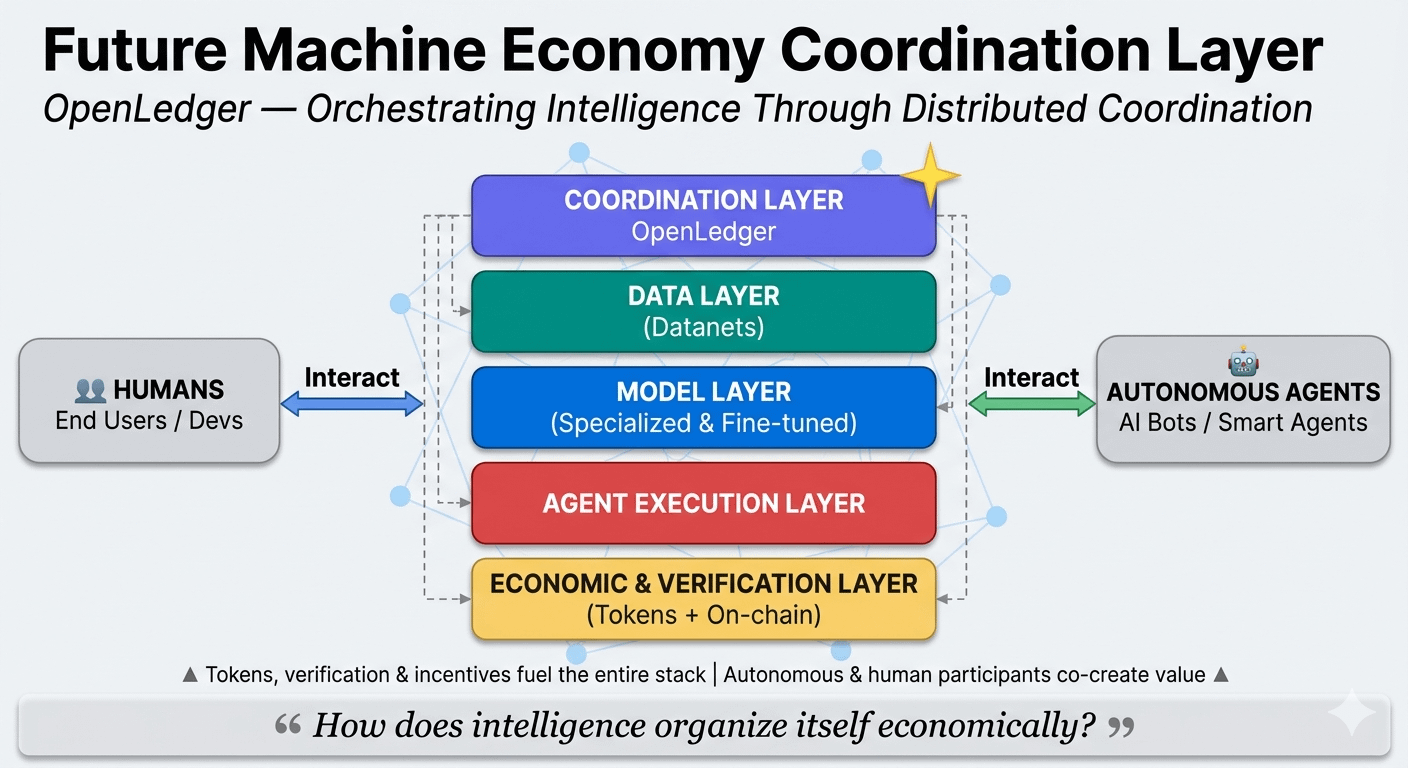
Who organizes resources best? Who creates efficient interaction layers? Which systems become economically attractive not just for humans, but for machines themselves?
That last question feels strange to even say out loud.
Because crypto spent years obsessing over onboarding humans into digital economies.
But what happens when autonomous systems become the primary participants interacting across networks?
At that point, usability may matter less than coordination efficiency.
The dominant systems may simply become the environments machines prefer operating inside.
And philosophically, that changes how you think about infrastructure completely.
OpenLedger may succeed. It may fail. It may evolve into something entirely different over time.
But the reason I keep revisiting it is not because I expect certainty.
It is because the project seems to be asking a more important question than most of the market currently understands.
Not how to create smarter machines.
But how intelligence itself organizes economically once it becomes distributed everywhere.
And honestly, I think that question may define the next era of both AI and crypto far more than people realize today.