
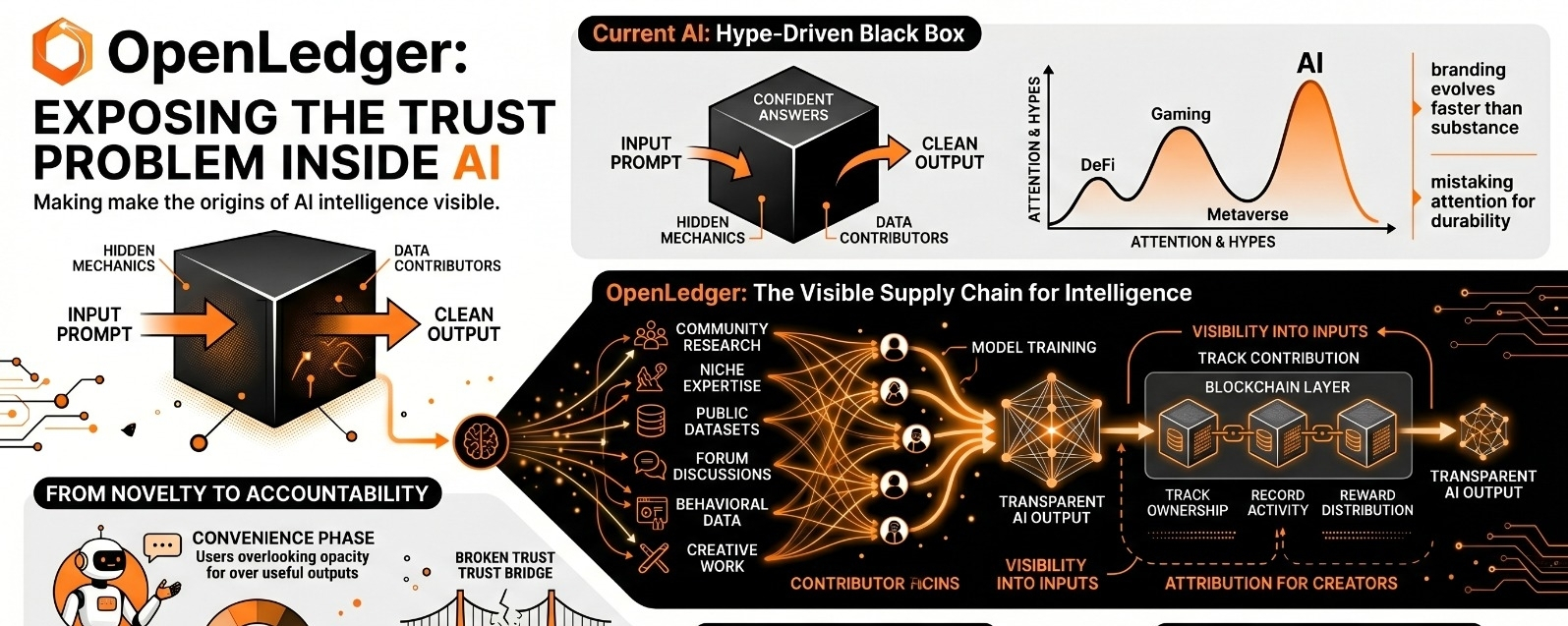
OpenLedger caught my attention for a reason most AI projects fail to. It made me think past the hype layer. At first glance, it looked like another project entering the AI x crypto cycle with the same familiar formula I have watched repeat across this industry for years. A strong narrative appears, liquidity rushes toward it, timelines fill with recycled talking points, and suddenly every new startup claims it is building the future. I have seen this pattern too many times to react emotionally anymore.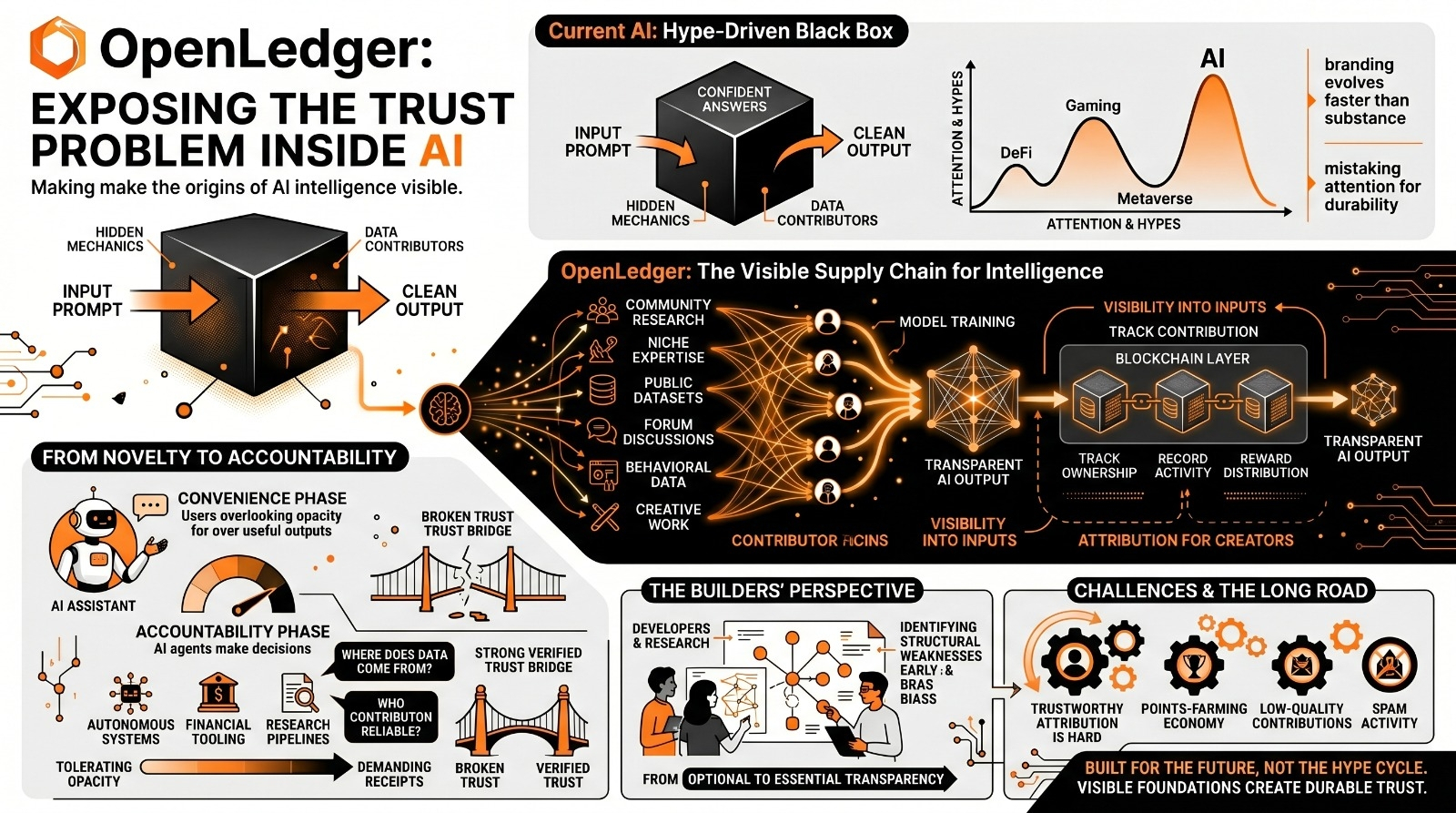
One cycle, everything becomes DeFi infrastructure. Another cycle, every project suddenly becomes gaming. Then metaverse arrives. Then real-world assets. Now AI has become the new uniform everyone wants to wear because the market is desperate for the next thing that feels larger than speculation itself. Most of the time, though, the underlying structure barely changes. The branding evolves faster than the substance.
That is why I usually ignore projects that lean too heavily on narrative. Not because narratives are useless, but because crypto has a habit of mistaking attention for durability. A token trends for a few weeks, engagement spikes, influencers start calling it the future, and suddenly people stop asking difficult questions. Then the excitement fades and reality starts collecting debt.
OpenLedger caught my attention because it seems to be asking a question most AI projects avoid entirely: where does intelligence actually come from? Not the polished output. Not the AI-generated response. Not the demo. The trail behind it.
That distinction matters far more than people realize. I think one of the biggest problems with modern AI systems is how clean they appear from the outside. You type a question into a box, receive a confident answer within seconds, and the process feels almost magical. The machine sounds certain. Smooth. Efficient. Intelligent.
But the moment you stop admiring the response and start asking what created it, the entire system becomes much less simple. What data trained the model? Who contributed that data? Was the information reliable? Who refined it? Who benefited from it? Who got ignored while value accumulated elsewhere?
Those questions usually disappear because they slow down the momentum of the story. Markets do not like slowing down. Crypto especially does not reward patience. The timeline wants movement, catalysts, listings, token charts, partnerships, and engagement loops that create the illusion of inevitability. Very few people want to stop and inspect the machinery underneath.
That is why OpenLedger feels different to me. Not because it claims to be building AI. Everyone claims that now. The interesting part is the attempt to make the origins of intelligence visible instead of invisible. And honestly, I think the market is eventually going to be forced toward that direction whether it likes it or not.
Right now, AI still benefits from novelty. Users tolerate black-box behavior because the outputs feel useful enough to overlook the uncertainty underneath. If an AI writes a decent paragraph, summarizes a document, generates code, or automates a task, most people do not immediately care where the model learned those abilities. Convenience wins first. Principles usually arrive later.
But I do not think that dynamic lasts forever. Especially once AI moves beyond assistance and starts making decisions that affect real value. That shift is already beginning. AI is no longer limited to generating text or answering prompts. It is moving into automation systems, agents, financial tooling, research pipelines, operational workflows, and environments where outputs influence actual outcomes. Once that happens, opacity stops feeling harmless.
If an AI agent makes a poor financial decision, people will ask questions. If a model produces biased outputs, people will ask questions. If a system is trained on unreliable or manipulated data, people will ask questions. And eventually, people will want receipts. Not because transparency sounds noble in a conference presentation, but because trust collapses quickly when systems become powerful enough to matter.
That is the part of OpenLedger I keep thinking about. The idea that AI should not simply produce answers while erasing the chain of contribution behind them. The world is feeding machines with enormous amounts of human knowledge every single day. Community research, niche expertise, public datasets, forum discussions, market analysis, academic material, behavioral data, creative work — all of it becomes training material somewhere inside the system.
Yet most contributors disappear from the final equation entirely. The machine gets smarter. The platform gets more valuable. The users consume the output. But the people who helped shape the intelligence often become invisible. That imbalance is becoming harder to ignore.
And this is where blockchain finally starts making sense to me again in a way that feels practical instead of performative. Not blockchain as a speculative wrapper. Not blockchain as forced tokenization. Not blockchain as a meaningless buzzword inserted into products that never needed it. I mean blockchain functioning as a transparent record layer.
A system capable of tracking contribution, attribution, activity, ownership, and potentially reward distribution in a way that remains visible instead of hidden behind centralized infrastructure. That idea feels far more relevant to AI than most of the shallow integrations currently flooding the market.
Still, I am careful about becoming overly optimistic too early. I have watched too many projects begin with legitimate problems and collapse under execution pressure. Crypto is full of intelligent concepts that eventually turned into inactive dashboards, abandoned ecosystems, or incentive structures that attracted the wrong behavior entirely. OpenLedger is not immune to that risk.
In fact, the problem it is trying to solve may become even messier once incentives enter the system. Because attribution sounds clean in theory until real rewards appear. Then things become complicated very quickly. People farm rewards. They manipulate systems. They upload low-quality contributions. They create spam activity. They optimize for extraction instead of usefulness.
I have seen this happen repeatedly across crypto ecosystems. The moment a network introduces economic incentives, participants immediately begin testing the edges of the system. Some contribute genuine value. Others look for the fastest path to rewards regardless of long-term consequences. That tension matters here. Because OpenLedger does not just need attribution. It needs trustworthy attribution. That is much harder.
The project has to figure out whether useful data can be identified without drowning in noise. It has to determine whether contributors can actually be rewarded fairly without turning the entire ecosystem into another points-farming economy. It has to prove that traceability can exist without destroying usability. And honestly, that is where the real test begins.
Not in the branding. Not in the marketing. Not in the token narrative. In the friction. I pay attention to how projects behave under friction because that is where strong systems separate themselves from temporary stories. Anyone can design a beautiful concept in ideal conditions. The difficult part is surviving contact with real users, conflicting incentives, low-quality participation, market boredom, and the relentless pressure of speculation-driven behavior.
That is why I keep coming back to the infrastructure layer underneath OpenLedger rather than the AI narrative sitting on top of it. Most people only focus on the visible layer of AI. The assistant. The agent. The output. The product demo. The short clip designed for social media attention. But AI systems are only as strong as the material feeding them.
Weak data creates weak intelligence with better presentation. Poor attribution creates systems where value flows upward while contributors disappear. Bad incentives create temporary ecosystems filled with participants who leave the moment rewards slow down. OpenLedger appears to understand that the data layer is not boring infrastructure hidden beneath the product. It is the foundation itself.
The problem is that foundations rarely generate immediate excitement. Infrastructure projects usually suffer from a brutal visibility problem. They are building systems the market may eventually depend on while competing inside an environment obsessed with instant movement and fast narratives. That is difficult. Especially in crypto.
A project focused on data ownership, attribution, and traceability has to convince people that invisible architecture matters before most users even recognize the problem. It has to explain why the origins of intelligence matter while traders are watching token candles move every fifteen minutes. That is not easy positioning.
But it may attract the right audience first. Because I do not think OpenLedger’s early users are necessarily going to be casual consumers. The first meaningful audience may be builders themselves — developers, researchers, AI teams, and infrastructure participants who already understand that specialized AI systems require cleaner data flows and more transparent contribution models.
Builders usually recognize structural weaknesses earlier than retail users do. They see the scaling problems sooner. They understand where systems break. And if enough builders start viewing attribution and traceability as essential rather than optional, OpenLedger could become far more important over time than it appears right now.
That possibility is what makes me keep watching. Quietly. Not because I think the hard part is already solved. The hard part has barely started.
Can the network attract high-quality data instead of low-effort farming behavior? Can contributors actually earn meaningful value? Can attribution systems remain reliable at scale? Can developers build AI models people genuinely prefer because the outputs are better, not because the marketing is louder? Can OpenLedger create transparency without making the user experience painfully complicated?
That last question matters more than people think. Because users may support transparency philosophically while rejecting it behaviorally if the system becomes too heavy to use. I have watched that happen before too. Projects get the philosophy right and the product wrong. The community applauds the vision. Engagement fades anyway.
The market eventually moves on because attention alone cannot sustain ecosystems forever. Crypto is ruthless about that. It burns through narratives quickly and rarely waits around for unfinished execution to catch up. That is why I am far more interested in whether OpenLedger can survive the slow phase than whether it can dominate a temporary trend cycle.
Useful infrastructure often looks boring before it looks important. The market usually realizes value late. Especially when the work happening underneath is invisible to casual users. And maybe that becomes OpenLedger’s real challenge: convincing people that intelligence should have a visible supply chain.
Because right now, most users do not think that way. They want convenience. They want speed. They want systems that feel seamless. Few people wake up thinking about attribution trails or data ownership mechanics. But people also ignored internet privacy until platforms became powerful enough to reshape behavior at global scale.
They ignored platform dependence until ecosystems became monopolized. They ignored data extraction until companies built trillion-dollar businesses on top of user activity. AI may follow a similar path. At first, convenience dominates. Later, accountability becomes unavoidable.
That is where OpenLedger’s direction starts feeling less like optional infrastructure and more like something future systems may eventually require. Receipts for data. Receipts for contribution. Receipts for model behavior. Receipts for value creation. Not because transparency sounds idealistic, but because trust becomes fragile once intelligence starts interacting with real economic systems.
And if AI truly becomes embedded into markets, autonomous agents, financial coordination, and decision-making infrastructure, then invisible foundations may eventually become unacceptable. Someone will need to explain where outputs came from. Someone will need to verify who contributed value. Someone will need to track accountability when systems fail.
Maybe OpenLedger becomes part of that future. Maybe it fails trying. Both outcomes are still possible. That is why I am not interested in calling it “the future of AI” or pretending the outcome is already decided. This market has buried too many ambitious ideas for me to speak in absolutes anymore.
What I will say is this: OpenLedger is asking a more serious question than most projects in the AI narrative cycle. Not how to make AI louder. Not how to attach a token to automation. Not how to ride the current trend until liquidity rotates somewhere else.
It is asking whether intelligence should remain a black box once it starts influencing real systems. And honestly, I think that question becomes more important with every passing cycle. Because intelligence does not appear from nowhere. Data has origins. Knowledge has contributors. Models have inputs. Value has sources.
The market may ignore that for now. But eventually, systems built on invisible foundations tend to run into trust problems. And when that happens, projects already thinking about attribution, transparency, and contribution tracking may suddenly stop looking boring.
That is why I am watching OpenLedger carefully. Not loudly. Not emotionally. Just carefully. Because sometimes the most important shifts in crypto begin underneath the surface long before the market notices them.
@OpenLedger #OpenLedger #openledger $OPEN
