

I keep coming back to a simple question whenever I look at projects like OpenLedger: if AI is going to become one of the most valuable layers of the internet, who actually captures that value? For years in crypto, we have talked about ownership, incentives, decentralization, and open networks. But when AI entered the conversation, a lot of that language suddenly became vague again. Everyone started saying “decentralized AI,” as if putting those two words together automatically solved something. It doesn’t. In fact, it usually creates more questions than answers.
That is why OpenLedger caught my attention, not because it uses the familiar combination of AI and blockchain, but because it seems to be pointing at a more specific problem: the monetization of data, models, and agents. That sounds simple on the surface, but the more I think about it, the more complicated it becomes. Data is everywhere, models are becoming easier to build, and agents are slowly turning from demos into tools that can actually perform tasks. Yet the economic layer around all of this still feels unfinished. People contribute data, train systems, fine-tune models, create workflows, and build agent logic, but the value often flows upward into platforms rather than outward to contributors.
Crypto has always claimed it can fix that kind of imbalance. Sometimes it has. Often, it has only created new versions of the same problem with tokens attached. So when I look at OpenLedger, I try not to ask, “Is this the next big AI blockchain?” That question feels too shallow. I’d rather ask: does this project identify a real coordination problem, and does its architecture make that problem easier to solve?
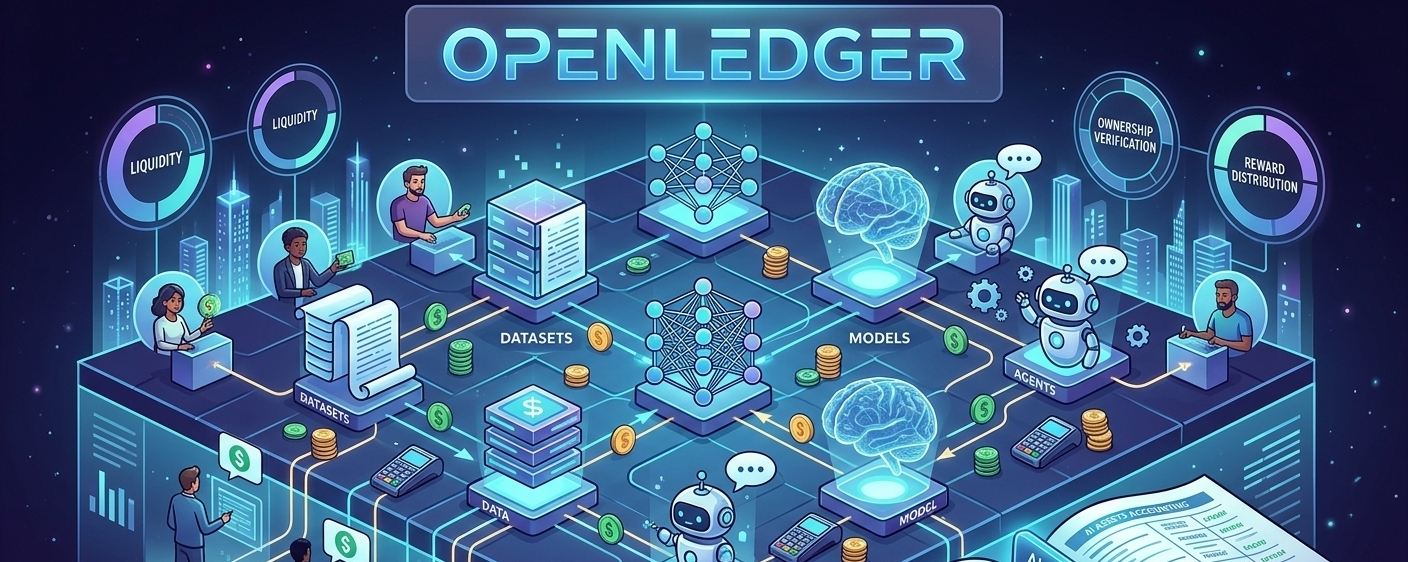
The core idea, as I understand it, is that OpenLedger wants to unlock liquidity around AI-related assets: data, models, and agents. In traditional markets, liquidity usually means the ability to buy, sell, price, and move assets efficiently. In AI, that is harder. A dataset is not like a coin. A model is not like a simple NFT. An agent is not just software sitting still; it can act, adapt, interact, and produce outputs over time. If these things are going to become economic assets, then the system needs ways to verify contribution, assign ownership, measure usage, and distribute rewards.
That is where blockchain can make sense, at least in theory. A blockchain is not magically useful just because something involves technology. But it can be useful when multiple parties need a shared record, transparent settlement, and programmable incentives without relying entirely on one central platform. If OpenLedger can create a credible ledger for AI assets and their economic activity, then it is working on a problem that matters.
What I find interesting is that OpenLedger is not only talking about data. Many AI-crypto projects stop there. They say users should own their data, sell their data, or get rewarded for contributing data. That idea is appealing, but it is also incomplete. Raw data by itself is not always valuable. Context matters. Quality matters. Provenance matters. The model trained on the data matters. The agent using the model matters. The final economic value may come from a chain of contributions rather than one isolated input.
This is where OpenLedger’s framing around data, models, and agents feels more realistic. AI value is layered. Someone may contribute a dataset. Someone else may refine it. Another person may train a model. Another may create an agent that uses that model in a specific market. If revenue appears at the end, how should it be distributed? Who deserves credit? How do you avoid rewarding noise? These are not easy questions, but they are the kinds of questions crypto is actually built to explore.
At the same time, I am cautious. The crypto industry has a habit of turning every coordination problem into a token problem, and then pretending the token itself is the solution. A token can help coordinate incentives, but it can also distort them. If people are rewarded mainly for participation rather than useful contribution, the system fills with low-quality activity. We have seen this pattern many times: farming, spam, inflated metrics, artificial demand, and communities that care more about points than products.
For OpenLedger, the challenge will be proving that its economic design can reward genuine AI value rather than just activity around AI. That distinction matters. A network can have many users, many assets, and many transactions, but still fail to create meaningful intelligence or sustainable revenue. In AI, quality is harder to measure than quantity. A model may look impressive in a demo but fail in production. A dataset may be large but messy. An agent may be active but unreliable. If OpenLedger wants to become an economic layer for AI assets, it will need strong mechanisms for trust, verification, and usefulness.
The broader crypto ecosystem needs this kind of thinking because it is still searching for real demand beyond speculation. DeFi created financial primitives, NFTs experimented with digital ownership, and infrastructure projects built faster chains and better tooling. But many networks still struggle with the same question: what valuable activity happens here when the market is not euphoric? AI might provide one answer, but only if the blockchain layer does something necessary.
That is why I am more interested in OpenLedger’s architecture than its narrative. Narratives are easy. “AI plus blockchain” is already one of the strongest narratives in the market. But architecture reveals whether a project is trying to solve a real problem or simply position itself inside a trend. If OpenLedger can create infrastructure where AI assets become traceable, composable, and monetizable, then it may offer something more durable than another speculative cycle.
Still, I do not think the path is straightforward. AI markets are messy. Data rights are legally complex. Model ownership can be unclear. Agents introduce accountability problems. If an agent makes money, who owns the output? If it causes harm, who is responsible? If a model is trained on contributed data, how much of the future value belongs to the original data provider? These questions do not disappear because a blockchain records transactions. In some cases, blockchain may make the questions more visible without fully solving them.
But maybe visibility is part of the point. One of the problems with today’s AI economy is that value creation often happens in the dark. Users generate data. Developers build tools. Communities produce knowledge. Platforms absorb the output. The accounting is hidden. OpenLedger seems to be asking whether that accounting can become more open. Not perfect, not magically fair, but more legible.
That matters because the next phase of AI may not be only about bigger models. It may be about specialized intelligence: niche datasets, domain-specific agents, smaller models with clear use cases, and networks where contributors can participate economically. If that future arrives, then liquidity around AI assets becomes important. People will need ways to price, exchange, combine, and earn from these assets. OpenLedger appears to be positioning itself around that possibility.
What feels different here is the attempt to treat AI components as economic objects rather than just technical tools. In most crypto projects, the asset comes first and the utility comes later. With AI, the utility already exists in the world. The question is whether crypto can create better markets around it. That reversal is important. Instead of inventing demand for a token, the project has to connect with existing demand for data, models, automation, and intelligence.
Of course, execution will decide everything. The idea can be strong and still fail if the user experience is poor, if developers do not build on it, if incentives attract extractive behavior, or if the network cannot prove that its assets have real value. OpenLedger will also have to compete with centralized AI platforms that move faster, control distribution, and offer simpler onboarding. Decentralization is meaningful, but convenience often wins unless the decentralized alternative offers something clearly better.
I also wonder how much users will actually care about owning and monetizing AI assets. In crypto, we sometimes assume that ownership is always the strongest motivation. But many users choose convenience over ownership every day. For OpenLedger to matter, it may need to serve builders and contributors who feel the current AI economy is unfair or inefficient enough to seek another path. That is a narrower but potentially more serious audience.
My view is that OpenLedger is worth watching because it is circling a real issue: AI value is becoming too important to remain trapped inside closed systems. If data, models, and agents become major productive assets, then the economy around them needs better rails. OpenLedger’s bet is that blockchain can provide those rails through transparency, liquidity, and programmable incentives.
I am not convinced yet, but I am interested. And in crypto, that is usually the healthier position. Conviction too early often turns into blindness. Skepticism without curiosity turns into missed opportunities. OpenLedger sits somewhere in between for me: not a guaranteed breakthrough, not just another empty narrative, but a project asking a question that the industry will probably have to answer sooner or later.
Who owns intelligence when intelligence becomes an asset? Who gets paid when machines learn from human contribution? And can crypto build a market that rewards the people and systems behind that intelligence, instead of only rewarding the platforms that capture it?
Those are difficult questions. OpenLedger may not answer all of them. But the fact that it is aiming at them makes it more interesting than the average AI-chain pitch. In a market full of loud claims, I tend to pay more attention to projects that expose complexity rather than hide it. OpenLedger, at least from this angle, seems to belong in that conversation.
