
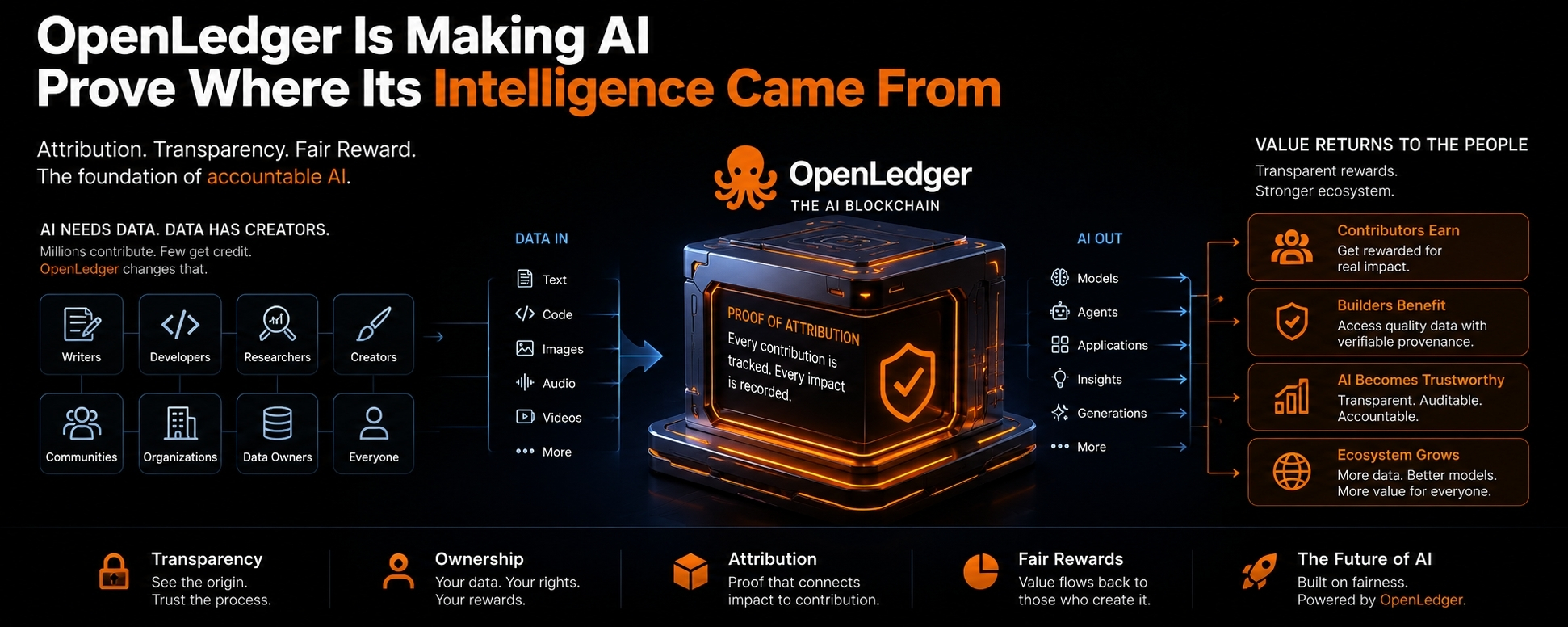
I’m watching OpenLedger come into the AI story at a very specific moment, and that is what makes it interesting. Not when everyone is calmly thinking about trust. Not when the rules are clear. But right now, while AI is moving fast, value is being created everywhere, and almost nobody can clearly prove where that value came from.
That tension matters.
Because AI is becoming powerful before it has become transparent.
It can write, code, research, summarize, answer, and act like it understands the world. But behind the clean output, there is still a messy question sitting quietly underneath everything.
Who contributed to this intelligence?
OpenLedger is focused on that question.
And in my opinion, that is why the project feels different from the usual AI-and-crypto noise.
It is not just saying AI needs blockchain because that sounds good in a market cycle.
It is looking at the deeper problem.
AI depends on data.
Data comes from people.
People create, write, build, label, organize, explain, correct, and share knowledge.
But once that knowledge enters a model, the original contributors usually disappear.
No trace.
No credit.
No upside.
Just value moving away from the people who helped create it.
OpenLedger is trying to change that relationship.
It wants AI to have memory.
Not memory in the emotional sense.
Memory in the economic sense.
A way to know what data shaped an AI system.
A way to understand which contributions mattered.
A way to connect value back to the source instead of letting everything vanish inside a black box.
That is a serious idea.
Because the future of AI will not only depend on bigger models.
It will depend on better trust.
A company using AI will want to know why it should trust the output.
A developer building AI agents will want to know what the system was trained on.
A data contributor will want to know whether their work is being used fairly.
A community with valuable knowledge will want a reason to participate instead of being extracted from.
OpenLedger sits right in the middle of that future.
It is building around attribution.
That word sounds small, but it may become one of the most important ideas in AI.
Attribution means the machine does not just produce an answer and walk away.
It means there is a trail.
It means contribution can be seen.
It means data can carry value beyond the moment it is uploaded.
It means the people behind useful intelligence do not have to stay invisible forever.
That is where OpenLedger starts to feel powerful.
Because the AI market is full of projects trying to look intelligent.
OpenLedger is trying to make intelligence accountable.
There is a big difference.
The world already has enough tools that generate content.
It has enough chatbots.
Enough dashboards.
Enough agents pretending to be revolutionary.
What it does not have enough of is infrastructure that makes AI more honest.
That is the lane OpenLedger is moving into.
And honestly, it feels early.
Not early in the empty hype sense.
Early in the sense that the market has not fully priced in how badly AI will need proof.
Right now, people are still impressed by output.
They see a good answer and move on.
But that will not last.
As AI starts touching finance, healthcare, law, education, research, trading, business decisions, and automated workflows, people will demand more than confidence.
They will demand origin.
They will demand accountability.
They will demand systems that can show how value was created.
OpenLedger is building for that demand before it becomes obvious to everyone.
That is usually where the best infrastructure stories begin.
Quietly.
Before the crowd catches the real problem.
The project also understands something simple that many AI companies avoid saying out loud.
High-quality data is not free forever.
The best knowledge belongs to people and communities.
And those people will not keep feeding AI systems if the deal is always one-sided.
If OpenLedger can help create a system where data contributors, model builders, and AI applications are connected through clear attribution and rewards, then it is not just improving AI.
It is improving the economics around AI.
That is the bigger vision.
An AI economy where contribution is not lost.
Where useful data can become a productive asset.
Where communities can build around knowledge.
Where AI models are not just trained on invisible work, but connected to visible value.
That is a much stronger idea than simply launching another AI token.
OpenLedger feels like it is aiming at the foundation.
The part beneath the products.
The part users do not always see at first, but eventually cannot live without.
Because every serious technology market reaches a point where trust becomes more important than speed.
At first, people want things fast.
Then they want them reliable.
Then they want them verifiable.
AI is entering that transition.
And OpenLedger is positioning itself around verification, attribution, and ownership at exactly the time those ideas are becoming harder to ignore.
That gives the project a real narrative.
Not a forced one.
A natural one.
AI is creating value at massive scale.
OpenLedger is asking who gets remembered in that value.
AI is becoming part of business and culture.
OpenLedger is asking how we prove what shaped it.
AI is becoming more powerful.
OpenLedger is asking how we keep it accountable.
That is why I think the project deserves attention.
Not because attention is easy in Web3.
It is not.
But because OpenLedger is pointing at a problem that will only get bigger.
The more AI grows, the more attribution matters.
The more AI earns, the more contributors will ask where their share is.
The more AI makes decisions, the more users will ask where its knowledge came from.
OpenLedger is not chasing the surface of the trend.
It is working closer to the root.
And projects that work near the root are often the ones people underestimate in the beginning.
Then one day the market turns around and realizes the root was the whole story.
That is the feeling I get with OpenLedger.
It is not trying to make AI louder.
It is trying to make AI fairer, clearer, and more trustworthy.
It is trying to give intelligence a trail.
It is trying to make sure the people and data behind AI do not disappear once the output becomes valuable.
And if AI really is going to become one of the most important economic layers of the next decade, then the question OpenLedger is building around will not stay small.
Who created the value?
Who can prove it?
Who gets rewarded?
That is where the project becomes interesting.
Because OpenLedger is not just building for AI as it looks today.
It is building for the moment when AI has to show its work.