
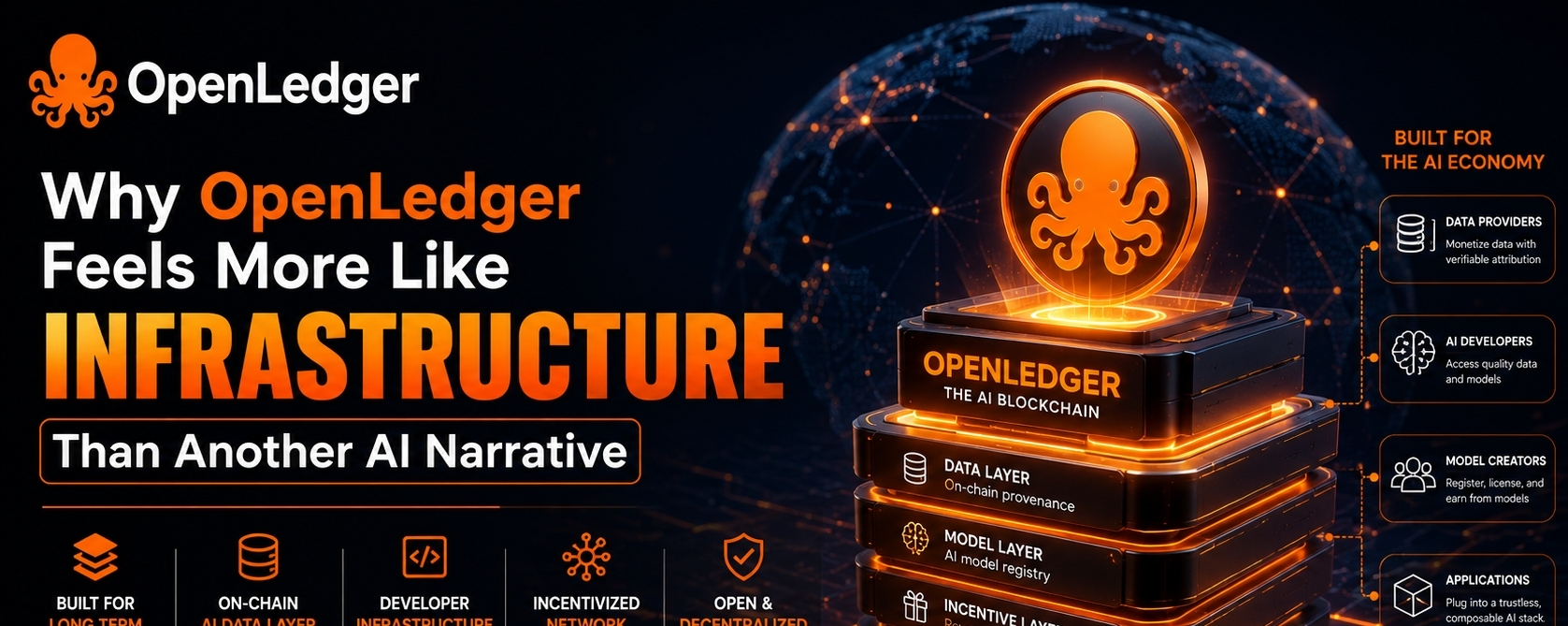
Most people still talk about AI as if the important part is the model itself. Bigger models. Faster inference. Smarter agents. Better outputs. But after spending enough time watching the ecosystem closely, you begin realizing that intelligence is no longer the rare thing. Coordination is. The real weakness inside modern AI systems is not the lack of capability. It is the inability to fairly organize the people, data, models, and incentives surrounding that capability without eventually collapsing into centralization.
That problem becomes visible in small ways first.
Communities contribute enormous amounts of behavioral data but rarely maintain ownership over how that value compounds. Independent developers improve ecosystems they cannot meaningfully influence later. Researchers release work that becomes commercially valuable elsewhere while attribution slowly disappears beneath larger platforms. The AI economy keeps expanding, yet the distance between contribution and reward keeps widening.
The uncomfortable truth is that most systems today are designed to absorb intelligence not distribute its value.
That is why OpenLedger feels different when you study it beyond surface-level narratives.
The project does not come across like something created to chase temporary excitement around AI. It feels more like an attempt to correct a structural imbalance before that imbalance becomes irreversible. There is a noticeable level of restraint in the ecosystem almost as if the builders understand that once coordination systems break at scale, rebuilding trust becomes far harder than building technology.
What stands out immediately is that OpenLedger seems less obsessed with maximizing short term activity and more focused on preserving long term economic relationships between contributors and intelligence creation. That sounds theoretical until you observe how differently participants behave inside systems where attribution actually matters.
In most digital ecosystems, contribution is temporary. A user creates value, the platform absorbs it, and the relationship effectively ends there. Over time this creates shallow participation because users understand, consciously or subconsciously, that they are building inside environments they do not truly belong to.
OpenLedger appears to challenge that pattern by treating data, models, and agents as continuously traceable economic entities rather than disposable inputs. That single design philosophy changes behavior more than most technical features ever could.
When people believe their contributions remain visible over time, they stop optimizing purely for immediate extraction. The ecosystem becomes less transactional. Builders think longer term. Contributors become more selective about quality. Reputation starts mattering because the network remembers participation instead of flattening everyone into anonymous activity metrics.
You can actually see the difference between early and later users through this shift.
The earliest participants behaved like explorers moving through an unfinished frontier. Many were experimenting with ideas rather than committing to infrastructure. They tolerated instability because they were more interested in testing whether decentralized AI coordination was even possible. Discussions were highly ideological during that period. People focused on narratives, possibilities, and future potential more than operational discipline.
But ecosystems mature when ideology collides with reality.
As OpenLedger evolved, the nature of participation began changing. The users who remained active were increasingly the ones paying attention to system behavior rather than announcements. They watched how attribution mechanisms held up under stress. They observed whether integrations continued functioning quietly after launch. They cared less about vision statements and more about structural consistency.
That transition is incredibly important because it marks the moment a protocol starts moving from experimentation toward reliability.
Reliability is what separates infrastructure from trends.
And infrastructure thinking requires a very different mindset from growth at all costs thinking.
Many projects expand rapidly because attention rewards speed. But speed often hides unresolved coordination problems that only become visible later under scale. Incentives get distorted. Governance becomes reactive. Low quality participation overwhelms useful contribution. Reputation systems become exploitable. Shortcuts taken during expansion eventually become structural weaknesses.
OpenLedger often feels unusually cautious around these dynamics.
Some features appear intentionally delayed until the ecosystem can support them responsibly. Some growth opportunities seem avoided entirely if they threaten attribution integrity or long term coordination quality. From the outside, this can look slower than competing ecosystems. But internally, that discipline may be exactly what prevents the network from becoming unstable later.
There is a difference between systems designed to look alive and systems designed to survive.
The distinction becomes clearer when observing integration quality across the ecosystem. Temporary activity is easy to manufacture. Sustainable integrations are not. Developers only continue building around protocols when operational reliability consistently justifies the effort. Every stable integration represents a form of long-term confidence that cannot be easily faked.
And confidence inside infrastructure ecosystems compounds slowly.
This is also where OpenLedger’s philosophy around liquidity becomes more meaningful. The project is not simply trying to tokenize AI activity. It seems focused on making intelligence production economically interoperable without losing attribution along the way. That is a much harder challenge than creating isolated AI products because it requires balancing openness with accountability simultaneously.
Too much openness creates noise and manipulation.
Too much control destroys decentralization entirely.
Most ecosystems struggle to navigate this tension because both extremes create different kinds of failure. OpenLedger appears to recognize that durable coordination systems are not built by eliminating trade offs, but by managing them carefully over time.
That awareness gives the ecosystem a more mature feeling than many AI related projects currently operating in crypto.
Another subtle but important aspect is how community trust forms inside the network. In speculative ecosystems, trust is often emotional and temporary. People trust momentum, personalities, or incentives. But inside more durable systems, trust becomes observational. Participants stay because they repeatedly witness coherent behavior across long periods of time.
They observe whether governance decisions remain rational under pressure.
They observe whether contributors continue receiving fair attribution.
They observe whether the ecosystem prioritizes stability during periods where rapid expansion would be easier.
Over time, these repeated observations create a form of confidence that marketing cannot manufacture.
That confidence becomes especially important once ecosystems enter quieter phases. Every protocol looks strong during periods of attention. The real test begins when external excitement fades and only structural quality remains visible. Weak systems begin fragmenting during those periods because participation was never rooted in trust to begin with.
More resilient systems often become stronger quietly.
OpenLedger increasingly feels like a project entering that stage where the focus gradually shifts away from proving legitimacy and toward refining durability. Conversations inside the ecosystem seem less centered around excitement and more centered around coordination quality, integration depth, and contribution reliability.
That change in conversation is one of the clearest indicators that an ecosystem is maturing.
Because mature communities stop asking whether something sounds revolutionary and start asking whether it can remain dependable for years.
The OPEN token also becomes easier to understand through this perspective. Its importance is less about speculation and more about maintaining alignment across participants who otherwise have very different incentives. Contributors, developers, governance participants, and infrastructure operators all interact with the network differently. Sustainable systems require mechanisms that encourage these groups to think beyond immediate self interest.
Otherwise ecosystems eventually become extraction environments where everyone optimizes against everyone else.
The strongest networks avoid that outcome by making long term ecosystem health economically relevant to participants themselves. OpenLedger appears increasingly designed around that principle.
Still, the challenge ahead is enormous.
AI coordination at scale is probably one of the hardest infrastructure problems emerging right now. The moment real economic value flows consistently through decentralized intelligence systems, every weakness becomes amplified. Manipulation attempts increase. Governance pressure increases. Contribution verification becomes harder. Maintaining fairness across distributed participants becomes increasingly complex.
There are no perfect solutions waiting at the end of this process.
Only systems disciplined enough to continuously adapt without losing their foundational principles.
That may ultimately become the defining test for OpenLedger.
Not whether it can generate temporary attention, but whether it can maintain attribution integrity, coordination quality, and operational consistency while the ecosystem around AI becomes larger, noisier, and more financially aggressive.
Because if those foundations remain intact, OpenLedger could eventually evolve into something far more important than another blockchain narrative.
It could become part of the invisible coordination layer beneath decentralized AI economies the kind of infrastructure people stop discussing ideologically because they simply begin relying on it operationally.
And historically, that is usually how the most important systems emerge.
Quietly at first.
Then permanently.
