
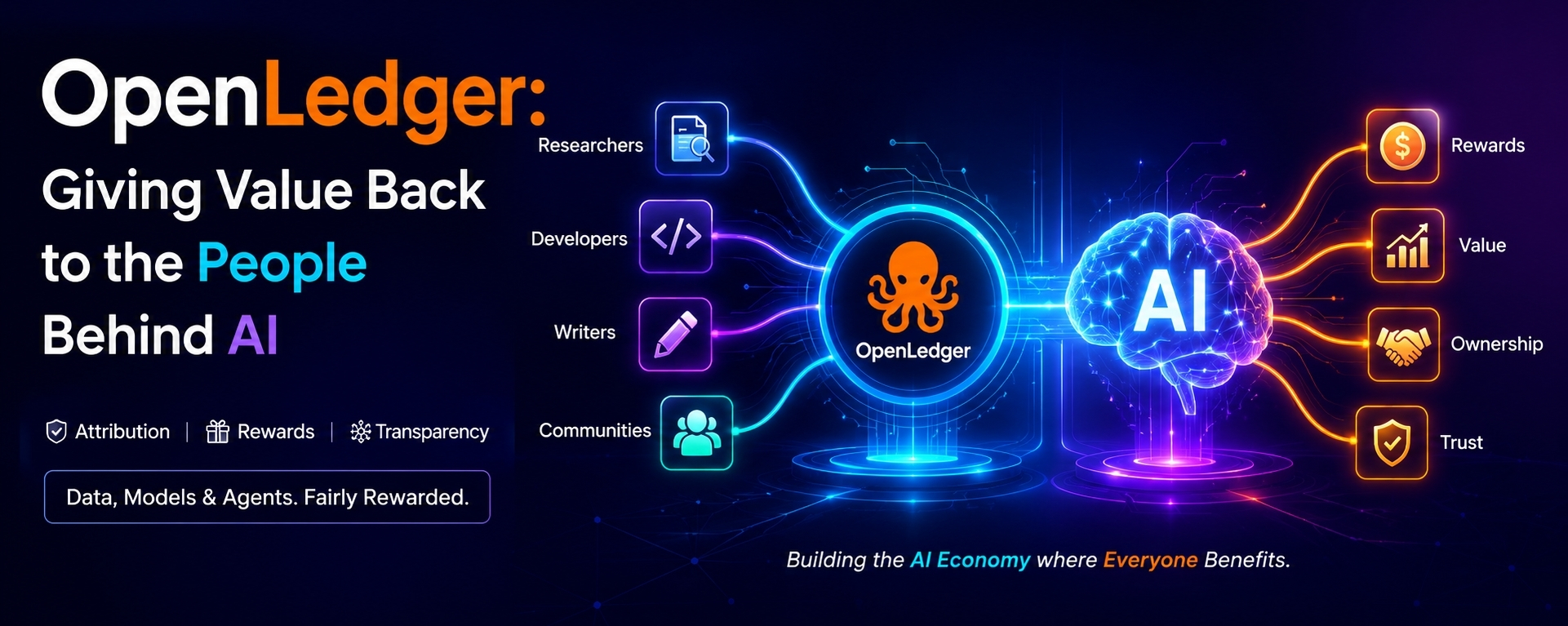
I remember reading an online discussion last year where people were arguing about whether artificial intelligence would eventually replace certain jobs. The conversation went in circles for hundreds of comments, but one person asked a much more interesting question. If AI systems are generating enormous value, who actually deserves a piece of that value in the first place?
The question stuck with me because most of the attention around AI focuses on the companies building the models, the investors funding them, or the products being launched. Much less attention goes to the people whose knowledge, data, expertise, and content help make those systems useful. Researchers publish papers. Developers contribute code. Communities spend years discussing niche subjects. Writers create articles. Experts share insights online. All of that information becomes part of the digital ecosystem that modern AI learns from, yet very few contributors have any visibility into how their work is used or whether it creates value long after it leaves their hands.
That is the problem OpenLedger is trying to address.
At first glance, OpenLedger can sound like another project combining blockchain and AI, two of the most crowded buzzwords in technology. There are plenty of projects that attach themselves to popular trends without offering much substance underneath. What makes OpenLedger interesting is that it starts from a genuine economic problem rather than a marketing narrative. The team behind the project believes that data, models, and AI agents should function within a system where contributions can be tracked and rewarded instead of disappearing into a black box.
The idea sounds almost obvious when you hear it. If someone contributes valuable data that helps improve an AI model, shouldn't they benefit when that model creates value later on? In most cases today, the answer is no. Data often enters a training pipeline, becomes part of a larger system, and effectively loses its identity. The resulting model may generate revenue for years while the original contributors remain invisible.
OpenLedger wants to create a framework where that relationship becomes more transparent. Rather than treating data as a disposable input, it views data as a long-term asset. The project's vision revolves around identifying contributions, recording them, and creating economic incentives that reward people when their contributions help power AI systems.
What I find compelling is that this isn't just a theoretical issue anymore. A few years ago, AI was largely experimental for most businesses. Today it is becoming a real economic engine. Companies are building products around it, automating workflows, creating new services, and generating revenue from AI-powered tools. As the financial stakes increase, questions around ownership and attribution naturally become more important.
One area where OpenLedger's thinking feels particularly relevant is the growing importance of specialized data. For years, the industry seemed obsessed with making models larger. More parameters, more computing power, more training material. That strategy produced impressive results, but many experts now acknowledge that high-quality data often matters more than sheer quantity. A medical AI system gains more value from accurate healthcare information than from endless generic text scraped from the internet. The same applies to legal analysis, cybersecurity, finance, and scientific research.
This is where OpenLedger's approach makes practical sense. Instead of focusing solely on models, it pays attention to the ecosystem surrounding them. Better data tends to produce better outcomes. If contributors have incentives to provide and maintain high-quality information, the entire network potentially benefits.
Of course, the attractive part of any vision is usually the easy part. The difficult part is implementation.
The biggest challenge facing OpenLedger is also the challenge facing anyone attempting to solve attribution in artificial intelligence. Modern AI systems do not learn in simple, linear ways. Knowledge becomes distributed across millions or even billions of parameters. Determining exactly how much influence a particular dataset had on a specific output is incredibly difficult.
Think about human learning for a moment. If someone asks where your understanding of history comes from, you probably couldn't provide an exact breakdown. Some knowledge came from school, some from books, some from documentaries, some from conversations. Everything blends together over time. AI systems face a similar complexity, except at a far larger scale.
This is why OpenLedger's ambition is impressive but also risky. The project is attempting to solve a problem that many researchers and developers still struggle to define precisely. The concept is attractive. The execution will determine whether it becomes something transformative or simply another interesting experiment.
There is also the unavoidable reality that every reward system attracts people looking for shortcuts. History has shown this repeatedly across technology, finance, gaming, and crypto. Whenever incentives exist, some participants will attempt to maximize rewards without creating corresponding value. Low-quality submissions, duplicated information, spam activity, and manipulation are challenges that nearly every decentralized network encounters eventually.
OpenLedger will need mechanisms strong enough to encourage genuine contributions while discouraging abuse. That sounds straightforward in theory but becomes significantly harder once real money enters the equation. Building sustainable incentive structures may end up being just as important as building the technology itself.
Another question worth asking is whether blockchain is actually necessary for this vision. It's a fair criticism because many projects introduce blockchain solutions to problems that could be solved with traditional databases. Skeptics often point this out, and sometimes they're right.
Yet OpenLedger's argument is not simply that blockchain is fashionable. The argument is that ownership, attribution, and reward distribution become more trustworthy when they exist within an open, transparent network rather than under the control of a single organization. Whether that advantage outweighs the complexity is something the market will ultimately decide.
What keeps bringing me back to OpenLedger isn't the token, the blockchain architecture, or even the technical details. It's the broader question the project forces people to confront.
For decades, digital platforms have concentrated value around infrastructure. The companies that owned the platform usually captured the majority of economic benefits. Artificial intelligence may push that model even further if a handful of organizations end up controlling both the models and the data that powers them.
OpenLedger proposes a different possibility. Not necessarily a perfect one, and certainly not a guaranteed one, but a different possibility nonetheless. It imagines an AI economy where contributors remain visible, where participation can be measured, and where value flows more broadly across the network instead of accumulating exclusively at the top.
Maybe that future arrives. Maybe it doesn't.
Technology history is filled with ambitious ideas that sounded inevitable until reality intervened. OpenLedger could become an important piece of AI infrastructure, or it could discover that solving attribution at scale is far more difficult than expected. Both outcomes remain possible.
What seems increasingly clear, however, is that the conversation behind OpenLedger is not going away. As AI becomes more powerful and more profitable, people will continue asking where intelligence comes from, who contributes to it, and who deserves to benefit from it.
For a long time, those questions were mostly philosophical.
Now they're becoming economic ones.And that shift may end up mattering more than any individual blockchain project ever could.