
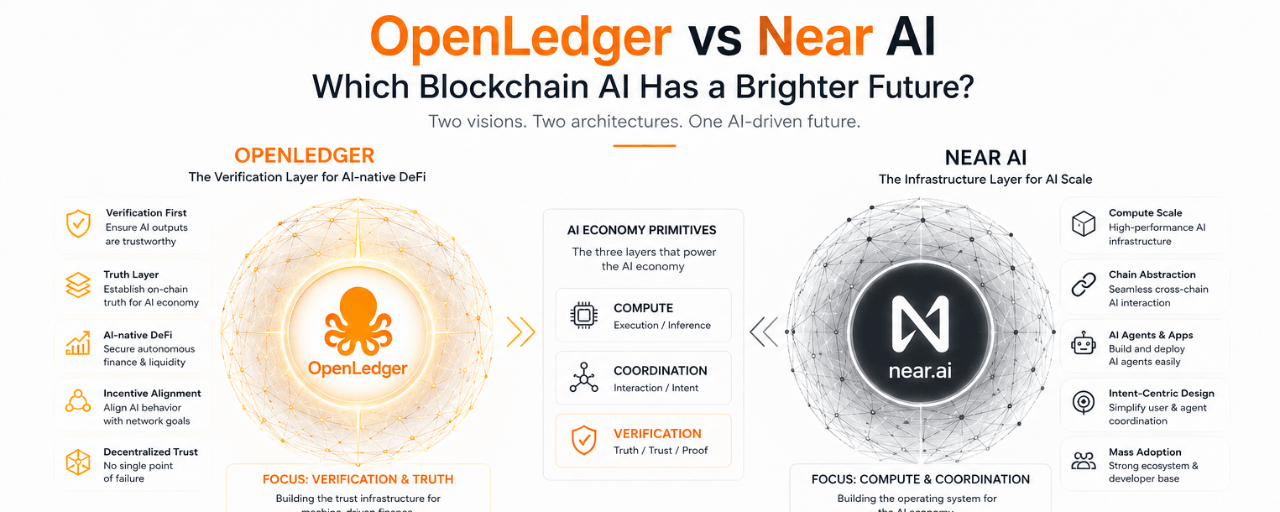
When comparing OpenLedger and Near AI, I think the most important thing to understand is that they are solving entirely different problems, even though both sit under the broader “AI + blockchain” narrative.
At the surface level, it’s easy to frame this as a competition over adoption, developer growth, partnerships, or market momentum. But the deeper I look into both ecosystems, the more it feels like they represent two very different interpretations of what an AI-native economy should actually look like.
Near seems to approach AI primarily as an infrastructure challenge. The focus is on making computation cheaper, improving inference, abstracting away blockchain complexity, and enabling AI applications to run seamlessly for consumers. That direction aligns naturally with Near’s long-term philosophy: blockchains should fade into the background and simply function as invisible execution layers beneath smooth user experiences.
OpenLedger feels fundamentally different.
I don’t see it merely as another AI-focused chain. Instead, it looks more like an attempt to redefine how intelligence itself is organized economically. The focus isn’t just where AI runs, but how data, model contributions, verification, and feedback loops become economic primitives inside a decentralized system.
At the simplest level, I think both ecosystems are optimizing for different outcomes.
Near is optimizing for intelligence accessibility.
OpenLedger is optimizing for intelligence ownership.
That distinction matters more than people realize.
Near is trying to make AI easier to deploy, easier to integrate, and easier for developers to turn into consumer-facing products. OpenLedger, on the other hand, appears focused on questions like: who contributed the data, who validated the outputs, who trained the models, and who captures value from the resulting intelligence network.
And increasingly, I think those questions become more important over time.
Because AI’s biggest bottleneck is no longer just compute power. Compute is rapidly becoming commoditized, and open-source models continue driving costs lower. What the market may eventually lack isn’t intelligence itself, but trustworthy intelligence.
That means systems capable of aligning incentives between data providers, model creators, validators, and users long enough to create sustainable economic coordination.
This is why OpenLedger stands out to me from a systems-design perspective, even if Near may currently be moving faster on infrastructure adoption.
Near is building highways for AI applications.
OpenLedger seems to be building the accounting system for the AI economy itself.
And I think that distinction becomes increasingly important once AI agents evolve beyond simple assistants and start acting as autonomous economic participants — managing liquidity, allocating capital, optimizing strategies, or interacting directly with other agents.
At that stage, the challenge is no longer just whether models are intelligent enough.
The challenge becomes whether the system can verify contributions, preserve trust, and distribute value fairly across millions of autonomous interactions.
That’s where OpenLedger diverges most sharply from Near.
Near treats AI primarily as a scalability and usability problem.
OpenLedger treats AI as a coordination and verification problem.
One is focused on making intelligence usable.
The other is focused on making intelligence economically legible.
That’s also why OpenLedger talks heavily about data attribution, decentralized trust, and verification flows. In a truly AI-native economy, “truth” stops being philosophical and becomes economic infrastructure.
As synthetic content floods the internet, the problem starts resembling what DeFi once experienced with liquidity. The issue eventually wasn’t liquidity itself — it was trustworthy liquidity.
AI may follow the same path.
The problem won’t be insufficient intelligence.
It will be insufficient verified intelligence.
And OpenLedger increasingly looks like an attempt to build a verified intelligence economy — a system capable of tracking where outputs originate, what context shaped them, who contributed to training and validation, and how reliable those outputs remain over time.
That’s an extremely difficult layer to build because AI networks are not just compute systems. They are trust systems.
Near may very well scale consumer AI interactions faster and attract broader developer adoption in the short term. But faster application growth alone doesn’t necessarily create a durable AI-native economy because economies ultimately depend on long-term incentive alignment, not just throughput.
Meanwhile, OpenLedger appears to be tackling deeper coordination primitives, even if adoption develops more slowly.
The challenge is whether markets have the patience to value that kind of infrastructure early on. Coordination layers are notoriously difficult to monetize in their early stages — similar to trying to build accounting standards for the internet before most people even understood why digital accounting mattered.
And historically, market cycles tend to reward visible applications long before they reward invisible trust architecture.
Users notice AI agents immediately.
They rarely notice the verification layer beneath them.
But eventually, AI economies may circle back to the same fundamental issue: once autonomous agents begin trading, allocating capital, managing liquidity, or making financial decisions independently, truth itself becomes an economic requirement rather than an optional feature.
That’s why OpenLedger is worth paying attention to.
Not because it has already won the narrative, but because it may be addressing a structural problem the market hasn’t fully recognized yet — one that could become unavoidable later.
Near appears focused on accelerating AI usability as quickly as possible.
OpenLedger appears focused on ensuring the AI economy remains trustworthy once it scales.
And perhaps the real question isn’t which ecosystem moves faster today, but whether the future AI economy ultimately rewards rapid adoption first or long-term trust coordination.
Because those two things rarely evolve at the same speed.