
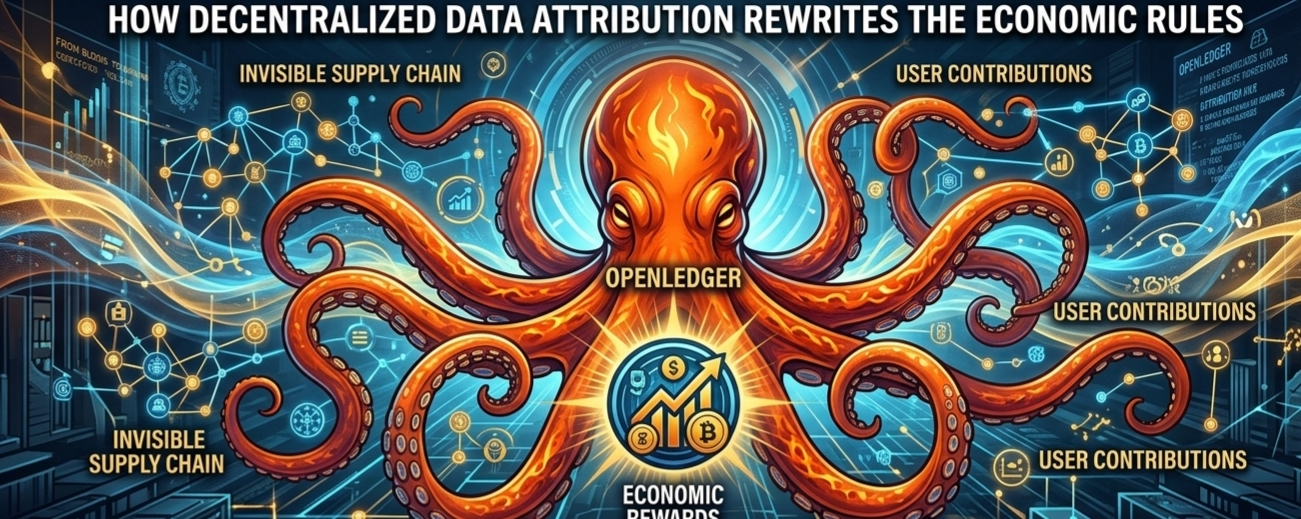

The deeper I look into the current convergence of cryptography and artificial intelligence, the more I feel we are asking all the wrong questions. For months, my screens have been flooded with the same repetitive narratives: who has the largest cluster of GPUs, which LLM benchmarks scored a fraction of a percent higher on a standardized test, and which decentralized compute protocol is spinning up the most raw, unverified hashing or inference power. It bores me. It lacks structural imagination.
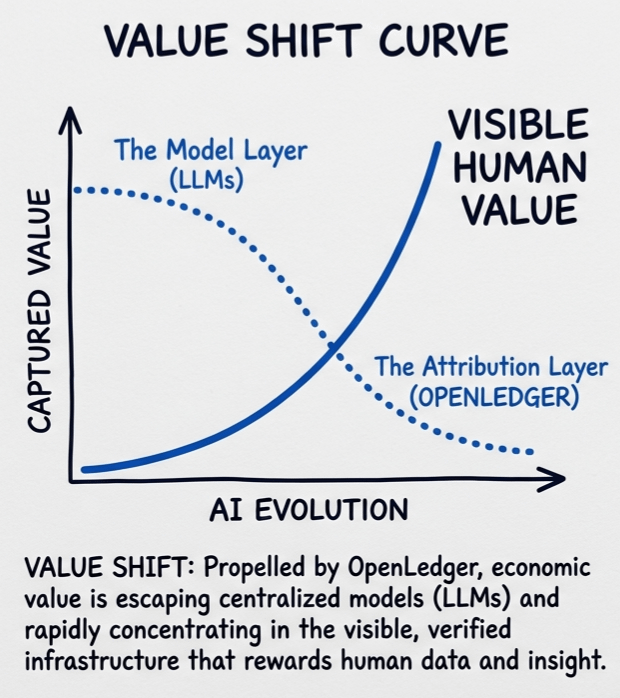
Everyone is obsessing over the finish line—the trained model, the flashy user interface, the instant generation of text or imagery—while completely ignoring the massive, invisible pipeline that makes the entire apparatus function.
When I look at projects trying to bridge the gap between Web3 and AI, my eyes don’t fixate on the speculative charts or the marketing buzzwords. I look straight at the plumbing. And looking closely at the core mechanics of what platforms like OpenLedger are quietly trying to map out, I’ve come to a striking, somewhat unsettling realization: The ultimate value in the next economic epoch will not belong to the entities that build the smartest models. It will belong to whoever controls the invisible toll road of human contribution.
We are standing at the precipice of a profound structural shift. To understand why, we have to look backward, peel away the tech romanticism, and dissect how networks actually capture value when the underlying technology undergoes a paradigm shift.
The Ghost in the Mining Rig
Let’s trace this back to the foundational psychology of decentralization. For the past decade, the uninitiated looked at crypto mining and saw a casino built on digital coins. They watched warehouse floors packed with ASICs consuming gigawatts of power and thought the point of the exercise was simply the creation of a speculative token.
But if you look at it through an infrastructure lens, the tokens were never the true output. They were merely the economic exhaust.
The real product of early proof-of-work mining was the programmatic manufacturing of absolute, unassailable trust within a hostile environment. The hardware and the electricity were a collective sacrifice required to mint a decentralized ledger out of thin air. The financial reward was a brilliant piece of behavioral engineering—an incentive loop designed to keep the machines hummed to the same rhythm until the network became too massive to break. The value was the network itself.
Now, look at what is happening with artificial intelligence. We are witnessing an eerie, amplified mirror image of that exact transition. We are moving from the era of block production to the era of intelligence production.
But here lies the historical paradox that fascinates me: while early crypto networks paid their node operators explicitly for every single hash contributed to the network, the AI industry has built a trillion-dollar empire on a foundation of completely uncompensated, invisible human labor.
Every single day, millions of people sit in front of screens interacting with AI models. We think we are merely consuming a service, but we are actually working for it. When you reject an answer and ask for a rewrite, you are labeling data. When you converse with an agent, adjusting your phrasing until it finally understands your intent, you are refining its semantic mapping. When you feed it an obscure edge-case from your specific professional field, you are handing over highly specialized training material.
In the old Web2 paradigm, the cliché was that if the product is free, you are the product. In the AI economy, that rule has mutated into something far more invasive: You are not just the product; you are the active, unpaid research and development department.
We aren't just using these systems. We are breathing life into them, day after day, through a continuous, unmetered stream of behavioral feedback. Yet, when the model updates, when its valuation skyrockets, and when corporate entities monetize that collective refinement, the economic loop closes tightly around a centralized boardroom. The value you generated vanishes from your hands the moment it crosses the interface.
The Illusion of the Sovereign Model
There is a fundamental lie embedded in the current tech narrative—the myth of the self-contained, sovereign AI model. Tech monopolies want you to believe that a model is a static, god-like asset sitting on a server, possessing an intrinsic intelligence that belongs entirely to the company that paid for the compute hours to train it.
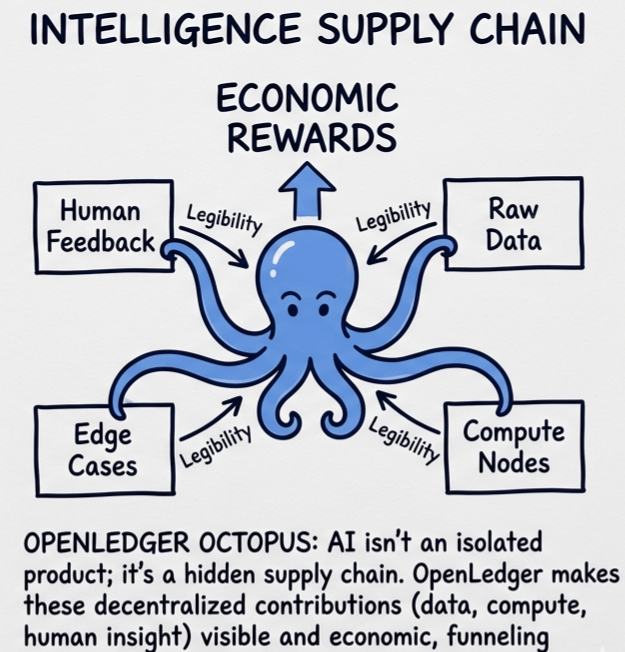
I reject this view entirely. When I look at how modern AI actually operates under the hood, I see that intelligence was never a standalone product. Intelligence has always been a supply chain.
An LLM or a specialized agent is not a monument carved out of stone; it is a highly volatile whirlpool that requires a constant, raging influx of new inputs to remain relevant. It is a composite architecture. The final output a user sees on their screen is a delicate, real-time tapestry woven from raw compute, base model weights, real-time retrieval systems, semantic query logic, context injection, and human reinforcement loops.
If you cut off the supply chain—if you isolate a model from the lived, real-time context of human behavior and updated knowledge—it begins to decay. It stagnates.
This brings us to the core economic crisis of our generation: the absolute breakdown of the accounting boundaries of human intellect. Right now, there is zero legibility in the AI supply chain. Millions of minds contribute to the collective pool of human knowledge that feeds these models, but there is no mechanism to track where a specific piece of insights came from, how it was altered during the training or inference process, and who deserves the economic credit when that insight solves a real-world problem.
This is the exact structural friction point where protocols like OpenLedger enter the picture. From where I sit, the long-term significance of this kind of infrastructure has almost nothing to do with launching another speculative asset or riding a temporary market wave. I don’t look at it as a way to decentralized AI models themselves.
Instead, I see it as a desperate, highly sophisticated attempt to build a universal attribution layer—a programmatic ledger designed to make the invisible supply chain of intelligence visible to the laws of economics.
Imagine a system where every piece of data, every specialized prompt, every corrective feedback loop, and every automated agent interaction is broken down into modular units of contribution. If you can track those units, you can price them. If you can price them, you can trade them. And if you can trade them, you can finally anchor the economic value of machine intelligence back to the human beings who actually authored its brilliance. It is an attempt to turn human interaction from a form of uncompensated digital exhaust into a formalized, sovereign economic surface.
When Metrics Become Targets
This sounds like a liberating, utopian vision of the future, doesn’t it? A world where your digital intellect is metered, protected, and compensated. But this is exactly where my optimism hits a hard wall of philosophical skepticism. I am trained to look past the initial promise of a protocol and stare directly into the unintended psychological distortions it creates.
What happens to the human mind when we transform every casual, organic interaction with technology into a explicit financial transaction?
If we successfully build an infrastructure that can measure, track, and reward every single data contribution, we will inevitably trigger a massive behavioral shift. The moment a system makes the value of data explicit, human behavior ceases to be organic. It becomes hyper-optimized for the metric.
I can already see the downstream consequences playing out in my mind like a slow-motion wreck. If people realize that certain types of data inputs or feedback loops yield higher protocol rewards, they will stop interacting with AI to solve problems or express genuine thought. They will start interacting with AI solely to manufacture the precise signals that the reward algorithm is looking for.
We will see the rise of decentralized feedback farming on a scale that makes old social media engagement loops look primitive. The digital landscape will be flooded with synthetic datasets, engineered edge-cases, and sophisticated spam loops designed not to improve intelligence, but to game the distribution mechanics of the attribution protocol.
This introduces a terrifying irony: The very economic incentives designed to map out and reward human data contribution could end up poisoning the quality of the data itself.
If the underlying infrastructure cannot distinguish between an organic piece of human insight and a highly optimized piece of financialized data-junk, the AI models being fed by these networks will begin to degrade. We risk entering an era of cognitive data pollution.
I look at the danger of models training on their own outputs, or training on human inputs that have been subtly distorted by the desire for programmatic rewards, and I see a closed, degenerative feedback loop. The systems will grow larger, the transaction volume on the ledger will look spectacular, and the charts will show exponential growth—but underneath the noise, the actual cognitive originality of the models will begin to collapse into a hollow, repetitive echo chamber.
The Centralization Paradox of the Open Network
This brings us to the ultimate bottleneck of the entire decentralized AI thesis, a problem that keeps me watching this space with intense fascination: the brutal, uncompromising reality of verification.
It is relatively easy to build a decentralized network where anyone can throw data, compute, or models into a shared pool. The real nightmare—the problem that breaks most architectures—is figuring out how to prove that any of it is actually good, honest, or useful without relying on a centralized judge.
In a pure Web3 environment, verification is the ultimate battleground. If an infrastructure layer wants to reward a user for a "valuable contribution" to an AI model, it has to verify that the contribution was genuine, that it wasn’t plagiarized, that it wasn’t generated by a cheaper, malicious bot, and that it actually improved the system’s performance.
But true verification is incredibly expensive. It requires immense computational power, vast amounts of time, strict architectural coordination, and heavy cryptographic proofs.
Here is the paradox that I cannot stop analyzing: as a network scales to handle millions of decentralized contributors, the computational burden of verifying those contributions can easily become heavier than the cost of running the AI model itself. If the verification protocol becomes too complex, the network is forced to compromise. It starts clustering the verification duties around a select few highly powerful nodes that possess the hardware capable of handling the load.
And just like that, the cycle completes itself. You start with a romantic, decentralized vision of a free, open network of sovereign human contributors, but the unrelenting laws of computer science and economics gradually force the system to reconstruct centralized power structures under a different name. The gatekeepers don’t disappear; they just change their titles from "corporate executives" to "validator networks."
We must remain clear-eyed about this. Open networks do not possess some magical exemption from the laws of physics, engineering, or basic human greed. A protocol can shout its commitment to decentralization from the rooftops, but if its latency is too high, if its storage layer is fractured, and if its compute costs are economically unviable compared to a centralized server in Virginia, the market will eventually crush it without mercy. Technology ultimately bows to efficiency, not to ideology.
The Value in the Middle
So, where does that leave us? When I look at the landscape through this analytical lens, I find myself arriving at a conclusion that departs significantly from both the hype of the bull market and the cynicism of the critics.
Projects attempting to map the AI supply chain may or may not succeed in completely liberating human data from the clutches of tech monopolies. The technical hurdles are monumental, the behavioral distortions are dangerous, and the risk of re-centralization is constantly hovering over the architecture.
But to me, the ultimate success of these protocols isn't measured by whether they provide a permanent, flawless solution to the AI ownership crisis. Their true power lies in the fact that they are forcing the crisis into the light.
They are making the exploitation visible. By attempting to build a system where data has a clear lineage, an explicit price tag, and a traceable path, they are exposing the sheer absurdity of the current status quo. They are forcing the average user, the researcher, and the investor to look at an AI model and finally ask: Where did this intelligence actually come from, and why am I content with receiving absolutely nothing in return for my role in creating it?
In the long run, the massive financial winners of the AI revolution might not be the companies that own the most popular consumer-facing applications, nor will they necessarily be the decentralized individuals typing prompts at home.
If you look closely at how wealth accumulates during industrial shifts, the most sustainable profits rarely go to the frontline pioneers or the raw material providers. The real wealth accumulates in the dull, unglamorous intermediate layers—the entities that manage the coordination, the translation, and the traffic between the two sides.
The ultimate value will likely concentrate squarely within the toll road that connects human behavioral contribution to economic monetization. The protocol that manages to survive the verification wars, preserve a shred of legible attribution, and handle the messy, chaotic compression of human intellect into clean economic signals will become the indispensable backbone of the next era.
I am watching this space not because I believe in flawless technical utopias, but because I am captivated by the sheer friction of the experiment. We are watching an architecture attempt to compress the vast, untamable, and messy reality of human thought into a structured, programmable ledger. It is a beautiful, terrifying, and deeply flawed endeavor. And as the layers of this digital supply chain slowly become visible, I will be right here, watching the pipes.
