

I keep thinking about Something most people still miss when they talk about AI.
Everyone is busy comparing models.
Which one is faster. Which one reasons better. Which company raised More money. Which system can generate cleaner code or better answers.
But the deeper question, at least from what I’ve been watching, is Not really about the models anymore.
It is about ownership.
I’ve spent a lot of time looking at how AI infrastructure is evolving, and the more I search, the more one uncomfortable pattern keeps showing up. Modern AI systems are built on enormous amounts of human contribution. Text, datasets, corrections, research, conversations, feedback loops, domain expertise. Millions of people quietly create the raw material that makes these systems valuable.
But once that value is created, most contributors disappear from the equation.
The system remembers the data.
The economy forgets the people.
And honestly, I think this imbalance is going to become one of the biggest structural problems in AI over the next decade.
Right now, most people do not feel this problem because the industry is still in its acceleration phase. Everyone is focused on capability growth. Bigger models. Better reasoning. Faster outputs.
That makes sense.
But eventually the market matures, and when that happens, people start asking harder questions.
Who owns the intelligence being created?
Who gets rewarded when systems generate economic value?
Can contribution actually be measured in a transparent way?
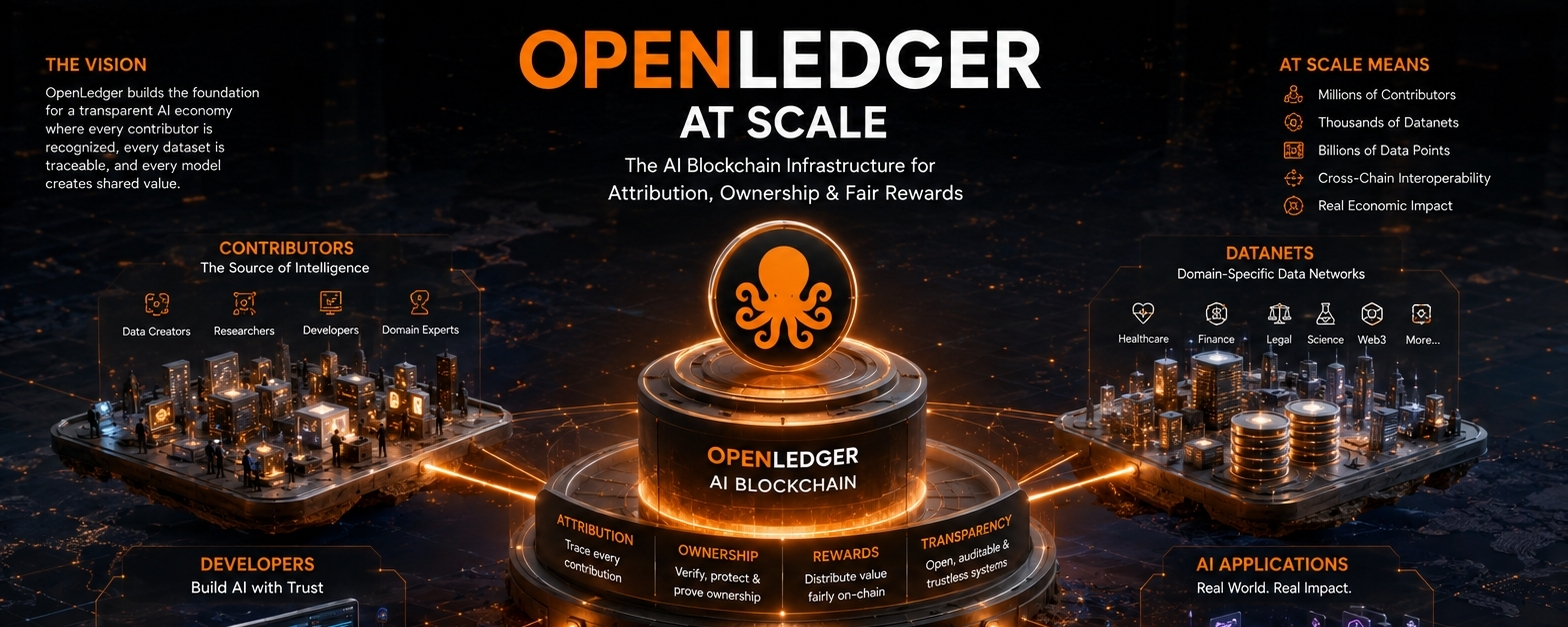
And this is exactly why I started paying closer attention to OpenLedger
I’m not saying they already solved this.
That would be too early to claim.
But I checked their architecture closely, and what stands out to me is that they are trying to address a problem most projects still avoid completely.
Their idea around AI blockchain infrastructure is not simply about launching another token around an AI narrative.
It is about building an attribution layer for intelligence itself.
That sounds abstract at first.
But the idea becomes clearer when you break it down simply.
Traditional AI systems collect data, train models, improve outputs, and generate value. The feedback loop works technically, but economically it is mostly one-directional. Contributors provide raw input, while ownership becomes concentrated around the final system.
Instead of treating data as invisible fuel, they treat it like traceable labor.
Contributors submit datasets into domain-specific data networks. Developers then use those datasets to train specialized models. If those models generate value, smart contracts distribute rewards back through on-chain attribution systems.
That changes the psychology of participation.
Suddenly contribution is not passive extraction.
It becomes measurable economic input.
I think that shift matters much more than people realize.
What caught my attention even more is their proof-of-attribution approach.
I spent time reading through how they describe gradient attribution for smaller models and token attribution systems for larger language models.
The concept is straightforward even if the math underneath is difficult.
If removing a certain dataset measurably reduces model performance, then that dataset clearly contributed value.
That sounds obvious, but applying that logic across massive AI systems is an infrastructure challenge very few teams are even attempting.
And no, I do not think attribution will ever be mathematically perfect.
Large model outputs are collective by nature. Influence gets blurred across billions of parameters.
But trying to create transparent approximation is still far better than pretending attribution does not matter at all.
That is where I think this gets interesting beyond crypto narratives.
If this kind of infrastructure works at scale, it could reshape how AI systems are built across sensitive industries.
Think about finance.
Think about healthcare.
Think about legal intelligence systems.
These sectors will eventually ask questions far more important than model speed.
Can this dataset be verified?
Can its ownership be proven?
Was it licensed correctly?
Can attribution be audited if disputes happen?
This is where blockchain-native attribution systems could become genuinely useful rather than speculative decoration.
And from what I see, OpenLedger at least appears aware of this future direction.
Their domain-specific Datanet design feels intentional.
They are not trying to become generic infrastructure for everything.
That focus gives the architecture more credibility in my view.
Of course, the real test starts now.
Mainnet changes everything.
Theory is easy.
Live systems expose weaknesses fast.
If real value enters these networks, gaming behavior will follow. Low-quality synthetic submissions, attribution disputes, leaderboard manipulation, reward farming.
These pressures are unavoidable.
The real question is whether validation systems stay trustworthy when scaled under economic stress.
I do not know that answer yet.
And honestly, that uncertainty is exactly why this stage matters.
Because this is where ideas stop being narratives and start becoming infrastructure.
If systems like this succeed, the future of AI may look very different from today’s centralized ownership models.
Intelligence could become economically collaborative rather than extractive.
Contributors might finally become visible participants instead of forgotten inputs.
And if that happens, it would change far more than token markets.
It would change how AI itself is owned.
That is why I’m watching this closely.
Not as short-term noise.
Not as chart speculation.
But as a structural question the entire industry will eventually have to answer.
If people help create AI value, should the system remember them?
And if the answer is yes, could attribution-first infrastructure become the foundation of the next AI economy?
What do you think?
Is this the missing layer AI still needs?
Or is attribution at scale still too difficult to ever work the way people imagine?
From everything I’ve searched and checked so far,
And in this market, asking the right question is often more valuable than pretending to already have every answer.