
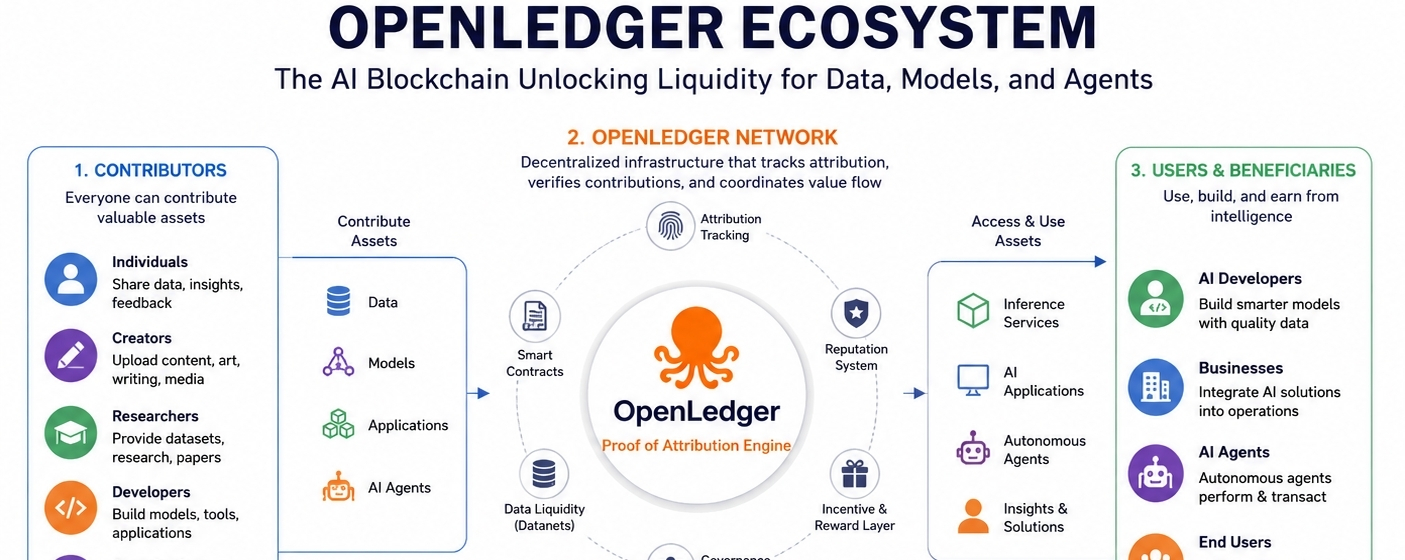
A strange feeling has been growing acros. the internet lately, and honestly, it is becoming harder to ignore. People everywhere are realizing that artificial intelligence did not appear out of nowhere. These systems were trained on years of human conversations, art, writing, emotions, corrections, behavior, research, opinions, and endless streams of online activity created by ordinary people who never truly owned any part of the value that came from it. Every photo uploaded, every late-night forum discussion, every creative idea shared publicly, and every interaction with an AI tool quietly became fuel for a massive industry that is now worth billions. The deeper I look into projects like OpenLedger, the more it feels like the industry is entering a turning point where people are starting to ask a much bigger question than simply “How powerful can AI become?” They’re asking who should actually benefit from it.
That is where OpenLedger enters the story, and what makes the project feel different is that it does not only talk about faster transactions or another blockchain ecosystem trying to chase attention around artificial intelligence. OpenLedger was built around a more emotional and uncomfortable reality that many people inside the tech world are finally beginning to acknowledge openly. The internet became incredibly good at extracting value from people without making them feel like they were losing anything at all. Data became the new oil, but unlike oil, most people never even realized they were giving it away every single day. OpenLedger is trying to challenge that system by building an AI blockchain where data, models, applications, and even autonomous AI agents can become part of a transparent economy where contributors are no longer invisible.
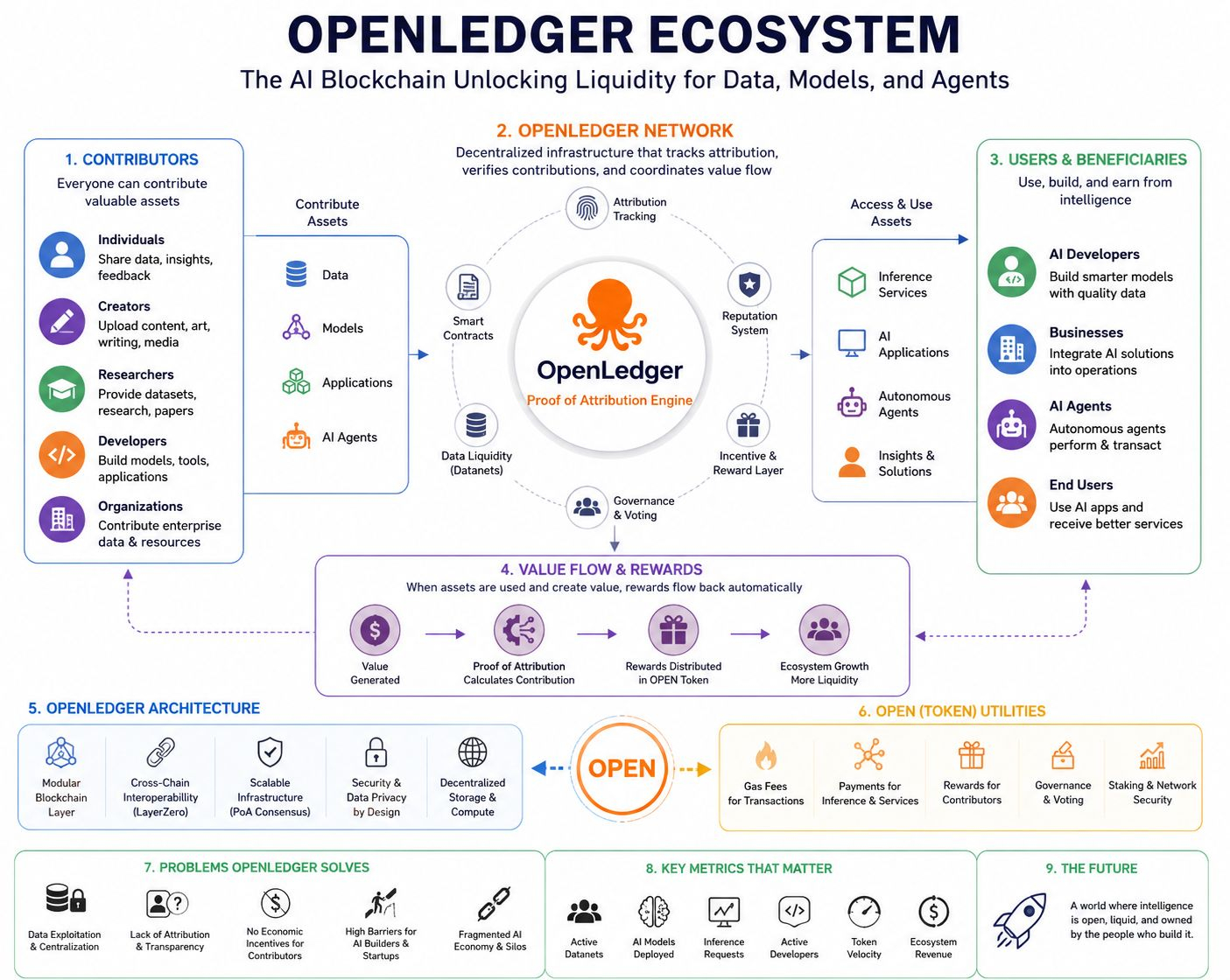
When I first started researching the project, what stood out immediately was the idea that OpenLedger does not treat data as something disposable. Most AI systems today operate like giant black boxes. People contribute information unknowingly, companies absorb it, models become smarter, profits grow, and almost nobody outside those corporations can track where the intelligence truly came from anymore. OpenLedger is trying to build an entirely different structure where contribution itself becomes traceable and economically valuable over time. Instead of information disappearing into hidden systems forever, the network wants every meaningful contribution to remain connected to the value it helps create.
The timing of OpenLedger’s rise also makes a lot of sense. Artificial intelligence exploded so quickly that society barely had time to process what was happening. One moment AI tools felt experimental and niche, and suddenly they were writing essays, generating images, replacing workflows, automating research, and reshaping industries almost overnight. But underneath all the excitement, there was also growing discomfort. Artists discovered their work had been scraped into training datasets without consent. Writers noticed language patterns from years of online publishing appearing inside machine-generated responses. Developers realized the companies dominating AI had access to enormous private data reservoirs that smaller teams could never realistically compete against. OpenLedger emerged during this exact moment, almost like a response to the fear that intelligence itself was becoming centralized too quickly.
The project’s core vision revolves around something it calls Proof of Attribution, and honestly, this may be the most important idea inside the entire ecosystem. OpenLedger believes AI should not only generate outputs. It should also recognize influence. That sounds simple at first, but when you think about how machine learning works, the challenge becomes incredibly complicated. AI models absorb information from huge amounts of sources simultaneously. Once the data becomes part of the model, tracing exactly who contributed value becomes extremely difficult. OpenLedger is attempting to solve that by creating systems where contributions can potentially be tracked on-chain, allowing rewards to flow back toward the people, developers, datasets, or communities that helped shape the intelligence behind an AI output.
What makes this concept feel powerful is that it changes the emotional relationship between people and artificial intelligence itself. Right now, most people interact with AI systems as users. OpenLedger imagines a future where people become participants inside the economic layer of intelligence. If someone contributes valuable data, helps refine a model, improves an AI application, or strengthens a network through participation, the ecosystem attempts to create ways for those contributions to remain economically connected to future activity. Instead of intelligence becoming another extractive system where value flows upward endlessly, OpenLedger wants intelligence to behave more like a living economy shared between contributors.
The architecture behind the project was built around that exact philosophy. OpenLedger introduced structures known as Datanets, which are essentially decentralized ecosystems for data contribution and collaboration. Rather than keeping valuable information trapped inside centralized corporate environments, the project wants datasets to become fluid, usable, and economically active across a broader decentralized network. I think this idea matters more than people initially realize because high-quality data has quietly become one of the most valuable resources in the world. AI models are only as useful as the information they learn from, and specialized datasets in fields like healthcare, finance, science, education, and language processing carry enormous long-term value.
What OpenLedger is trying to do is transform those datasets into assets that can continuously generate economic activity instead of remaining locked away in isolated silos. The project often talks about “Payable AI,” and the phrase actually explains the vision surprisingly well. They’re imagining a world where intelligence itself becomes programmable economically, where contributors can be rewarded automatically whenever their data or models help generate useful outputs or services. It feels like the project is trying to create an economy where intelligence does not only belong to whoever owns the biggest servers or the largest corporations.
The OPEN token sits at the center of this entire ecosystem, but the project clearly wants the token to represent more than speculation. Inside the network, OPEN is connected to governance, transactions, incentives, inference payments, and contributor rewards. Developers can use it while building AI-powered applications. Validators help secure the infrastructure while participating in network activity. Contributors can potentially earn rewards for providing useful data or helping improve systems across the ecosystem. The token is essentially designed to move alongside the flow of intelligence inside the network rather than existing as a disconnected financial asset with no real operational role.
At the same time, OpenLedger understands the reality of crypto markets. Visibility matters. Liquidity matters. Community attention matters. The project gained major exposure after listings on exchanges including Binance, which pushed the ecosystem into a much larger spotlight almost instantly. But honestly, this is also where one of the biggest dangers begins. The crypto industry moves incredibly fast, and narratives can become overheated before infrastructure is truly mature. AI projects especially attract huge waves of speculation because the combination of blockchain and artificial intelligence sounds futuristic enough to capture attention immediately.
I’m seeing more people slowly realizing that surviving hype is actually harder than creating it. OpenLedger now faces the difficult challenge of proving that its infrastructure can scale beyond exciting narratives. Building a decentralized attribution system for AI is not a small technical problem. It is one of the hardest coordination challenges imaginable because intelligence itself is messy. Data quality varies. Contributions overlap. Influence inside machine learning systems is rarely clean or perfectly measurable. The network must constantly balance fairness, efficiency, scalability, and security all at once.
There is also the human side of the challenge. If rewards exist, people will eventually try to manipulate them. Some users may attempt to flood systems with low-quality datasets purely for incentives. Others may disagree about how value is measured or distributed. Governance becomes incredibly important in ecosystems like this because the moment people feel attribution is unfair, trust can weaken quickly. OpenLedger therefore is not only building technology. It is building economic relationships between contributors, developers, validators, and AI systems simultaneously.
Still, despite all those risks, I think the reason OpenLedger continues attracting attention is because it touches something much bigger than blockchain speculation. The project reflects a growing fear that artificial intelligence could eventually become controlled by only a handful of institutions powerful enough to own the infrastructure, the compute, and the data. That future worries many people because AI is slowly becoming part of everything. Communication, finance, creativity, research, healthcare, education, entertainment, and even online identity are increasingly connected to machine intelligence.
OpenLedger is essentially trying to ask whether another path is still possible before the current system becomes permanent. What if intelligence could become collaborative instead of purely extractive? What if contributors remained visible? What if communities helping shape AI systems could also share in the economic value being created? What if data itself could become liquid, traceable, and alive economically instead of disappearing forever into corporate vaults?
Those questions give the project emotional weight beyond normal crypto discussions. Beneath the technical language and blockchain architecture, there is actually a very human idea driving the ecosystem forward. People want recognition for the value they create online. They want ownership to exist alongside participation. They want to feel like the systems shaping the future are not simply harvesting them silently in the background.
Whether OpenLedger fully succeeds or struggles along the way, I think the project represents something important about where technology is heading emotionally. The internet is slowly moving into an era where intelligence itself is becoming an economy, and whoever designs the ownership structures now could shape digital life for decades. OpenLedger is trying to build a future where that economy feels more open, more transparent, and more shared between the people contributing to it.
And honestly, maybe that is why the project feels so interesting right now. It is not only selling technology. It is selling the possibility that people might finally matter inside the systems they helped create all along.
