

I’ve noticed something strange happening in crypto lately. The market still reacts to hype, obviously, but underneath all the noise, people are becoming much more selective about where they pay attention. You can feel it in the way liquidity moves now. Capital isn’t chasing every shiny narrative equally anymore. Some sectors pump for a week and disappear. Others keep quietly attracting builders even when the market gets distracted.
That’s honestly why OpenLedger stayed in my head longer than I expected.
At first, I thought it was just another “AI + blockchain” project trying to squeeze itself into the hottest narrative of the cycle. We’ve seen hundreds of those already. Most of them feel like AI got added at the end of a pitch deck because somebody realized the market likes the word. After a while you stop taking these projects seriously unless something genuinely different stands out.
But the deeper I looked into OpenLedger, the more I realized the project isn’t really centered around AI hype itself. What caught my attention was the economic angle behind it.
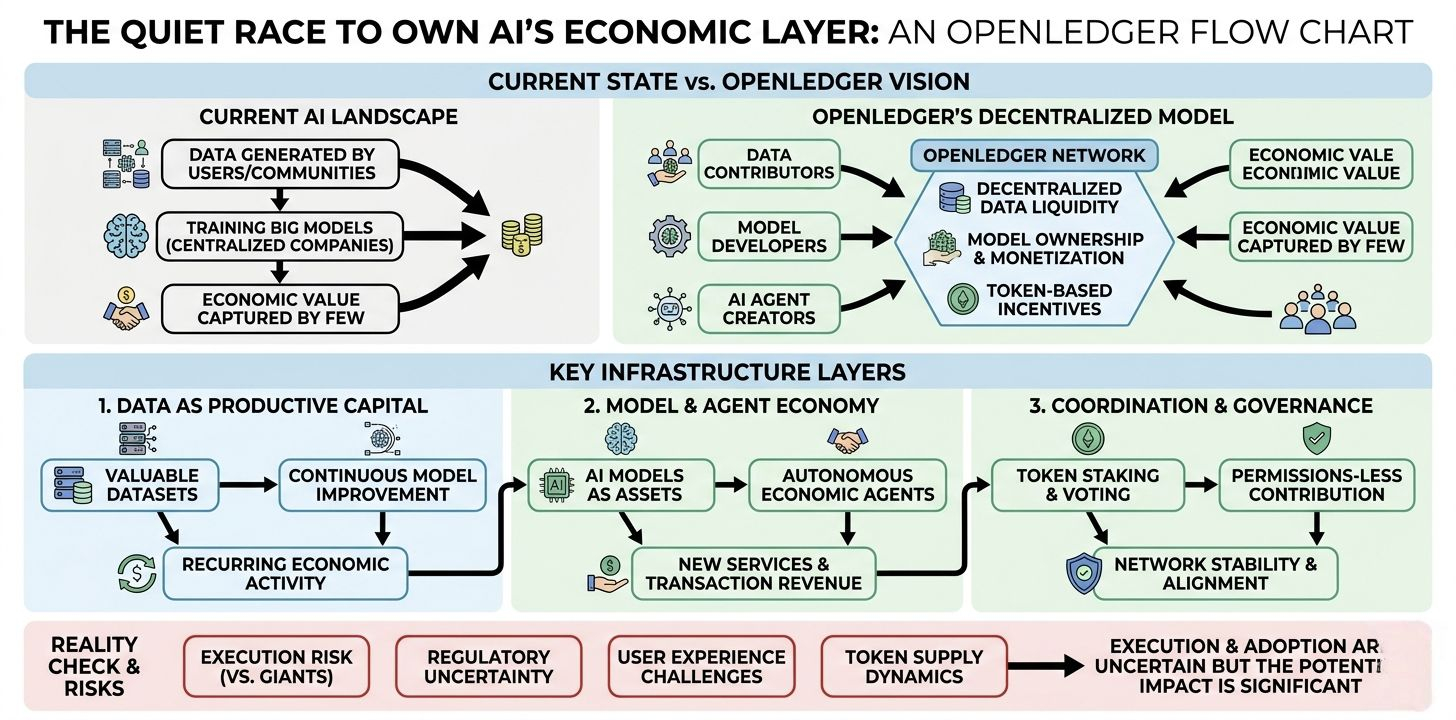
Right now, AI is becoming one of the most valuable industries on earth, but the strange part is how disconnected ordinary contributors are from the value being created. Massive companies train models using enormous amounts of data generated by millions of people, yet the actual economic upside remains concentrated in a few places. Users contribute information. Developers improve systems. Communities produce intelligence collectively. But ownership rarely flows back to them in any meaningful way.
I think OpenLedger is trying to challenge that imbalance.
And honestly, timing matters here more than people realize.
The market has entered a phase where infrastructure narratives are starting to regain attention. Not the old “faster blockchain” infrastructure stories from previous cycles. Something different. Now the focus is shifting toward ownership layers around AI, data, computation, and digital coordination. Investors are slowly realizing that if AI truly becomes the defining technology trend of this decade, then the systems controlling data liquidity and model monetization may become incredibly important.
That’s the lens through which OpenLedger started making sense to me.
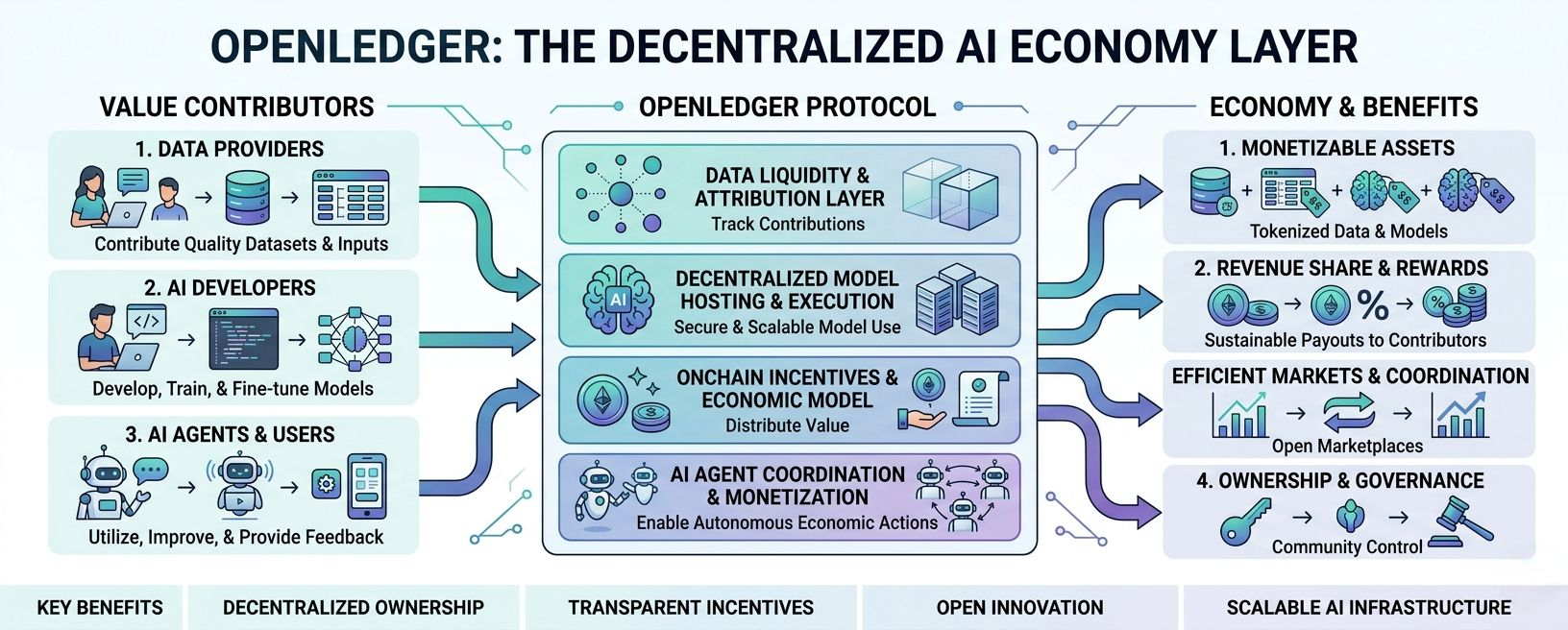
From what I’m seeing, the project is attempting to build an ecosystem where datasets, AI models, and autonomous agents can become monetizable assets inside a decentralized network. Instead of intelligence staying trapped inside centralized companies, contributors can potentially participate economically through transparent onchain systems.
That sounds technical at first, but I actually think the idea is pretty intuitive once you strip away the crypto wording.
The internet monetized attention. Social media monetized engagement. Maybe the next phase of the digital economy monetizes intelligence itself.
That’s basically the rabbit hole I went down while researching OpenLedger.
I kept thinking about how strange the current AI landscape actually is. Everybody talks about model performance, but very few conversations focus on incentive alignment. Who owns the training data? Who benefits when a model succeeds? How do contributors get rewarded over time instead of just being harvested as free input?
Crypto has always been good at solving coordination problems through incentives. That’s one of the few things this industry consistently does well. So when I saw OpenLedger focusing less on “AI magic” and more on liquidity, attribution, and ownership, it immediately felt more grounded than a lot of projects in this space.
The blockchain side of it actually serves a purpose here.
Without transparent ownership rails, it becomes very difficult to track contributions across decentralized AI ecosystems. If datasets, model improvements, and agent outputs all create value, then somebody needs to coordinate how that value moves. Traditional systems usually centralize that process. OpenLedger seems to be experimenting with whether blockchain infrastructure can decentralize it instead.
I think that’s a much bigger idea than the market currently prices in.
One thing I personally find underrated is how data itself is slowly transforming into productive capital. Most people still think of data as passive information sitting in storage somewhere. But in AI systems, data behaves more like fuel. Valuable datasets can generate recurring economic activity because they continuously improve models, outputs, and automated systems over time.
That changes the economics completely.
If OpenLedger succeeds even partially, it could create environments where communities don’t just consume AI products, but actually own parts of the intelligence economy they help build. And honestly, that feels philosophically aligned with why many people entered crypto in the first place.
Ownership.
Participation.
Permissionless contribution.
What also caught my attention is how the project approaches AI agents. Everybody’s talking about autonomous agents now, but most conversations still feel surface-level. People imagine trading bots or social media automation. But the deeper implication is that AI agents may eventually become independent economic actors online. They could manage tasks, analyze data, coordinate transactions, and interact with decentralized infrastructure continuously.
If that future develops even halfway as fast as current trends suggest, networks enabling agent monetization and coordination could become extremely valuable infrastructure layers.
OpenLedger seems aware of that direction early.
And I think that’s partly why the project feels more strategic than purely narrative-driven.
At the same time, I’m trying to stay realistic because execution risk here is enormous.
Building decentralized AI infrastructure isn’t like launching another DeFi protocol. The competition includes some of the most powerful companies in the world with massive compute resources, proprietary datasets, and established user bases. OpenAI, Google, Anthropic, Meta… these are giants operating at insane scale.
So OpenLedger can’t compete head-on through raw resources alone.
Its advantage has to come from openness, incentives, and coordination efficiency.
That’s where crypto still has a legitimate edge.
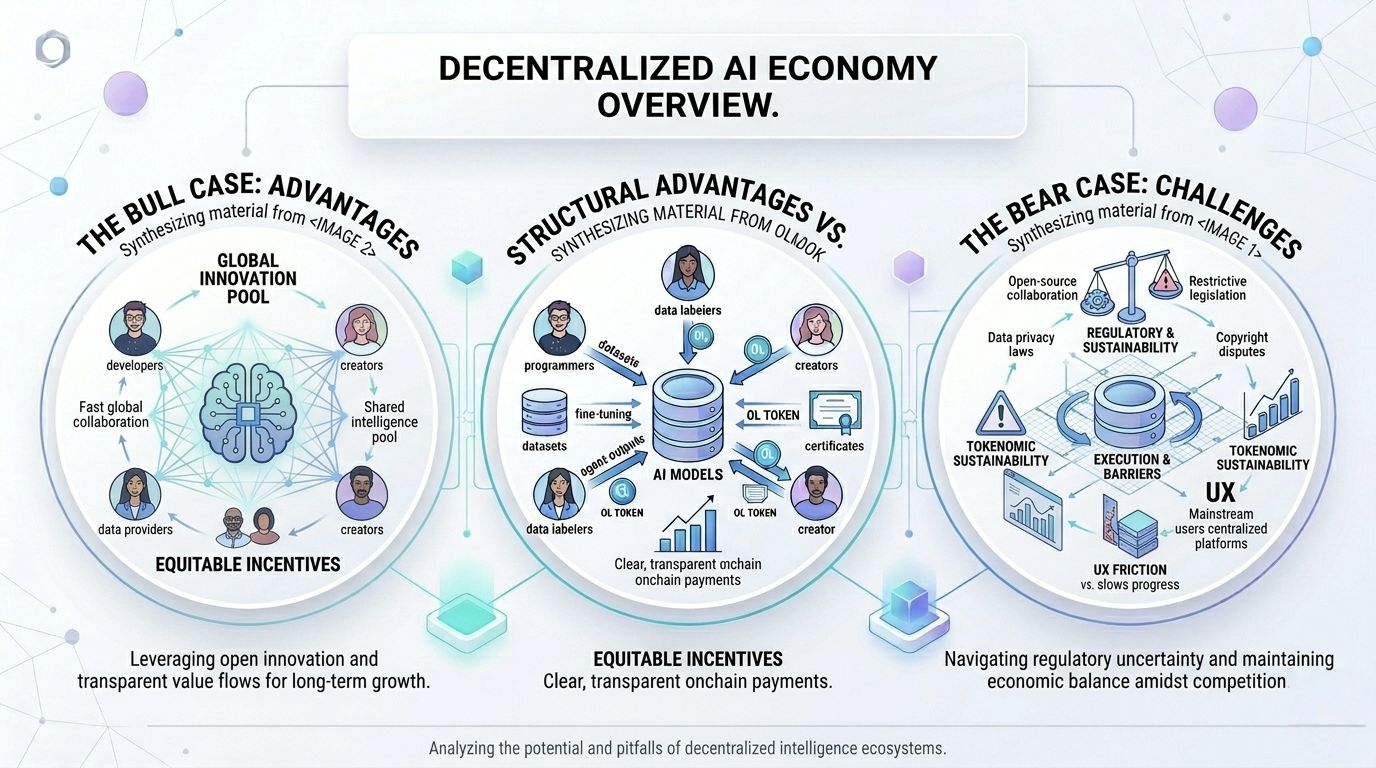
Open ecosystems often innovate faster because they attract external contributors rather than relying entirely on internal teams. Ethereum proved that years ago. The question now is whether decentralized AI networks can replicate that same network effect around intelligence infrastructure.
I’m honestly not sure yet.
But I do think the experiment itself matters.
Another thing I’ve been watching closely is the token structure because tokenomics usually reveal whether a project actually understands sustainability or if it’s just creating temporary market excitement.
From what I’ve observed, OpenLedger appears to position its token within the operational layer of the ecosystem rather than treating it like a disconnected speculative asset. Governance, staking, participation incentives, network coordination… the token seems tied to ecosystem activity instead of existing separately from it.
That’s important because AI infrastructure projects can become extremely capital intensive. Sustainable incentive models matter much more here than in lightweight meme ecosystems.
Still, there are risks people shouldn’t ignore.
Unlock pressure is always something I watch carefully in newer ecosystems because even strong narratives struggle when supply dynamics overwhelm demand. AI narratives also move very fast. Markets get distracted quickly. A project can be considered revolutionary one month and completely ignored the next if execution slows down.
Regulatory uncertainty is another major issue that I think the market underestimates.
AI and blockchain are individually complex regulatory sectors already. Combining them creates even more uncertainty around data rights, privacy laws, copyright disputes, and governance responsibilities. Nobody fully knows how governments will handle decentralized AI economies once they become large enough to matter.
That uncertainty could eventually create friction for adoption.
There’s also the user experience challenge.
Most mainstream users prioritize convenience over ideology. Centralized AI platforms are extremely easy to use right now. Decentralized alternatives need to offer not just philosophical advantages, but practical efficiency too. If OpenLedger wants real adoption beyond crypto-native users, the ecosystem has to become seamless enough that people care more about utility than infrastructure complexity.
That’s harder than many crypto projects admit.
But despite all those risks, I keep coming back to one observation I can’t shake.
Crypto narratives usually begin as speculation before gradually revealing whether they represent actual economic shifts underneath. DeFi looked experimental at first. Stablecoins looked niche. Even Ethereum once seemed unnecessary to many people.
I’m not saying OpenLedger reaches that level. It’s far too early for those comparisons.
But I do think the project reflects an emerging realization inside the market: AI alone is not the endgame. Ownership around AI may become just as important as the models themselves.
And that changes how I view projects like this.
What genuinely stands out to me compared to competitors is the focus on liquidity coordination instead of simply building another AI interface. A lot of AI crypto projects currently feel interchangeable. Same buzzwords. Same promises. Same agent demos. OpenLedger feels more focused on the underlying economic architecture supporting intelligent systems.
That’s a more durable direction in my opinion.
I also think there’s a subtle psychological shift happening among crypto investors right now. People are becoming more interested in systems connected to long-term digital behavior rather than short-term attention cycles. Data ownership, AI infrastructure, decentralized compute, autonomous economies… these narratives feel closer to where technology is naturally heading.
Whether markets reward that immediately is another question entirely.
Sometimes the most important sectors emerge quietly before the crowd fully understands why they matter.
And maybe that’s what I find most interesting about OpenLedger. Not the token. Not the short-term speculation. The broader idea underneath it.
Because if intelligence becomes one of the world’s most valuable resources over the next decade, then the systems deciding who owns, distributes, and monetizes that intelligence may end up becoming incredibly important infrastructure layers.
That future still feels uncertain. Maybe decentralized AI economies remain too fragmented to compete with centralized giants. Maybe regulation slows everything down. Maybe users simply don’t care enough about ownership to change their habits.
Or maybe we’re watching the very beginning of a new economic model where data, models, and AI agents become tradable productive assets instead of closed corporate property.
I honestly don’t know yet.
But I do know this project made me stop scrolling for a while and actually think about where crypto and AI are heading together instead of separately. And these days, when attention moves this fast, that alone says something.