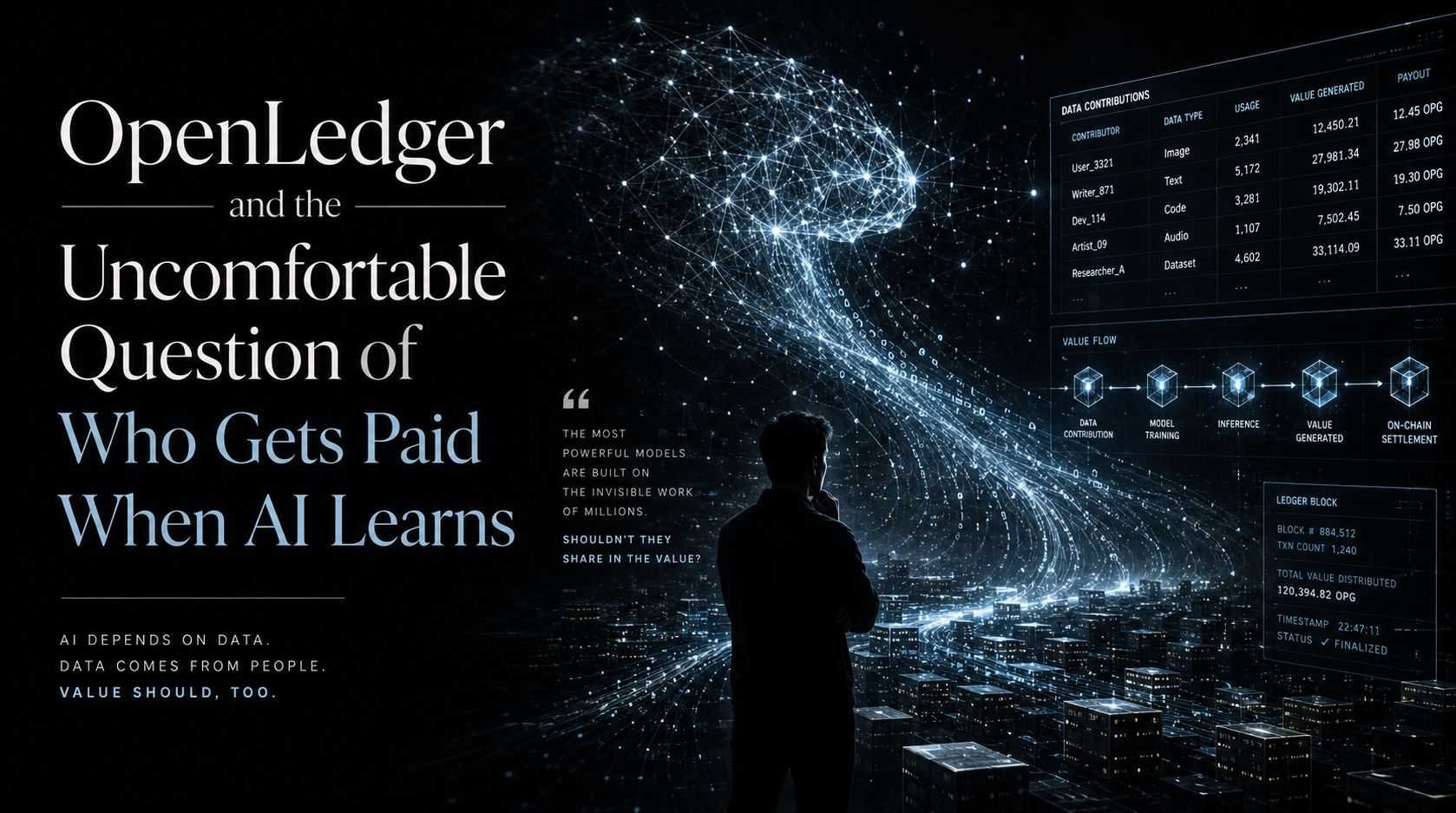
Sometimes I feel like this whole AI cycle has made people quieter in a strange way.
Not silent exactly. The chats are still moving. The timelines are still noisy. Everyone still has a take, a chart, a prediction, a reason why something will matter or disappear. But underneath all of it, there is this dull understanding that something has changed and nobody is fully sure what it means for them yet. I started noticing it late at night, mostly when I had too many tabs open and no real reason to keep scrolling. One tab had a token chart. Another had an AI tool I had been testing. Somewhere in the corner, a dashboard kept refreshing a small number as if that number was supposed to explain my participation back to me. A few community messages were moving too fast to read properly. People were asking about rewards, eligibility, wallets, future claims. It all felt familiar. Too familiar.
At first, I thought I was just watching another crypto pattern repeat itself. New project, new language, new promise, same human behavior. People arrive early, try to understand the rules, then slowly stop caring about the product and start caring about what their activity might become worth. I have done it too. I do not say that from some clean distance. I know that small pause before connecting a wallet. I know the feeling of wondering whether one more task, one more test, one more interaction might matter later. Crypto trains you to think like that. It turns curiosity into a habit of calculation.
But AI has made that habit feel different.
With AI, the thing being captured is not only attention or liquidity. It feels closer to thought. A prompt, a correction, a dataset, a workflow, a failed agent run, a useful response, a human adjustment after the machine gets something almost right but not quite — all of it leaves something behind. Most of the time, we do not treat it like labor. We treat it like usage. We are just trying something. Fixing something. Asking something. Testing something. But somewhere underneath, that activity becomes useful. It improves a system. It sharpens a model. It creates a pattern. It adds value.
And usually, that value goes somewhere else.
That was the part that made OpenLedger stay in my head longer than I expected. I did not come to it with instant belief. Honestly, I almost resisted it because the space has made me suspicious of anything that sounds too clean. “Ownership” gets used too easily. “Community” gets used too easily. Even “decentralized AI” has started to feel like one of those phrases people repeat before they have decided what problem they are actually solving. So when I first came across OpenLedger and its broader idea around AI value, data, models, and agents, I did not feel convinced. I just felt bothered by the question sitting underneath it.
Why should the value created around AI end up in one company’s pocket?
The more I thought about it, the less abstract it felt. Because AI is not built only inside offices or closed labs. Maybe the base models are. Maybe the infrastructure begins there. But the usefulness grows in public, through people, through communities, through messy repeated contact with real behavior. Users test it. Builders connect it to workflows. Domain experts correct it. Communities feed it context. Agents learn from being pushed into tasks that do not behave cleanly. Every failure teaches something. Every correction points somewhere. Every dataset carries a little history inside it.
Then the final value gets packaged as a product, a subscription, an API, a platform.
And the people who helped create that usefulness often disappear.
OpenLedger feels interesting because it tries to put pressure on that disappearance. Not in a perfect way, not in a way I fully trust without questions, but in a way that points toward something real. It is trying to imagine AI value with memory attached to it. Data should not just be swallowed. Models should not just become private machines. Agents should not just produce value for whoever controls the interface. There should be some way to recognize contribution, ownership, and economic claim before everything gets absorbed into another closed system.
That idea has weight.
But it also makes me uneasy.
Because I have seen what happens when crypto starts measuring participation. People change. A reward counter does not just record behavior; it shapes it. A leaderboard does not just show activity; it creates anxiety. A wallet connection does not just identify a user; it turns them into a possible future claimant. Slowly, the mood shifts. People stop asking whether something is useful and start asking whether it counts. They stop moving naturally and start moving strategically. The system may be trying to distribute value, but it also teaches everyone to see themselves as value waiting to be captured.
That is where OpenLedger becomes more complicated for me.
On one side, I understand the need for it. If AI is going to keep absorbing human knowledge, human feedback, and machine-generated workflows, then centralized companies should not be the only ones holding the upside. That future feels wrong. It feels too much like the old internet, where everyone produced the culture, the data, the attention, and the behavior, while platforms quietly built empires from it. OpenLedger’s instinct pushes against that. It says, in its own way, that contribution should not vanish just because it happens quietly.
But on the other side, once contribution becomes visible, it also becomes something people can chase.
That is the part nobody likes to sit with for too long. If your data can become an asset, you start thinking about your data differently. If your model can carry value, you start thinking about it not only as something useful, but as something positioned. If your agent can be owned, tracked, rewarded, or made liquid, then building it becomes less innocent. Even your interactions begin to feel different. You start wondering what they are worth. You start wondering whether the system noticed. You start wondering whether your ordinary behavior has become some small piece of financial inventory.
Maybe that sounds cold, but I think this is where the industry is already going.
OpenLedger is not interesting to me because it simply says AI and blockchain belong together. That sentence has become too easy. It is interesting because it touches the uncomfortable layer beneath that sentence: AI creates value from many sources, but the current structure wants to centralize the reward. Blockchain, at least in theory, offers a way to record, verify, and distribute claims. The promise is not just technical. It is emotional too. People do not want to be erased from the systems they help make powerful.
Still, fairness is never just a design problem.
It is also a behavior problem. The moment people believe their contribution might be rewarded, they begin performing contribution. Some of that is good. It brings energy. It attracts builders. It gives communities a reason to care. But some of it becomes strange. People become restless. Every update becomes a signal. Every campaign becomes a possible opportunity. Every dashboard becomes a mirror where people look for proof that they are early, useful, visible, eligible.
I think that is why OpenLedger feels less like a simple project to me and more like a sign of a larger shift. The market is slowly trying to price things it used to ignore. Not just coins. Not just images. Not just attention. Now it wants to price data, models, agents, feedback, corrections, intelligence, usefulness. It wants to give all of it ownership and movement. Maybe that is necessary. Maybe it is even better than letting a few companies quietly collect everything. But it also means more of life gets pulled into accounting.
And I am not sure we are ready for how normal that will feel.
There is something powerful about the idea that AI value should not end up in one company’s pocket. I believe that more than I expected to. The people who create the raw material of intelligence should not always be treated like background noise. Communities should not only be used as distribution channels. Users should not only be data sources with friendly avatars. Builders should not watch their work become invisible inside someone else’s closed system. If OpenLedger is trying to create a structure where contribution leaves a trace, then I understand why that matters.
But I also keep thinking about the person sitting behind the screen.
The one refreshing a dashboard at 2 a.m. The one reading a community message and wondering whether they are late. The one connecting a wallet with a small hesitation. The one testing an AI agent not only because it is interesting, but because maybe the test will matter later. The one slowly learning to see their own activity as something that should be recorded, scored, and possibly rewarded.
That person is not separate from the infrastructure.
That person is the infrastructure.
Maybe this is what OpenLedger really reveals to me. The next phase of AI and Web3 may not only be about who owns the models or who controls the data. It may be about how people begin to act once they realize their intelligence, behavior, and attention can all become economic material. There is promise in that. There is protection in that. There is also a quiet cost.
Because when value stops disappearing, it does not simply become fair.
@OpenLedger #OpenLedgers #OpenLedger $OPEN