
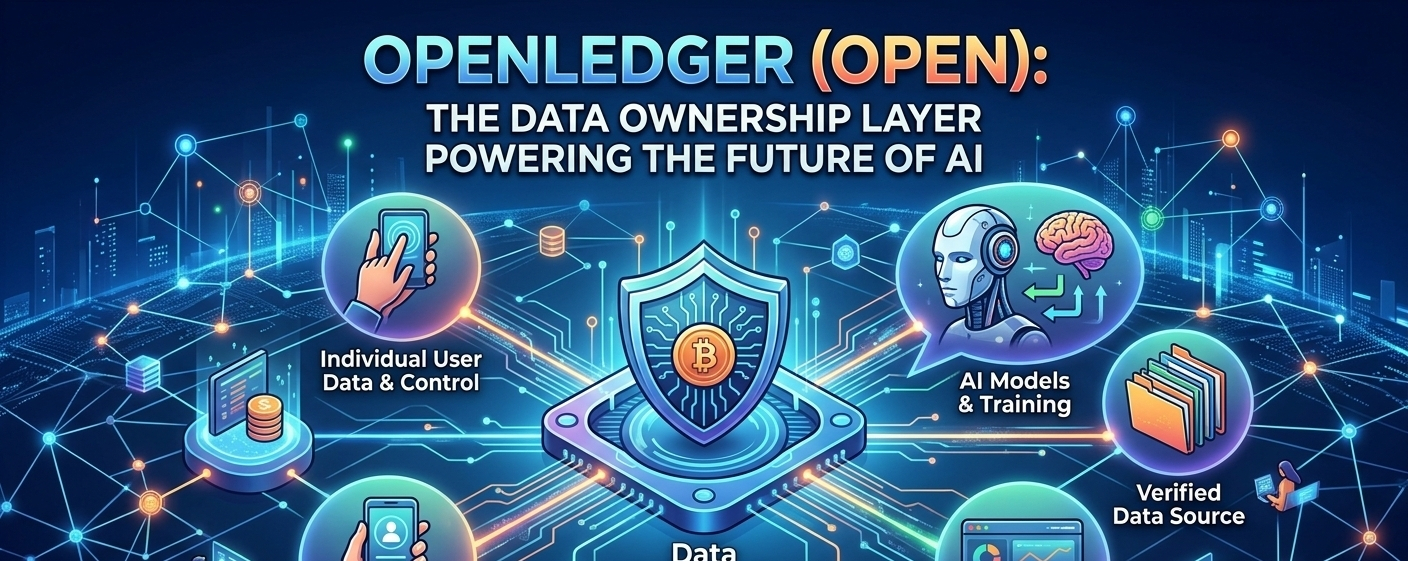
Most AI projects today talk about speed.
Faster models. Faster inference. Faster automation.
But very few projects stop and ask a much more uncomfortable question:
Who actually owns the value created by AI?
That question sits quietly underneath almost every major AI conversation right now, and it is exactly where OpenLedger starts to become interesting.
OpenLedger is not trying to build another chatbot ecosystem or another generic Layer 1 with “AI” added to the homepage. The project feels more focused than that. It is trying to create an ownership and liquidity layer for AI itself — especially for the data, models, and agents that power modern machine intelligence.
That sounds abstract at first. It did to me too.
But the idea becomes easier when you think about how AI currently works behind the scenes.
Right now, enormous amounts of data are constantly being consumed by models. Human conversations, financial datasets, medical records, market behavior, code repositories, images, community discussions — all of it becomes fuel for training and improving intelligence systems.
Yet the people contributing that value rarely capture anything meaningful in return.
The system extracts value very efficiently. Distribution is the weak part.
OpenLedger seems built around fixing that imbalance.
The project introduces something called “Datanets,” which are basically structured networks where data can be contributed, validated, priced, and monetized in a transparent way. Instead of data existing as a dead asset sitting inside private silos, OpenLedger tries to turn it into an active economic layer.
That distinction matters more than people realize.
Most blockchains tokenize assets after value is already obvious. OpenLedger is attempting to tokenize contribution before the market fully recognizes the value being created.
Small difference on paper. Huge difference in practice.
A developer building a specialized medical AI model, for example, may need extremely niche datasets that are difficult to obtain and expensive to maintain. Under traditional systems, those datasets are usually locked behind private agreements or centralized companies.
OpenLedger wants those contributors to participate directly in the upside.
The same applies to AI agents.
That part is quietly becoming one of the strongest narratives around the project.
AI agents are moving beyond simple bots now. Some can execute tasks, analyze markets, coordinate workflows, or even interact with protocols autonomously. But there is still a major infrastructure problem underneath them: agents generate value, but there are very few clean systems for ownership, attribution, and revenue flow.
OpenLedger is positioning itself directly inside that gap.
Not every AI chain understands this yet.
Some projects still look like normal blockchains wearing an AI costume.
OpenLedger feels more aware of where the market is actually heading.
A few weeks ago I noticed more developers discussing agent economies and attribution systems in community channels instead of just token price speculation. That shift matters. Communities usually reveal future direction before headlines do.
The token itself, OPEN, is also tied closely to ecosystem activity rather than existing as a decorative governance asset. That gives the network stronger economic logic if adoption grows. Utility inside AI infrastructure matters much more now because investors are becoming less patient with empty narratives.
And honestly, the market has become brutal toward weak AI projects lately.
People are no longer impressed by vague promises about “revolutionizing AI.” They want systems that solve real coordination problems.
OpenLedger at least appears to understand the actual bottleneck: AI is not struggling to create intelligence anymore. It is struggling to organize incentives around intelligence.
That is a very different problem.
One thing I find surprisingly important is the tone of the ecosystem itself. The project discussions often revolve around attribution, ownership, and economic participation instead of pure hype cycles. That creates a healthier feeling around the network. Still early, obviously. Very early. But culture matters in crypto more than most whitepapers admit.
There is also something slightly ironic happening here.
For years, blockchain tried to tokenize finance.
Now projects like OpenLedger are trying to tokenize intelligence production itself.
That changes the scale of the conversation completely.
A person contributing a valuable dataset, improving a niche model, or building an autonomous agent could eventually become part of an AI-native economy where contributions are measured and rewarded transparently onchain.
Not perfectly, of course. Nothing works perfectly in crypto ecosystems. Someone will probably still complain about incentives on Discord at 3:17 AM. That part never changes.
But OpenLedger is exploring a direction that feels structurally important rather than temporarily fashionable.
And in the middle of a market full of recycled AI narratives, that alone makes people pay attention.
