
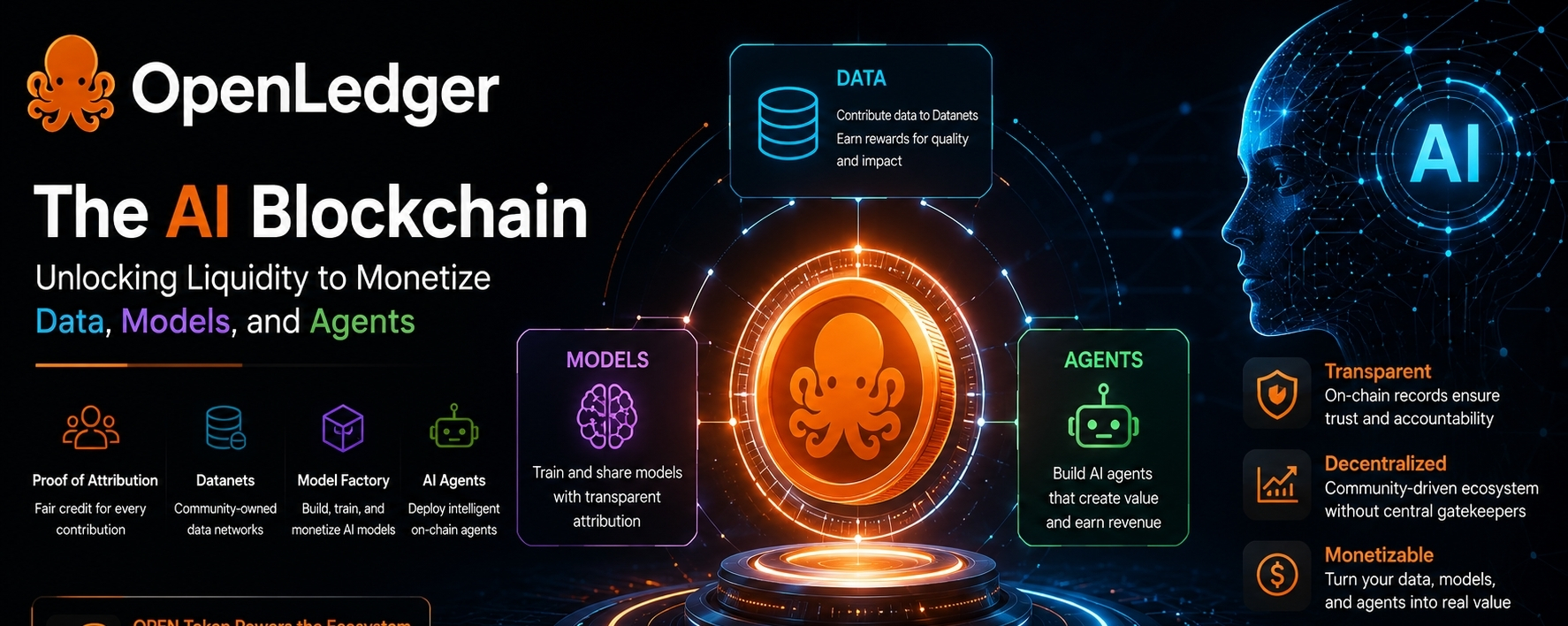

OpenLedger is one of those projects that becomes more interesting when you stop looking at it like just another AI narrative and start looking at the actual problem it is trying to solve. AI is growing fast, but the value behind AI is still very unfair. Data comes from people, models improve because of people, agents become smarter through real usage, but most of the reward usually goes to the platform sitting at the top. OpenLedger is trying to change that by building an AI blockchain where data, models, and agents can be owned, tracked, used, and monetized in a more open way.
The main idea behind OpenLedger is simple but powerful. AI should not be a closed system where everyone contributes and only a few capture the value. If someone provides useful data, that data should have a clear identity. If a model becomes better because of that data, the contribution should not disappear. If an AI agent uses that model and creates value, the reward should be able to flow back to the people and systems that helped build it.
That is where OpenLedger’s focus becomes different. Many projects talk about AI, but they only focus on the exciting surface: agents, automation, smart tools, faster systems, and future growth. OpenLedger is looking deeper. It is focused on the economic layer behind AI. Who owns the data? Who benefits from the model? Who gets paid when an agent creates value? These are not small questions. These are the questions that will matter more as AI becomes part of trading, finance, gaming, research, business, and daily online activity.
OpenLedger is built around the idea that data should not remain trapped or invisible. In normal AI systems, data is often used once and then forgotten. The person who created it or improved it usually has no control after that. OpenLedger wants to make data more like a real asset. Something that can be contributed, verified, connected to models, and rewarded when it creates value.
This is a strong direction because AI is only as good as the data behind it. A big model can sound smart, but if the data is weak, outdated, or messy, the output will still be weak. People who use AI seriously already understand this. The best answers usually come from focused, high-quality information, not from random noise. OpenLedger is trying to build around that truth.
Its Datanet concept is one of the most important parts of the project. A Datanet is basically a focused data network where contributors can bring domain-specific data. That could be data for finance, crypto, healthcare, gaming, legal research, education, or any other specific field. Instead of one closed company owning everything, OpenLedger allows communities and builders to create value around useful datasets.
This makes sense in the real world. A trader who studies wallet movements, liquidity zones, unlock schedules, and market behavior may have better market data than a general AI model. A developer who has seen hundreds of smart contract bugs may know patterns that are extremely valuable for security models. A gaming community may understand player behavior better than any outside company. These people have knowledge, but most of it never becomes liquid. OpenLedger gives that knowledge a possible path to become useful AI infrastructure.
The project also focuses on Proof of Attribution, which is a very important idea. The point is to track which data, model, or contributor helped create value. Without attribution, AI becomes a black box. People use it, but they do not know where the information came from. Builders improve it, but their role gets lost. Contributors add value, but they are not rewarded properly.
OpenLedger wants to make that contribution visible.
This is where the project feels more serious than a simple trend play. It is not just saying “AI is the future.” Everyone says that. OpenLedger is asking how the value inside AI should be shared. That is a much better question.
The future of AI will likely be full of specialized models. One model for legal work. One for trading. One for medical research. One for gaming agents. One for customer support. One for on-chain analysis. General AI will still exist, but the real value will come from models that understand specific areas deeply.
OpenLedger fits into that future because specialized models need specialized data. And specialized data usually comes from people with real experience. If those people can contribute and earn from their contribution, the whole system becomes stronger. Better data creates better models. Better models power better agents. Better agents create more usage. More usage creates more rewards. That is the loop OpenLedger is trying to build.
The OPEN token also has a role inside this system. It is not only there for market attention. It is connected to activity inside the network, including payments, rewards, staking, governance, and usage of the ecosystem. That gives the token a more natural place in the project. Of course, the token still needs real demand. Utility on paper means nothing if people are not using the network. But at least the design gives OPEN a reason to exist inside the system.
The real challenge for OpenLedger will be execution. The idea is strong, but ideas are easy in crypto. The hard part is building something people actually use. OpenLedger needs active data networks. It needs useful models. It needs builders who see value in creating on the platform. It needs contributors who feel rewarded enough to keep adding quality data. It needs AI agents that are not just hype, but actually useful.
That is the honest test.
If OpenLedger only becomes a narrative, it will fade like many other projects. But if it becomes a real place where data, models, and agents are created and monetized, then it can become part of the deeper AI economy.
What makes OpenLedger interesting is that it is not trying to make AI look more exciting. AI is already exciting. It is trying to make AI more fair, more traceable, and more valuable for the people behind it. That is a much harder mission, but also a much more meaningful one.
The current AI market has a problem with ownership. People provide data, but they do not own the value created from it. People improve systems, but the reward rarely comes back to them. Communities create knowledge, but platforms usually capture the upside. OpenLedger is trying to flip that model by giving contributors a clearer place inside the economy.
This could become very important as AI agents grow. Agents will not only answer questions. They will perform actions, manage tasks, interact with apps, analyze data, and maybe even move value on-chain. When agents become more active, people will need to know what data they use, what models power them, and who is responsible for the intelligence behind them.
A black-box agent may look cool, but it is risky.
An agent with visible data sources, trackable models, and clear attribution is much easier to trust.
That is where OpenLedger’s blockchain layer makes sense. Blockchain does not magically make AI smarter. But it can make the ownership and reward system cleaner. It can record contribution. It can support settlement. It can connect usage with rewards. It can help show where value came from.
That is practical.
The strongest part of OpenLedger is that it understands AI is not only about machines. It is also about the people, data, and communities behind those machines. Intelligence does not appear from nowhere. It is built from years of content, research, testing, feedback, and experience. OpenLedger is trying to give that hidden work a visible place.
That is why the project deserves attention.
Not because it uses the AI label.
Not because AI tokens are trending.
But because OpenLedger is focused on a real problem that will become bigger with time.
As AI grows, the world will ask harder questions about ownership, trust, and rewards. OpenLedger is already building around those questions. If it can turn this vision into real usage, it could become one of the more important infrastructure projects in the AI blockchain space.
OpenLedger is not just trying to power AI.
It is trying to make sure the value behind AI does not stay locked away from the people who helped create it.