

Everyone talks about AI like the future belongs to whoever owns the most GPUs.
But the deeper question is becoming impossible to ignore:
What happens to the people, datasets, models, and agents that actually help AI become useful?
Right now, most of them disappear into the background.
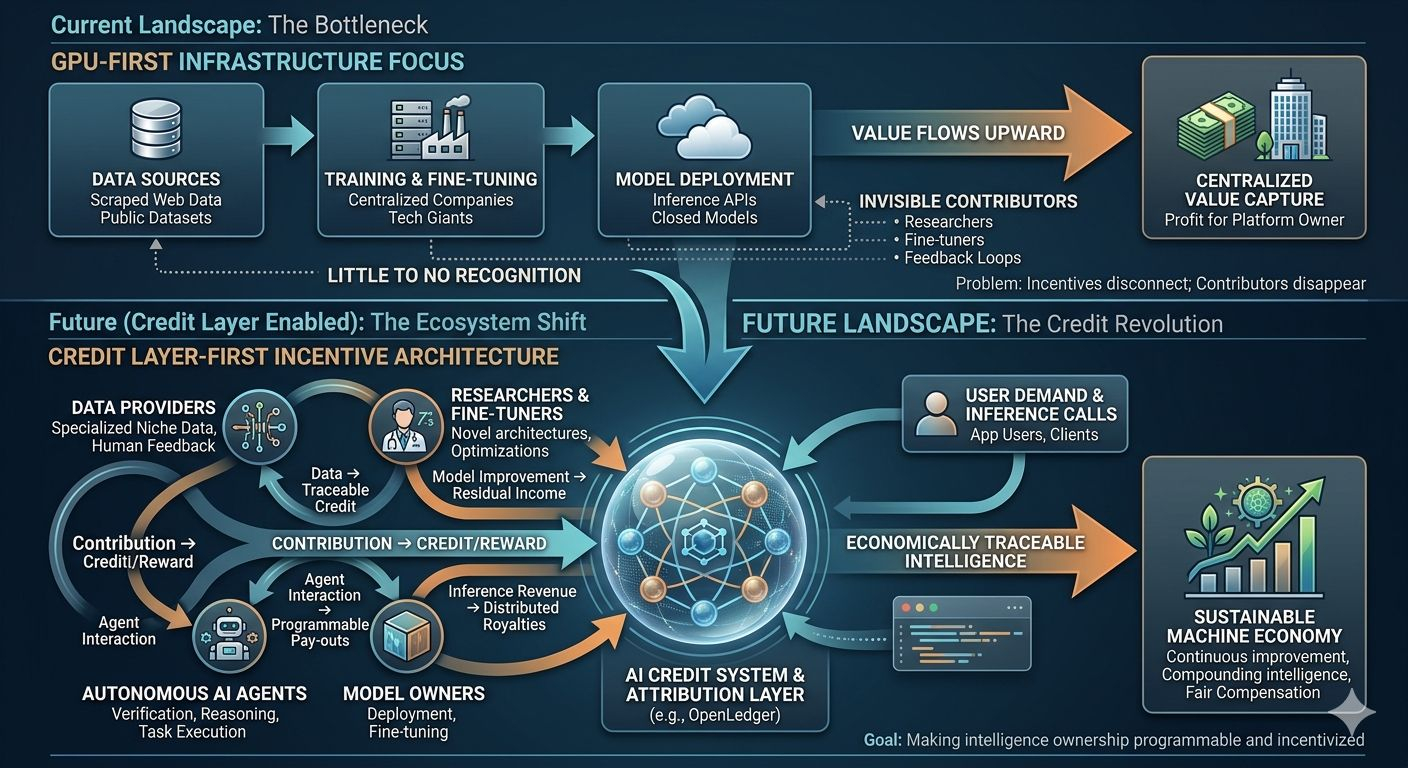
A model generates an output, a company charges for access, and the value flows upward. Meanwhile the contributors behind the intelligence — researchers, niche data providers, human feedback loops, fine-tuners, even specialized AI agents — rarely receive ongoing recognition or rewards.
That is why I think the real missing piece in AI is not just a compute layer.
It is a credit layer.
And that is what makes OpenLedger interesting to me.
Most AI-blockchain projects focus on infrastructure: decentralized GPUs, inference networks, cheaper compute, faster execution. Useful ideas, but still infrastructure-first thinking.
OpenLedger feels like it is approaching the problem from another angle:
How do you make intelligence itself economically traceable?
Because AI is no longer a solo system.
Every strong AI output today is usually the result of hidden collaboration:
someone collected the data,
someone refined the model,
someone corrected mistakes,
someone optimized performance,
someone built the agent workflow.
AI is starting to look less like software and more like an economy.
And economies break when contributors become invisible.
That is why attribution matters more than people realize.
The easiest analogy is music streaming.
Spotify did not invent music. It created a system where participation could be tracked and royalties could flow automatically.
AI may eventually need something similar.
Imagine future AI agents working together autonomously:
one agent gathers information,
another verifies it,
another executes tasks,
another improves reasoning.
Now imagine thousands of these interactions happening constantly across open ecosystems.
Without a transparent coordination layer, value capture becomes centralized very quickly.
That is where OpenLedger’s positioning around monetizing data, models, and agents starts making more sense.
The project is not only asking:
“How do we run AI?”
It is asking:
“How do we reward the layers behind AI?”
That feels like a much bigger conversation.
Especially because the AI industry is quietly shifting from model competition toward ecosystem competition.
The winning systems may not simply be the smartest models.
They may be the ecosystems that keep contributors incentivized long enough for intelligence to compound.
And honestly, this is where most AI narratives still feel incomplete to me.
People talk endlessly about faster inference and larger models, but very little about ownership.
Who owns improvement?
Who owns contribution?
Who gets rewarded when an agent becomes valuable because of thousands of invisible inputs?
Those questions become even more important once autonomous agents start interacting financially on-chain.
At that point, blockchains stop looking like “crypto infrastructure” and start looking more like accounting systems for machine economies.
That is why OpenLedger stands out to me compared to many AI tokens chasing trends.
The project’s broader direction feels tied to incentive architecture, not just hype around AI compute.
And long term, incentive architecture usually matters more than people expect.
Because technology scales faster when contributors believe they are participating in the upside — not just feeding value into someone else’s platform.
Maybe that becomes the real role of AI blockchains in the future.
Not replacing AI companies.
But making intelligence ownership programmable.
