
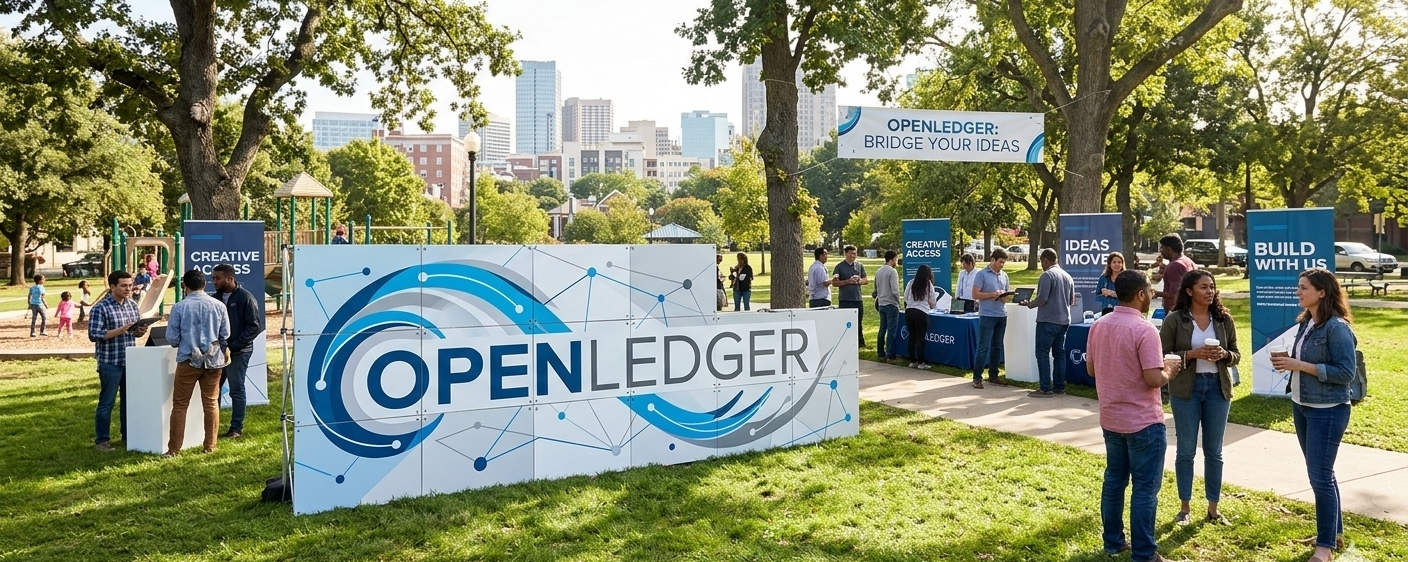

OPENLEGDER has been sitting in my mind for a strange reason lately. Not because of price action, hype cycles, or another “AI + blockchain” narrative, but because it touched something practical that I think a lot of people quietly deal with.
I’ve been thinking about how many good ideas never become real.
Not because the ideas are weak, but because the people holding them cannot build them.
That gap feels bigger than most people admit.
I spend a lot of time watching markets, tracking behavior, and writing down patterns I notice. Sometimes the ideas are simple. Sometimes they are very specific. A strange funding-rate shift before volatility. A wallet behavior pattern that repeats before liquidity moves. A way to combine on-chain signals with derivatives sentiment into one clean alert.
The logic exists clearly in my head.
But then reality starts.
APIs break.
Data feeds lag.
Hosting costs money.
One chain works differently from another.
Wallet permissions become messy.
And suddenly the idea dies before it even gets tested.
I think many traders, researchers, and even normal users live inside that exact frustration. We talk a lot in crypto about decentralization, ownership, and permissionless systems, but building still feels permissioned in practice. If you cannot code well enough, your ideas stay trapped inside notes apps and screenshots.
That’s the part of the conversation I feel the industry ignores.
People assume innovation only comes from developers, but markets have always worked differently. Some of the best insights come from users who spend years observing behavior directly. Traders notice patterns. Communities notice friction. Users understand emotional pain points long before engineers do.
The problem is that insight alone has never been enough.
You still needed technical execution.
That’s where OPENLEGDER started becoming interesting to me, especially around this idea of vibecoding.
At first I dismissed the term because the AI space is full of phrases that sound bigger than they really are. But the more I thought about it, the more I realized the concept itself points toward something important.
For years, AI coding tools mostly solved the easy part. They could generate snippets, explain functions, or help debug small issues. Useful, but incomplete. The hard part was always turning an idea into something alive. Something connected to chains, wallets, data flows, and real users without collapsing under pressure.
That middle layer is where most people fail.
What OPENLEGDER seems to be exploring is the idea that maybe AI can eventually reduce that distance between “I have an idea” and “I have a working system.”
Not perfectly. Not magically.
But enough to change who gets to participate.
And honestly, timing matters here.
A few years ago this probably would not have worked well. AI models hallucinated too much. Blockchain tooling across ecosystems was fragmented. Standards were inconsistent. Even experienced builders struggled to maintain stable applications across chains.
Now things feel different.
The infrastructure is slowly maturing at the same time AI models are becoming more useful as collaborative tools instead of just novelty assistants. Those two curves developing together changes the environment completely.
That combination is what makes this moment feel more serious than previous “AI will build everything” narratives.
Still, I think people should stay realistic.
Easy building does not automatically mean safe building.
That might actually become one of the biggest risks in the next phase of crypto. When systems become easier to create, people may deploy things they do not fully understand. An AI-generated strategy can still contain flawed assumptions. A smart contract can still behave unexpectedly during extreme market conditions. A clean interface can still hide weak logic underneath.
Markets punish weak logic very quickly.
So I do not look at vibecoding as replacing understanding. If anything, I think it raises the importance of understanding. Because when execution becomes cheaper, the real edge shifts toward judgment, testing, and original thinking.
That changes the competitive landscape.
Simple ideas will spread faster because more people can implement them quickly. Small trading edges may disappear faster than before. But at the same time, people with genuinely unique thinking finally gain leverage they never had previously.
That feels important.
For OPENLEGDER itself, I think the long-term question is much bigger than whether people like the narrative. Narratives come and go constantly in crypto. What matters is whether real users keep building useful things after the excitement fades.
That is the real test.
Do people continue using these systems after the first wave of curiosity?
Do the tools survive real market conditions?
Does value flow back into the ecosystem naturally because the infrastructure matters, or does the token become disconnected from actual usage?
Those questions matter more to me than short-term momentum.
What keeps me watching is not the idea of replacing developers. I actually think strong developers become even more valuable in this environment. What changes is the number of people who can finally participate in creation itself.
That shift could reshape crypto more quietly than people expect.
Because once building becomes more accessible, the pace of experimentation increases dramatically. More people test niche ideas. More custom tools appear. More strategies emerge from users instead of companies. Markets evolve faster because participation expands beyond technical specialists.
And maybe that changes the culture too.
Crypto spent years talking about financial access. Maybe the next phase becomes creative access. Not everyone wants to become a software engineer. But many people still have systems, workflows, and ideas worth building.
Maybe the real unlock is giving those people a bridge.
I keep coming back to that thought.
What happens when the barrier between thought and execution becomes small enough that ordinary users can finally build around their own experience?
Does that create more innovation, or just more noise?
Will AI-assisted building make markets more efficient, or simply more crowded?
And if systems like OPENLEGDER succeed, are we watching the beginning of a more open builder economy, or just another temporary cycle dressed in smarter language?
I do not think we fully know yet.
But I do think this direction is worth paying attention to before the rest of the industry treats it as obvious.