

AI is becoming smarter every month.
But economically, it still feels unfinished.
Models generate enormous value.
Agents are starting to automate tasks.
Entire industries are restructuring around machine intelligence.
Yet one major question remains strangely unresolved:
Who actually deserves credit when AI creates value?
Not platform ownership.
Not company branding.
Actual contribution.
Because modern AI is not built by one entity anymore.
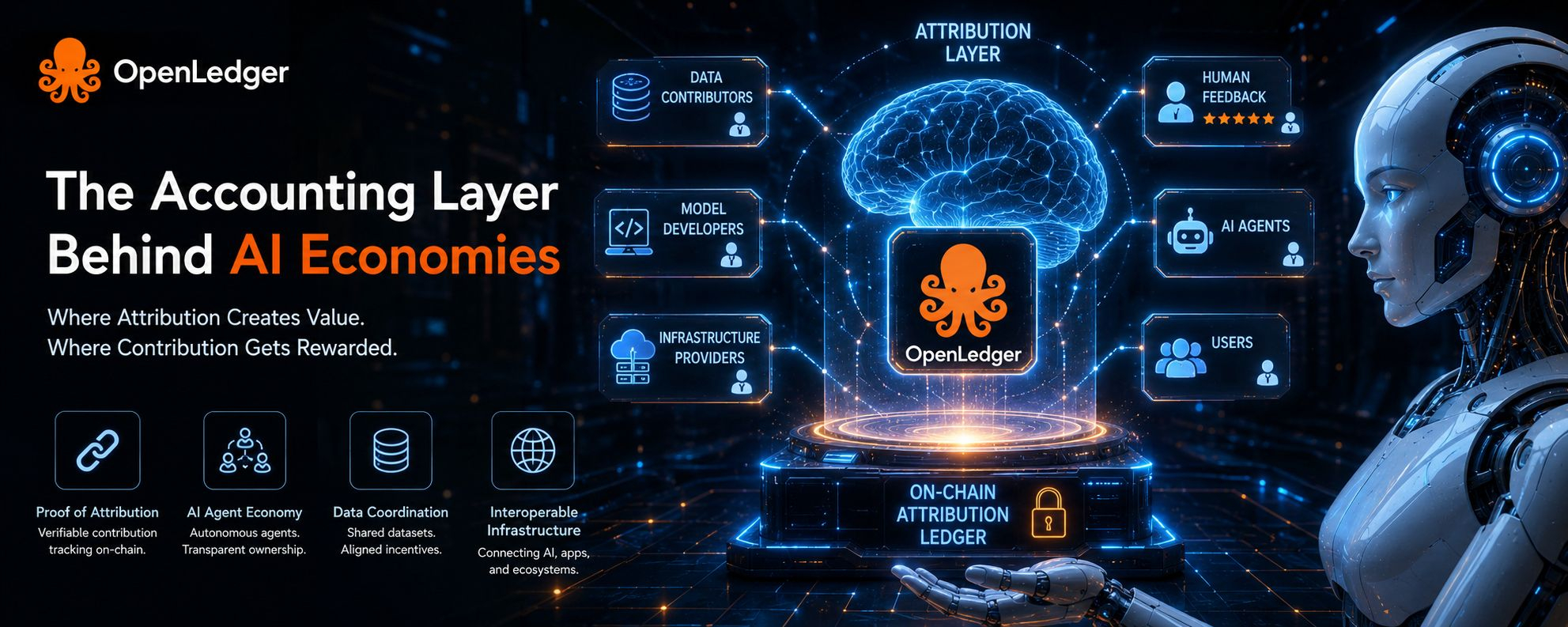
Every model is shaped by an invisible network of datasets, human feedback, fine-tuning, infrastructure providers, developers, and users constantly feeding signals into the system.
The intelligence may look centralized on the surface…
…but underneath it is massively collaborative.
And right now, most of those contributors disappear economically once the final output is produced.
That is the gap OpenLedger is trying to solve.
Not by building another AI model.
But by building what could eventually become the accounting layer behind AI economies.
Most blockchain projects focus on transactions.
OpenLedger is focused on attribution.
That difference is much bigger than it sounds.
A transaction tells you where value moved.
Attribution tells you where value came from.
And I think that distinction becomes incredibly important once AI agents begin operating autonomously across digital markets.
Because the moment AI systems start interacting economically, the internet needs something it currently lacks:
A transparent financial memory for intelligence itself.
Who trained the model?
Who supplied useful data?
Who improved outputs?
Who contributed to the system becoming more valuable over time?
Traditional databases can store information.
But blockchains create shared economic state.
That is why OpenLedger’s approach feels structurally important instead of purely narrative-driven.
It is exploring whether contribution inside AI systems can become measurable, verifiable, and rewardable on-chain.
The project’s Proof of Attribution framework is what makes the idea especially interesting.
Instead of treating AI like a black box, OpenLedger is attempting to create economic traceability around how intelligence evolves.
That may become one of the most valuable infrastructure layers in the future AI economy.
Because today’s systems are heavily optimized for extraction.
Users contribute data.
Models improve.
Platforms capture most of the upside.
OpenLedger hints at a different direction:
An ecosystem where participation itself becomes economically visible.
And honestly, that changes the entire psychology around AI.
The internet rewarded attention.
AI may eventually reward contribution.
That is a completely different economic structure.
What also stands out is that OpenLedger is quietly building infrastructure while much of the market is still chasing narratives.
Its ecosystem expansion around AI agents, data coordination, interoperability, and execution environments suggests the team understands something important:
AI does not only need intelligence.
It needs coordination.
Because once autonomous systems begin interacting with applications, liquidity, datasets, and other agents, the complexity of ownership and reward flows increases dramatically.
At that point, accounting infrastructure becomes just as important as the models themselves.
And that is where blockchain suddenly makes much more sense.
Not as a replacement for AI.
But as the ledger keeping track of the economic relationships underneath it.
Of course, attribution inside AI systems is incredibly difficult.
Outputs emerge from overlapping datasets, layered tuning, and probabilistic behavior. Measuring contribution fairly at scale may become one of the hardest technical problems in the industry.
But the fact OpenLedger is focused on solving a real structural issue already separates it from projects simply attaching tokens to AI hype cycles.
Because long term, the winners in AI may not only be the projects building intelligence.
They may also be the projects building the financial infrastructure that intelligence depends on.
And if that future plays out, blockchain may evolve into something much bigger than speculative technology.
It may become the bookkeeping system for the machine economy itself.
