
Sometimes I think the AI industry is still focused on the wrong layer of the conversation.
Most discussions revolve around models:
Which AI is smarter.
Which company raised more money.
Which system generates better outputs.
But underneath all of that, a much bigger question is quietly emerging:
Who actually owns the value created by AI?
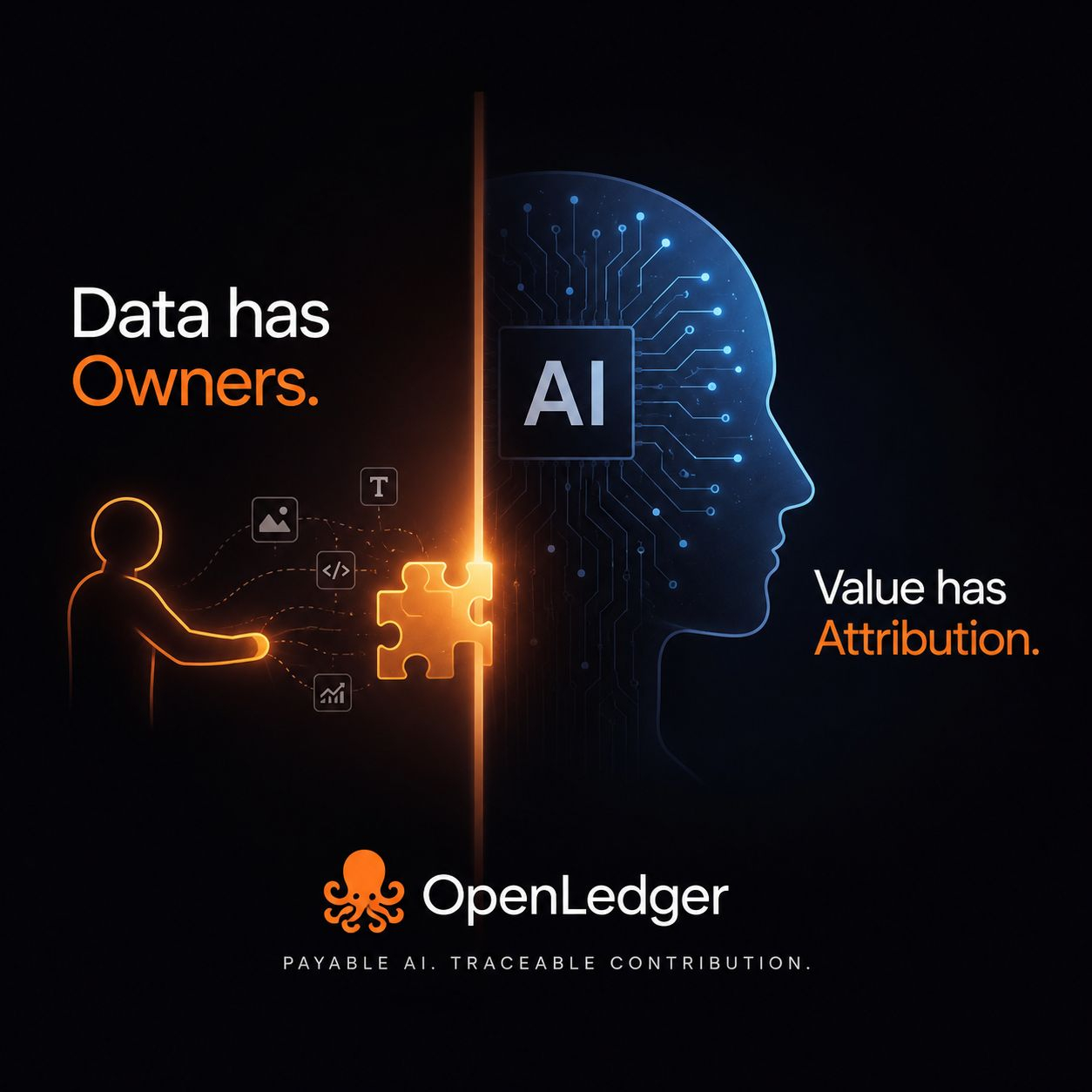
The more I look into @OpenLedger the more I feel they’re trying to tackle something deeper than another AI + crypto narrative. They seem focused on attribution the idea that contributors to AI systems should not disappear once the model becomes profitable.
For years, AI has consumed massive amounts of human input:
datasets,
annotations,
feedback loops,
domain expertise,
corrections,
behavioral patterns.
Yet once these systems become commercially valuable, the contributors are mostly forgotten.
The system remembers the data.
The economy forgets the people.
That imbalance may become one of the defining issues of the AI era.
This is where OpenLedger’s “Payable AI” concept becomes interesting to me. Not because of branding crypto creates new buzzwords every cycle but because they’re attempting to turn contribution into something measurable and economically recognized.
With $OPEN Mainnet now live, the idea is moving beyond theory. Contributors can submit datasets, developers can train specialized models, and rewards can be distributed on-chain through attribution systems tied directly to usage and performance.
Suddenly, data stops being invisible fuel.
It becomes traceable labor.
And honestly, that shift feels more important than most people realize.
What caught my attention most is the infrastructure challenge behind attribution itself. Small-model gradient attribution already makes intuitive sense if removing certain data weakens model performance, then that data clearly had value.
But tracing influence inside large language models is far harder. Outputs become collective, blurred, almost anonymous. Trying to connect generated tokens back toward training influence is an incredibly ambitious technical problem.
Maybe impossible to perfect mathematically.
Still, attempting to create transparency around contribution already feels like a major shift from how AI platforms traditionally operate. Most systems optimize extraction first. OpenLedger seems to be experimenting with accountability.
And the timing matters.
As AI enters industries like finance, healthcare, and law, enterprises may eventually care just as much about data legitimacy as model intelligence itself.
Can the dataset be verified?
Licensed?
Attributed?
Legally defended?
Those questions could shape the next generation of AI infrastructure.
At the same time, another part of OpenLedger caught my attention for a completely different reason: vibecoding.
Half my best trading ideas never leave my notes app. Not because the ideas are weak, but because building them into working tools becomes a wall. I understand trading logic. I don’t want to become a backend engineer just to automate strategies.
For months I wanted a system that alerts me whenever funding flips negative while open interest spikes across multiple exchanges. The logic is simple in my head. Building it was not.
APIs.
Hosting.
Rate limits.
Debugging.
Infrastructure headaches.
So the idea stayed buried like many others.
That’s why vibecoding feels different from typical “AI writes code” hype. If someone can describe workflows naturally and generate tools that actually function in live environments, the barrier between ideas and execution drops massively.
Of course, easier building also creates new risks. Markets punish weak logic quickly. AI-generated systems still need testing, validation, and human judgment.
But the bigger shift may already be happening:
When building becomes cheap, the edge moves away from “who can code” toward “who has the best ideas and the discipline to refine them.”
And honestly, that may become one of the most important competitive shifts in both AI and trading over the next few years.