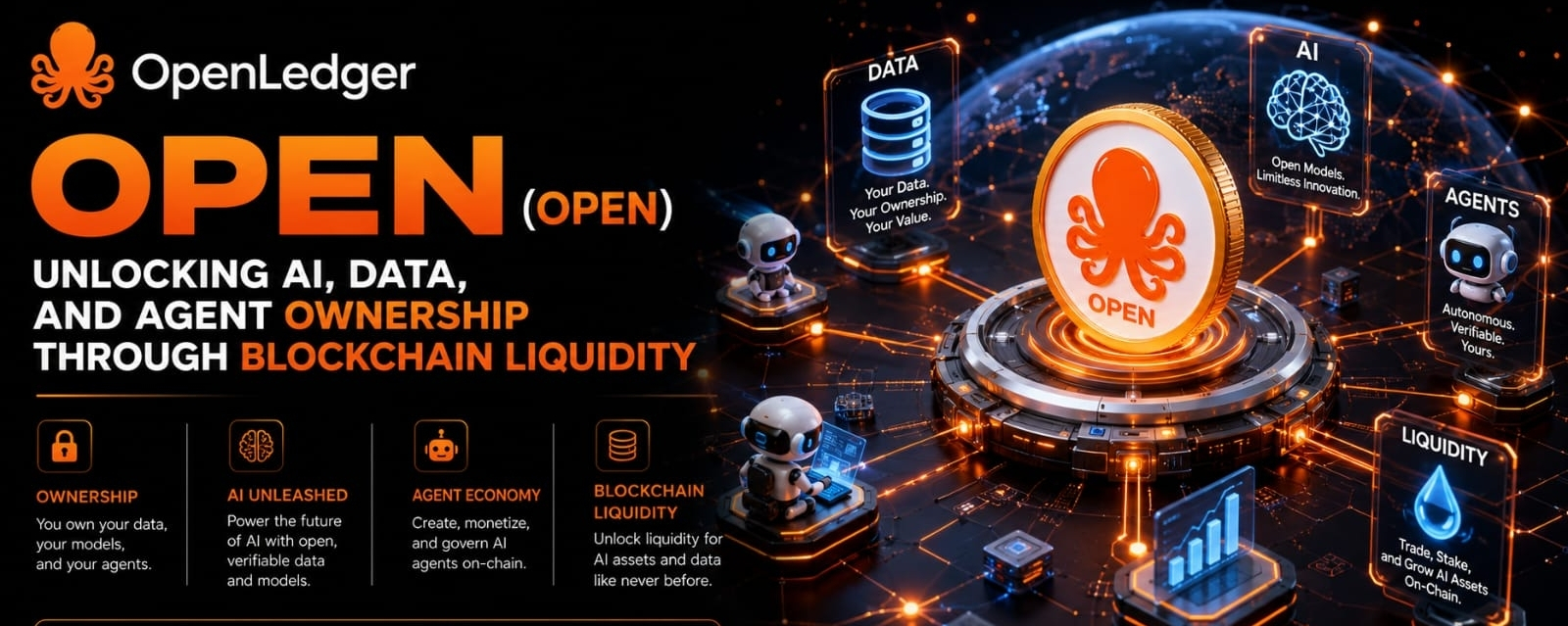
When I look at OpenLedger, I don’t see it as just another AI + blockchain project trying to ride two hype cycles at once. I see it as an attempt to answer a problem I increasingly notice in real systems: data is everywhere, intelligence depends on it more than ever, but ownership, access, and incentives are completely misaligned. I also feel a strange dual reaction when I think about it. On one side, I’m genuinely interested in the direction it is pointing toward. On the other, I remain cautious because I’ve seen similar ideas struggle when they meet real-world constraints like regulation, trust, and institutional inertia.
What stands out to me first is the core tension the project is trying to solve. I notice that modern AI systems, especially in healthcare, finance, and enterprise environments, are starving for high-quality structured data. At the same time, the most valuable data is locked away in private systems that cannot easily share it. Hospitals hold sensitive patient histories, imaging data, and diagnostic outcomes that could significantly improve AI models, but they cannot simply export it to external systems. Companies sit on behavioral, transactional, and operational data that could train powerful models, but they hesitate because of compliance risk, competitive pressure, and security concerns. I see this gap every time AI progress slows down not because of lack of algorithms, but because of lack of usable data.
OpenLedger’s idea, as I understand it, is to turn this problem into a kind of programmable marketplace where data, AI models, and even autonomous agents can participate in an economic system without requiring raw exposure of sensitive information. Instead of the traditional model where data is copied, centralized, and stored elsewhere, I see a shift toward controlled computation where the data stays where it is, and only the results or validated outputs move. That distinction matters a lot in practice because it reduces the fear of leakage while still allowing value extraction.
In my mind, healthcare is the clearest real-world test for this type of system. I imagine a hospital in Pakistan or Europe that has millions of patient records accumulated over years. Normally, if a research lab or pharmaceutical company wants access, they either receive a heavily anonymized dataset or they are blocked entirely due to regulation. I think about how much medical insight is potentially trapped in those systems. With a model like OpenLedger proposes, I can imagine the hospital allowing AI models to train or query data inside a secure boundary without actually transferring raw records. The hospital could still maintain control, define permissions, and even track usage. In return, it could be compensated when its data contributes to model improvement. That creates a different kind of incentive structure where data is no longer just a liability but becomes a regulated asset.
I also think about medical imaging, which is another strong example. Radiology models become more accurate when trained across diverse populations and equipment types. But in reality, imaging data is fragmented across hospitals, and moving it around is slow, legally complicated, and expensive. If I imagine OpenLedger working well, I see a system where hospitals contribute to a shared intelligence layer without actually exposing the scans themselves. Instead, computation happens locally or in encrypted form, and only validated learning signals are shared. That could significantly speed up medical AI development while reducing privacy risk, at least in theory.
But I also can’t ignore the technical and operational difficulty here. I know from observing similar systems that combining blockchain infrastructure with AI workflows and privacy-preserving computation is not just complex, it is fragile. Each layer introduces its own challenges. Blockchain systems often struggle with scalability and real-world throughput. AI systems require heavy compute and constant iteration. Privacy-preserving methods like federated learning or secure enclaves add overhead and can slow down performance or increase cost. When I put all of that together, I realize how hard it is to make the system feel seamless enough for everyday institutional use.
Another thing I think about is incentives. OpenLedger is essentially trying to create a liquidity layer for data and intelligence. That sounds powerful, but I also know that once money enters a system involving sensitive data, behavior changes quickly. I can easily imagine organizations optimizing for revenue generation from data rather than purely improving outcomes. I can also imagine scenarios where participants try to game attribution systems or inflate the perceived value of their data contributions. Any economic system built on AI outputs has to solve not just technical trust, but incentive integrity, and that is usually where systems become complicated in unexpected ways.
From a user perspective, I think the most important promise here is operational convenience. If I put myself in the shoes of a hospital administrator or an enterprise CTO, what I would care about is not blockchain architecture or token mechanisms. I would care about whether I can participate in AI ecosystems without rebuilding my entire data infrastructure. If OpenLedger can genuinely allow me to plug in existing systems, define access rules, and immediately start monetizing or contributing data safely, then that is meaningful. But if it requires heavy migration or introduces regulatory uncertainty, adoption becomes much harder.
I also think about future benefits, and here I feel a mix of optimism and restraint. In a best-case scenario, I see a world where smaller institutions are no longer excluded from AI development. A regional hospital could contribute to global medical intelligence and receive compensation or access to better diagnostic tools. A research institute with limited funding could still participate in large-scale AI training networks without owning massive infrastructure. That democratization of data participation is one of the most appealing aspects of the concept.
However, I also think about risks in a very grounded way. The first is regulatory friction. Data governance laws are becoming stricter globally, especially in healthcare and personal data domains. A cross-border system that handles sensitive data computations will constantly have to navigate different legal frameworks. I don’t see this as a minor issue; I see it as a structural constraint that can slow adoption significantly.
The second risk is trust. Even if the system uses advanced cryptography or secure computation, institutions still need to believe that their data cannot be reconstructed, misused, or indirectly exposed. Trust in this space is not just technical, it is institutional and reputational. One failure or perceived vulnerability could significantly slow down adoption.
The third risk I think about is maturity. The idea of data marketplaces, AI token economies, and decentralized intelligence layers has existed in various forms for years. Many of these ideas looked strong in theory but struggled in practice because real-world users did not have strong enough incentives to change behavior. I see OpenLedger facing the same challenge: it is not enough to be conceptually elegant, it has to be frictionless in practice.
Still, I don’t dismiss the direction entirely. In fact, I think the timing is more favorable now than in previous cycles. AI demand has grown dramatically, especially for domain-specific models in healthcare, finance, and industrial systems. At the same time, data access is becoming more restricted rather than more open, which increases the value of controlled computation systems. And privacy technologies like federated learning and confidential computing are more mature than they were a few years ago, even if still expensive. So I do see a convergence happening, even if it is early.
If I try to summarize my overall view, I would say OpenLedger represents a direction I find intellectually consistent with where AI infrastructure is heading. I can see why someone would try to build this now, because the pressures in data, regulation, and AI demand are all increasing at the same time. But I also remain realistic about execution risk. In this space, the hardest problem is not building the system; it is getting real institutions to trust, adopt, and rely on it at scale.
So my final feeling is not extreme optimism or dismissal. It is more of a careful curiosity. I see the logic, I see the need, and I also see the friction. Whether OpenLedger becomes foundational infrastructure or remains an ambitious experiment will depend less on the vision itself and more on how quietly and reliably it can integrate into systems that were never designed to be part of a decentralized AI economy.