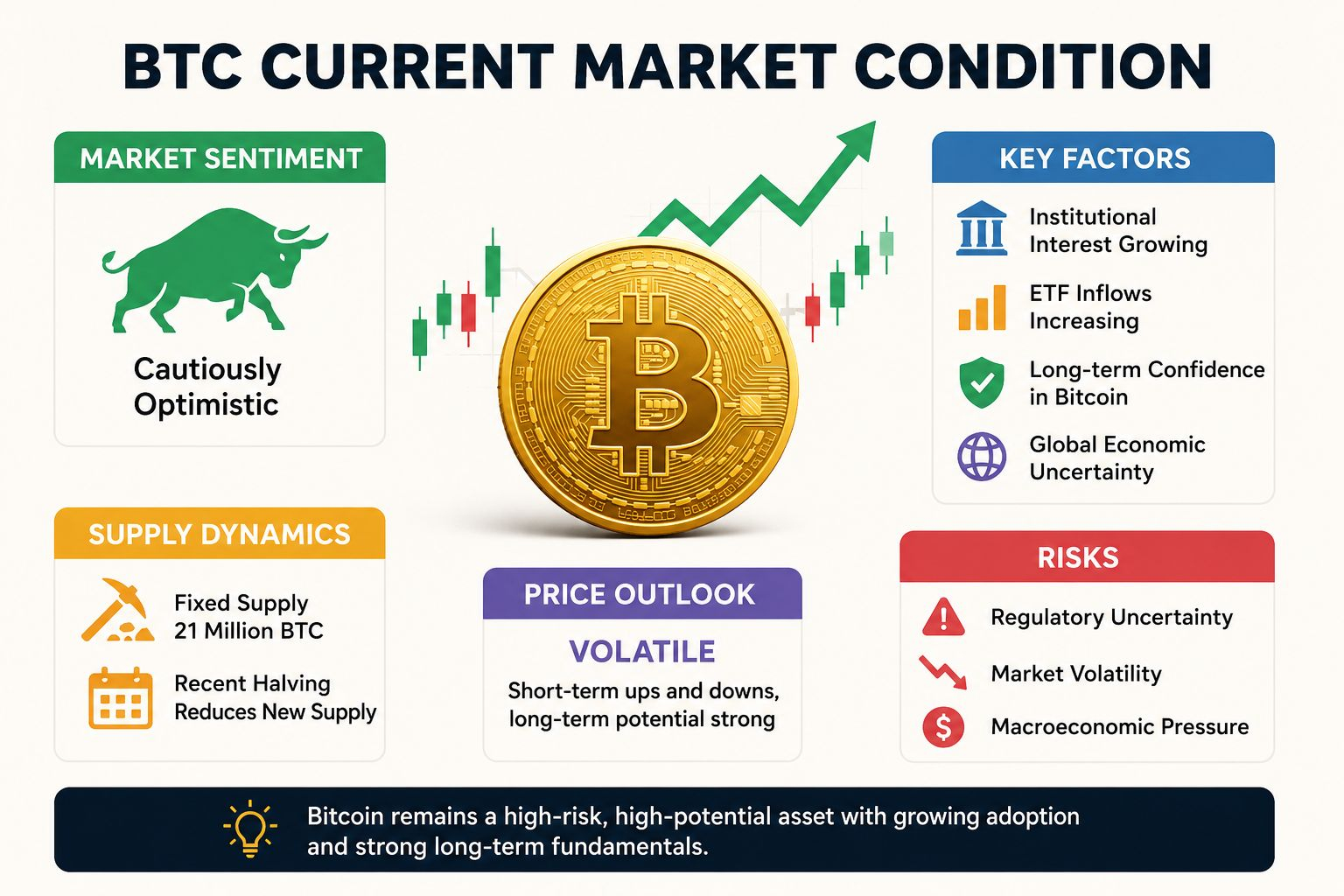
$BTC Bitcoin (BTC) is once again standing at the center of global financial attention as the cryptocurrency market moves through another important phase. The current market condition of BTC reflects a mix of optimism, caution, institutional interest, and macroeconomic uncertainty. While volatility remains a core part of Bitcoin’s identity, recent price behavior shows that the asset is continuing to mature as both a speculative instrument and a long-term store of value.
One of the biggest factors influencing Bitcoin right now is institutional participation. Over the past year, large financial firms, investment funds, and asset managers have shown increasing interest in BTC exposure. Spot Bitcoin ETF developments, growing corporate adoption, and rising integration of crypto-related services into traditional finance have helped strengthen market confidence. This institutional presence has reduced some of the fear that previously surrounded Bitcoin markets, although it has not completely eliminated sharp price swings.
At the same time, macroeconomic conditions are heavily shaping Bitcoin’s movement. Global inflation concerns, interest rate policies from central banks, and uncertainty in traditional financial markets continue to impact investor sentiment. Many investors now view Bitcoin as a potential hedge against currency devaluation and long-term monetary instability. However, others still classify BTC as a high-risk asset, especially during periods when liquidity tightens across global markets. Because of this, Bitcoin often reacts strongly to economic announcements and policy decisions.
Another important aspect of the current BTC market is supply dynamics. Bitcoin’s fixed supply remains one of its strongest narratives. With only 21 million coins ever to exist, scarcity continues to drive long-term bullish sentiment among holders. The recent Bitcoin halving event also plays a major role in market psychology. Historically, halvings have reduced new supply entering circulation and have often been followed by strong upward price movements over time. While history does not guarantee future performance, many traders and long-term investors are closely watching whether BTC follows previous post-halving cycles.
Market sentiment currently appears divided between short-term caution and long-term optimism. Some traders expect continued volatility due to profit-taking, regulatory uncertainty, and global economic pressures. Others believe Bitcoin is gradually entering a stronger accumulation phase supported by institutional demand and reduced sell-side pressure. Social media activity, derivatives markets, and on-chain data all suggest that investor interest in BTC remains extremely high despite periodic corrections.
Regulation also continues to shape the current market environment. Governments and financial regulators around the world are still determining how cryptocurrencies should be classified and managed. Positive regulatory clarity could encourage further institutional participation, while restrictive policies could temporarily slow market growth. This ongoing regulatory evolution creates both opportunities and uncertainty for Bitcoin investors.
Overall, the current condition of the Bitcoin market reflects a transition period between speculation and broader financial acceptance. BTC remains highly volatile, but it is increasingly being treated as a serious financial asset by both retail and institutional participants. Whether Bitcoin experiences another major rally or enters a longer consolidation phase, its influence on the global financial landscape continues to grow. For many investors, $BTC is no longer viewed as just a digital experiment — it is becoming a permanent part of the modern financial conversation.