


Let's be real: the golden era of treating AI like a Tamagotchi is dead. Buried. Good riddance
A couple years back, i've thinking during the peak of the AI agent hype cycle, I must've cycled through a dozen projects. You know the drill: flashy frontend, whitepapers dripping with "autonomous networks" and "distributed brains"
Then try connect your wallet and all it does is chat. Market trends, strategy discussions, maybe spit out a tweet. On chain execution? Sorry, not my job
That kind of fake intelligence completely divorced from ledgers, wallet permissions, and actual money flows is genuinely nauseating.
Crypto's full of storytellers. What it lacks are tools that integrate AI into real asset flows and solve actual user problems.
So when OpenLedger crossed my radar, it wasn't the fancy AI narrative that grabbed me. It was OctoClaw

OctoClaw: Finally, Something That Isn't Just a Chatbot
Set to launch in April 2026, OctoClaw is a trading platform that pieces together cloud configuration, on-chain execution, and trading brokerage. No renting servers, no setting up environments, no writing scripts, no tweaking RPC ports. Set your strategy, and it runs 24/7. That's a fundamentally different beast from competitors offering a simple web plugin or Telegram bot. It's not a glorified textbox it's a production environment designed to handle real money $TST
And here's the kicker: OctoClaw isn't floating in thin air. It's built on OpenLedger's own blockchain, which is tailor made for AI. OpenLedger runs on the OP Stack, with RaaS from AltLayer, following an EVM compatible path. That means your existing wallet and smart contract ecosystem plugs right in. Friction? Almost zero
But Let's Talk About the Money First (Because You Care)
Funding-wise: $8M seed in 2024 led by Polychain Capital and Borderless Capital. Total reached $15M by 2025. Founders? Pryce Adade Yebesi, Ashtyn Bell, Ram Kumar legit Web3 infrastructure backgrounds. Not some anonymous degens
Tokenomics: 1 billion OPEN total supply, ~21.55% initial circulation. Community and ecosystem allocations take 61.71%. Team and investor tokens locked for 12 months, then linear unlock over 36 months. Currently about 18M OPEN enter the market monthly unlocking pressure ramps up in H2 2026
What does $OPEN do in the ecosystem? Four things: pay network fees, reward data contributors, stake for governance, and settle Agent collaborations
How much real value it captures depends entirely on Agent call frequency and trading volume. That's a long term game. Anyone expecting a short term pump is delusional

I've always judged trading routing products by one simple rule: don't trust the backtest curves that come out of a lab. Anyone who's done quant work knows pick your sample period cleverly enough, and even a garbage strategy can produce a 45 degree "to the moon" net value chart
But real onchain environment? That's a nightmare. Liquidity black holes. MEV sandwich attacks. Volatile gas fees. Cross chain bridge delays. Underlying protocol pinning issues. That's the actual battlefield for any agent worth its salt.
That's why I was relieved to see OctoClaw put cloud configuration front & center. For regular users, the gap between "having a strategy idea" and "running it 24/7" is so vast that most never cross it. If cloud config works smoothly, that barrier vanishes.
And not bro, it's not a black box. You set a strategy parameters in plain English. Every execution step leaves a traceable footprint onchain. And before any onchain operation triggers? The Agent needs explicit human signatures
The Elephant in the Room: Permission Management
This is where most AI agents fall flat on their face and the thing that keeps me up at night. I've discussed this with a few security auditor friends. Current AI agents either do nothing (because no permissions) or have full access (because you handed them the keys). Once you delegate private keys or transfer authorization, the security boundary becomes tissue paper thin
🤔 We've seen entire liquidity pools drained this way. After years in the trenches, the most expensive lesson I've learned is: I'd rather miss a 2x than hand my wealth to an opaque black box
To OpenLedger's credit, they've actually done work here. Their Agent roots in Trust Wallet it can summarize holdings, flag unusual activity, suggest strategies. But final execution? User signature required.
Core contributor Kamesh once said in an interview: "While AI can be a powerful tool, it shouldn't strip away human decision making power." That attitude might not be mainstream in AI circles, but in DeFi? It's exactly what we need
They've gone further. In January 2026, OpenLedger partnered with TheoriqAI to bind every Agent operation to on-chain execution records traceable and auditable from decision to settlement.
Their February docs mention that the Agent generates encrypted signature records before any on-chain operation. No silent access to your funds. And their November integration with Injective adds a lowlatency DeFi execution environment into this verifiable framework.
Honestly? These security mechanisms won't pump the token price. But for a project bold enough to let AI handle real funds, it's a necessary hurdle.
If you look at traditional grid trading bots, they're rigid. You hard code an if else condition, and it runs until the sun explodes. Even if the market flips from a one sided bull run to a liquidity starved chop zone, that bot will keep banging its head against the wall.
A competent agent should be able to recognize when a strategy has become toxic based on on chain abnormal movements, extreme funding rate inversions, or specific whale wallet activity and hit the brakes before disaster.
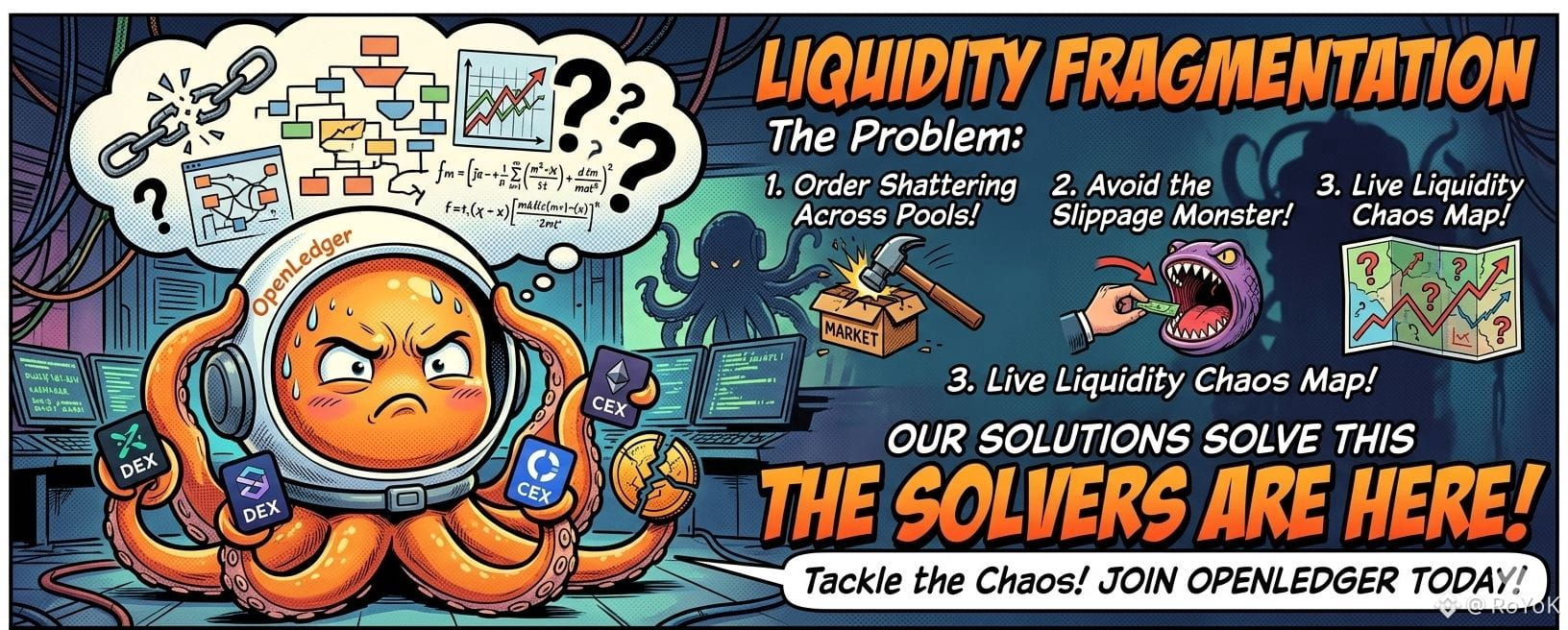
OpenLedger's integration with Algebra is a strategic move in that direction: AI agents analyze liquidity distribution across multiple DEXs, infer optimal paths, and execute real trades end to end.
They're also building an AIdriven dynamic fee system that adjusts transaction fees based on real user behavior and market conditions. This is embedding AI directly into asset flows and execution paths lightyears ahead of those sandbox simulation projects.
As for OctoClaw, I'm staying cautiously observant. The architecture and logic hit the core scenarios of Crypto AI no doubt. But this road is brutal. Don't mythologize any tool. It's not a wealth freedom cheat code.
Think of it as a configurable, verifiable execution layer. You bring the market insight and risk tolerance. It helps smooth out those counterintuitive, high frequency, speed sensitive onchain operations.
In this increasingly ruthless game, step one is survival. Step two is efficiency. Focus on execution granularity and risk control parameters that's the safest play
The AI x DeFi intersection shouldn't be a PR circus. It's a grinding battle of execution precision and safety boundaries. When the hype fades, the false prosperity that can't deeply bind with real asset flows will get flushed.
What remains will be the hardcore tools that dare to handle money, take responsibility, and log every single step onchain
#OpenLedger @OpenLedger $PROVE
DYOR